Mack Day (no. 11)

She is still here, my Mack. She resides in my heart. She dances daily in my thoughts. She is every four-leaf clover. I tell her all the big stuff and the hard stuff and the stuff about which I know not what to do. Her good spirit laughs with me, cheers me on, and gives me courage in the dark. I will always need her, like I need water and air and doughnuts.

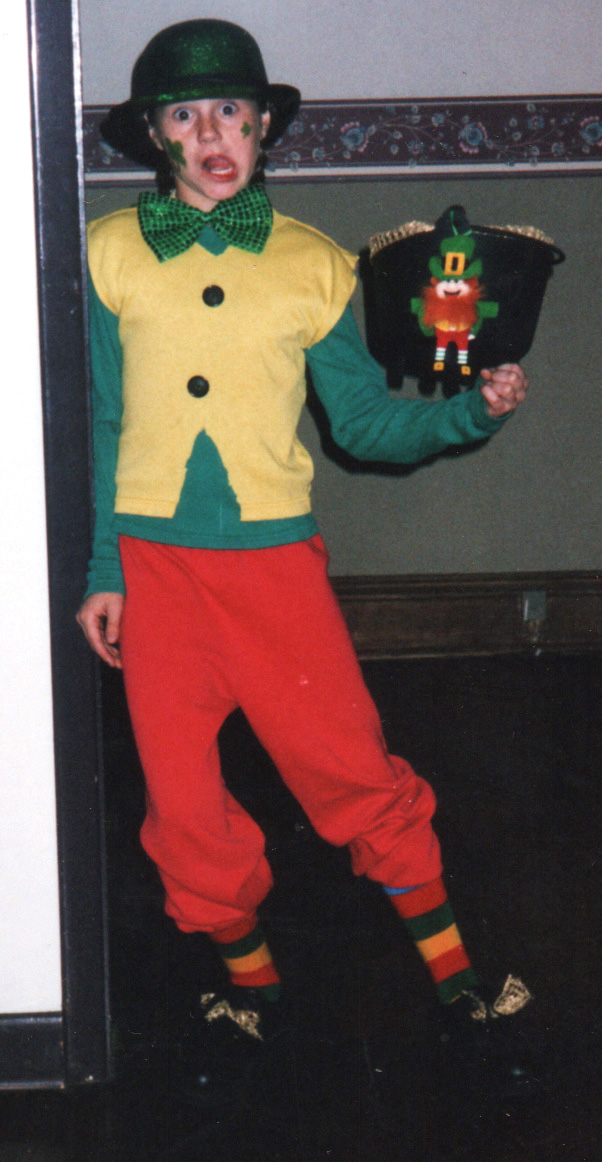
Mack Day, her birthday, is always a bad day and a good day. My tears and longing for her are more bitter, but I also celebrate her joy of being a leprechaun, quarter Irish and born on St. Patrick’s Day. As I have done eleven years now, I will take Mack Day to grieve my girl and to give myself space and a little extra grace. To sob alone and feel in my bones the loss of her. To eat something decadent for her. To belly laugh at least once for her.

This year is a discombobulating year of contrasts for me, and I have been thrown off balance.

As a historian supported by the National Endowment for the Humanities, my livelihood, health benefits, and life’s work are in jeopardy. The assault on American democracy, the dismantling of our government, and the turning away of our country’s core values are making me physically and emotionally unwell. As a voter, what is happening enrages me. As a woman and a mother, I am horrified. As a human being who cares about the vulnerable people among us, I am terrified. And as a historian of American history, I am profoundly sad.

If Mack were here today, she would have wisdom for me to better navigate my anger, horror, terror, and sadness. She had this way of diffusing catastrophe, of redirecting negativity, and soothing anxiety. Her wit and her silly songs could walk me back from every ledge.

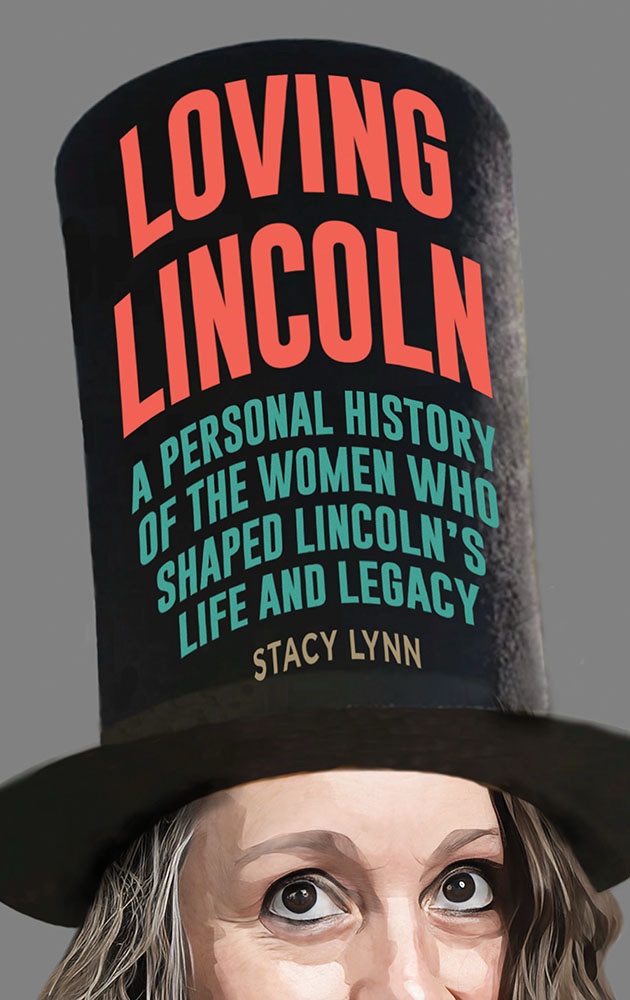
As I am missing her ever so keenly in this difficult historical moment, so too is her absence a fresh heartbreak as I meet my own personal, triumphant moment. I would do anything to have Mack with me to celebrate in April the publication of my new book Loving Lincoln, the deeply personal and most important creative achievement of my life. Oh my, would she have loved the cover of this book. It would have produced one of her famous cackles, and she would have been so proud of her Momma Bear and the book, giddy that her kindergarten drawing of Abraham Lincoln was published within it. I can hear her voice in her favorite refrain, “Lincoln is dead, mom, you know that, right?”  

There are few things in this mortal life we can control. While I must face this Mack Day alone, I will go forth into the sunshine as best I can, with Mack’s good cheer in tow. I will let the tears flow (sorry, my dear girl), but I will also raise a Guinness. To Mackenzie Kathleen McDermott, I am grateful you were here. I was damned lucky to have such a daughter, a bright light who touched the lives of every person who knew her.

As I have always done, I will hug Mack’s spirit close to my heart, keep her quiet wisdom in my mind, and let her joy put the spring in my step. But perhaps during this year—this unbalanced, terrible, joyful year—I will find new ways for Mack to guide me, to inspire me, and to sally me forth through all the darkness and all of the light. And no matter what happens to me or my job or my country, I will endeavor to be good and to be true. To locate a new and lasting peace of mind. To honor Mack’s faith in me. To do justice to all she was and all she taught me.

Cheers and peace and happy Mack Day.

Mack poking fun of the scholarly nature of my first book, The Jury in Lincoln’s America, in 2012.

Falling

I stepped outside into the warm sun and despite the brisk Autumn air, too cold for bare legs, my summer-loving heart was smiling. My freckled face was a feeling-good grin and giant sunshades, framed by freshly crimped hair. I was puffed up and downstate pretty in my Lotus-for-POTUS t-shirt, wool lumberjacket, leggings, and purple Allbirds sneakers with chunky white soles. I was a little full of myself if I am honest; and that vanity pause to congratulate my casual, put-together cool was my downfall.

I should have gone back into the house to humble up and check my conceit at the door instead of skipping down my porch steps and up the sidewalk toward the town square.

Because thirty seconds later, I was falling, tumbling down in instantaneous slow motion, landing hard on my right knee, a victim of my mirth and the broken, sidewalk slate at the corner of my front garden.

My hands burned from catching myself on the ground, but I pressed them down and rolled myself over onto my back. I grimaced. A flaming hematoma was blooming on my knee. I looked up at the blue sky and accepted my prostrate position. I breathed into the vulnerability of my human, middle-aged body.

One minute you’re open-hearted and skipping. The next minute you’re flat on your back and humbled. Hello, life, you bastard. I didn’t need this metaphor from the cosmos, by the way. I know full well that every day and life itself is up and down and sideways. And falling.

Some people say: “when life gives you lemons, make lemonade.” I now will always say: “when life brings you down on your knees, roll over onto your back and have a little think.”

I cared not that someone might see me and look away or pass by and not see me at all. I did not rush myself to get up and get going. I am not British. I do not keep calm and carry on. I am a grieving mother. I take my time to gather all the good and the bad and the ugly before continuing on my way. In part, I stayed still on the ground because I worried about my ability to get up and walk. But mostly, I just wanted to be still for awhile, feeling the cold ground holding me up.

A European starling flew overhead. I imagined that her affected screech was for me. A greeting or acknowledgment, a shared moment between fragile creatures confronting their particular days.

I noticed the sedum turning fall, the grass still emerald, house sparrows conferencing in the barberry bush, and a dog barking far off in the distance.

I rubbed the dirt from my hands. I touched the leggings on my throbbing knee. The fabric was not torn, but I could feel the swelling and the scraped skin underneath it.

I thought about Mack and the election and the novel waiting for me at the public library’s circulation desk. I thought about the difficult week I had just had, my lovely birthday party with my family, and the quiet, restful, lazy weekend in front of me. I thought about summer gone, fall’s arrival, and the coming of winter. I thought about falling and walking. I thought about my dogs inside the house and the pumpkin-bucket of Halloween candy on my dining room table.

When I was ready on my own terms, I stood up, gingerly testing my knee. It was boil sore but bravely bearing my weight. I was hobbled but strong enough to get on with my day. I was no longer full of myself, but I was okay.

Life is hard. It knocks us down. It leaves us with bruises. We are always falling, I suppose, in this way or that way. Falling reminds us to be in the moment, that we are human, and we are alive.

My Poor Ear and a Little Clarity

Awake under the surgical drape, I can see the torso and knees of the nurse monitoring my vital signs. She is sitting in a chair next to me, and I can read her badge. “Shirley, RN.” A middle-aged name. My age or older, I am guessing. There is another nurse behind her who leans down to peak at me under the drape. “You all right under there?”

“Yes,” I reply, but I don’t believe it. Given the tremble in my voice she probably doesn’t believe it either. She smiles at me with her piercing blue eyes. She is younger than Shirley and me.

I am lying on my right side with only my left ear and cheekbone exposed above the surgical drape, which is adhered to my face with sticky tape. There is a firm pillow at my back and a softer one between my knees. I would be comfortable if I wasn’t on an operating table about to be sliced up and stitched back together. I could be sleeping right now if not for the thumping beat of my heart and the nightmare of the full-thickness skin graft that will soon be cut from a healthy place on my ear to seal the wound at the edge of my ear caused from last week’s removal of a spot of basal-cell carcinoma.

Oh, no, my poor ear. My perfect, cute, little ear.

But this is what happens when you are a sun worshipper who spent the 1980s lathered up in baby oil and sunbathing on foil. This is what happens when anxiety keeps you away from doctors for ten years because the medical profession failed your daughter. Basal-cell carcinoma bores through cartilage if you ignore it, like I ignored it. How long did I know that spot was no bug bite? How long did I pretend it wasn’t there? So long. Too long. Long ago and away in my denial.

So here I am on a Monday morning in an operating room. Naked under a thin, cotton hospital gown, I am helpless in the hands of five medical professionals who do not know that I am a historian, a mother, a yogi, a lover of dogs and birds and Abraham Lincoln. How weird it is … how unreasonable … how crazy … how amazing … that we give ourselves over to doctors and nurses, human beings just like us, who sometimes burn their toast and forget to water that lonely Monstera adansonii on the sideboard, so far away from all the other plants that get watered on Fridays.

Be careful with me. I have two dogs at home, and I need to water that plant on my sideboard.

I am untrusting and petrified and scared like a wide-eyed child, but no matter my circumstances I am always compelled to be observant. My eyes dart around to see all I can see through the narrow opening of the drape, expertly tented to quell claustrophobia. A steel cabinet with drawers stands against a gleaming white wall. A gray power cord trails below a table. The black scrub pants of the blue-eyed nurse are cinched by flat, gray drawstrings with a single red stripe at each end. Shirley’s chair is a standard black office chair, which seems odd to me and makes me smile. There is a green light on the bottom of the monitor tracking my vital signs. I guess that means I am alive.

Wow. This experience is almost cool. I mean, it’s not every day you get your ear reconstructed by a plastic surgeon. It’s not every day you are awake in an O.R. I pretend I am an attractive patient on Grey’s Anatomy. That gorgeous Dr. Avery will be here any moment to make me gorgeous, too.

I am ridiculous.

I inhale deeply and slowly and then count down my exhalation. Seven … Six … Five … Four … Three … Two … One.

Gasp.

My first surgery is plastic surgery! And I’m awake for it? I am so afraid of the cutting and the pain and the stitches. I want to go home. I need to go home. Now. Please.

“Hush. You are strong, and you are lucky.”

It is my inner warrior speaking to me now. That warrior born from the husks of a grieving mother has arrived to do battle for me. “The skin cancer is gone, and this is a simple repair. You heard the plastic surgeon; this is nothing in the realm of plastic surgery. And look at you. You made it to fifty-seven without surgery, major injury, or serious illness. You delivered two humans into the world. It is okay to be scared, but you can do this.

Oh, shut up.

Inner warriors are so annoying sometimes.

The surgical nurse is now cleaning my ear. I can hear her working, and I feel the cold saline when it arrives at the back of my neck, beyond the reach of the lidocaine. She stuffs cotton in my ear. I know it because I can hear it, THUNDEROUS and SMOOSHING. Now faded away is the jazz music I selected, because, did you know, that awake patients get music dibs over surgeons?

A bright light comes on above me, immediately hot like the Midwestern sun I have tearfully broken up with, because it has, like a cheating lover, betrayed me. I start to sweat under the heated blankets the surgical nurse had so kindly draped around my body to keep me safe from the blasting chill of the operating room, even as she pushed me so dangerously close to a silver tray of scalpels.

Damn. I wish I had not seen those scalpels.

My surgeon arrives and taps my shoulder. I struggle to hear what he is saying, his gravelly voice difficult to understand even without the cotton muffling. He has decided on a different approach, he says, to improvise a better repair. “Watch this,” he says to the nurse. “You’ve never seen this surgery before, because I just made it up.”

Do I look like a guinea pig to you?!!

Oops. I said it out loud. There is muted laughter. “Two incisions instead of three,” he says. “You’ll like it.” He taps my shoulder three times.

Blue eyes smile at me again. “You still okay under there?”

No.

“Yes.” This time I want to mean it.

Then the cutting begins. I hear it. I feel pressure and pulling. The surgeon gets traction or steadies his hand by leaning on my left arm. Then there is sewing. Loud, unapologetic stitching. My ear is a megaphone turning the slipping of delicate sutures into the sound of rope and tug of war. Slip. Tug. Slip. Tug. My face is pulled taught. I feel pressure, but there is no pain. I feel my heart in my throat, but I don’t stop breathing as I listen to Dr. Frankenstein making his monster.

I breathe with my eyes wide open. I breathe with my eyes shut tight. I think about the new walking shoes I need to order this week. I wonder what my sister is doing out in the waiting room. My stomach rumbles, and I think about what I will eat for lunch before the lidocaine wears off. I imagine Bug, at home, sleeping on the back of the couch. I hear the surgeon singing. Is that Jimmy Durante? The sound is deep and lovely, and I think how funny it is that a person’s singing voice can be so different from their speaking voice.

After a month or forty minutes, the surgeon taps my shoulder. “You did good, kid,” he says.

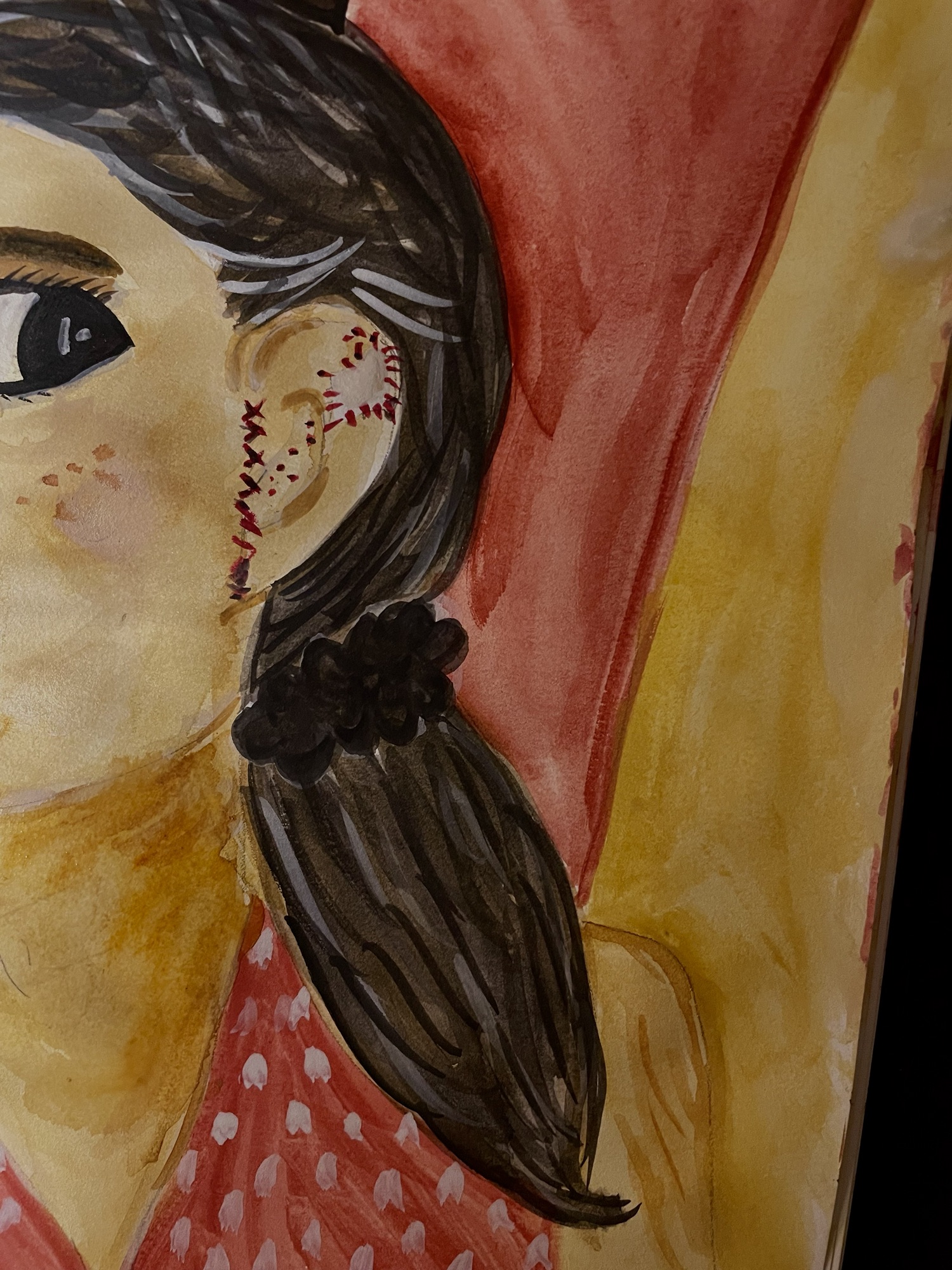
No yoga or strenuous exercise for at least two weeks, so I’ll be leaning a little more on watercolor. Painting my poor ear was oddly therapeutic.

He’s right. I did do good. I did not deploy my plan to secure the strings of my hospital gown and run like the wind for the Illinois prairie. I breathed through all the fear and the disconcerting vulnerability. I breathed through all the cutting and the stitching. I managed my anxiety like a warrior.

What’s more, I am still a kid, but not only a kid to my chubby, singing surgeon who is in his mid-seventies. At fifty-seven, I am still a kid to me. With every new experience, in the face of change, or when standing on the precipice of the unknown, we are all babies. In these moments of course we are scared, because in these moments we are actively learning about the terrifying, wonderful world and learning how to survive what life is throwing at us. In this particular fascinating moment in my ordinary life, I am, indeed, just a kid. Young and scared and hopeful.

The Seriousness of Silly Soap Stories

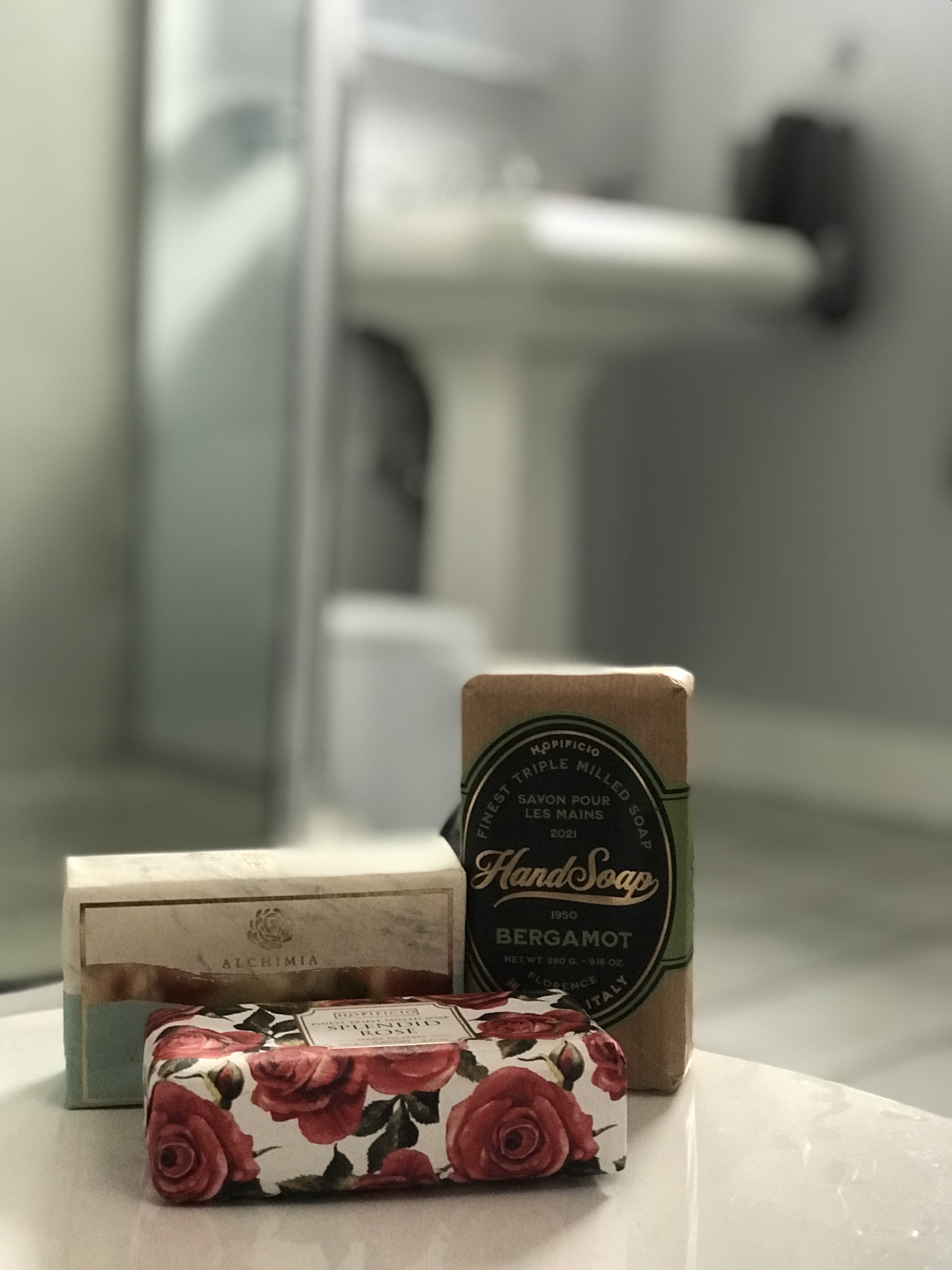
In the shower the other day, I threw a bar of soap with an uninspired floral scent over the glass shower wall.  I am an afficionado of strong scented, beautifully crafted soaps, and this bar was a dud. I deserved better. I was aiming for the sink, where the soap loser could await its fated deposit into the garbage bin. Instead, the thick bar slid down the inner side of the sink nearest the shower, traveled across the bottom of the basin and picked up speed, ramping up the other side of the sink. The soap then flew up into the steamy air before landing with a plop into a small drinking cup perched on the top of the sink. I squealed. It was like a three-point shot from midcourt at the buzzer.

But there were no cheering fans to adore me. No partner to call to the bathroom to share the story of my sensational shot. No handy family member or friend to regale with my dramatic telling. No one but me to care that a story of soap was a joyful beginning to another morning of my life on the planet.

You see, along with the momentous moments of life, I also need to share the mundane and the absurdities. When I read an interesting news article, get lost in a great book, or see a person in a taco suit on my noontime walk, I want to tell someone about it. I need to tell someone about it. For me, it’s less interesting, less great, and far less funny if I can’t share it. Mack was like that, too. She wanted the people around her to take part in the things that amused her, and those amusements were enhanced by the sharing. She is the one I most wanted to call to share the story of Stacy’s spectacular soap shot.

Instead, I threw the soap in the bin where it belonged, got dressed, and went downstairs to my home office to start my day. No one to tell, so I put the soap out of my mind; what do little dogs know of soap and midcourt shots at the buzzer? I did wonder, however, if my ex-husband Kevin got a little twinge in his stomach at the moment I squealed over that soap. The twinge like a ghost of the past giving him a strange sense that he had been saved from another drawn-out telling of a silly story, Stacy’s eyes wide as she told it with her hands and her eyeballs and her words, fast like a child, chattering on and on and starting the story all over again.

Clearly, I didn’t forget about the soap. I’m writing about the soap story because it got me analyzing myself in the context of this new quiet life of mine. I am a storytelling chatterbox living alone, and that has been of surprising consequence to me, I suppose, and I’m just now realizing it. Oh, I text or call my daughter Savannah several times a week, and she indulges my stories when I tell them. My sister will tolerate my stories while she has a cocktail in hand. My mother, who lives far away, always appears to be listening to my stories when I tell them, but really I think she is just measuring the size of my eyeballs as I jabber on, telling the story two or three times to make sure she hears it all. And, I also have friends, near and far, with whom I will relate a story or two, if I remember a good one when I see them.

Yet I think it is true, that living alone has altered the rhythm of my storytelling, narrowed my eyes and dimmed the sparkle. This realization of diminished, daily storytelling is another clue to me that I am struggling to adjust to living alone, to relying on myself for everything that I want and need. For fifty-three years I lived with my family, then college roommates, and then a husband and daughters. For fifty-three years, I had a captive audience. I’ve only been solo for two years, and almost all of that time during a global pandemic. Such a change was bound to be dramatic, radical even, and it has altered many rhythms of my life.

And that’s okay. Good, maybe. Or, perhaps, even great. The altered rhythm of a heart demands attention, requires assessment, suggests treatment. Why not the rhythms of a life?

What the altered rhythm of my storytelling means going forward, I do not know. I realize now that I have always found joy in sharing the stories of my life, particularly the silly ones, and also in sharing my observations about the world. Perhaps that is why since living alone I have taken to Instagram. It is no true substitute, of course, but it has given me an outlet, especially on the many days in each week when there are only the walls and the dogs to hear my stories and random observations.

I miss the chattering, the animated telling, and the instant gratification of getting the words, the thought or the story, into the ears and the heart and the funny bone of someone I care about. Not a great reflection of myself, centered as it is upon my ego. But that statement is the truest statement I have written about myself in a long time.

Perhaps I should learn how to enjoy unusual occurrences like spectacular soap shots all by myself  in the same way I learned how to use a drill and to cook for one. With practice. And cursing. Lots and lots of people are content to live quietly, laugh on the inside, and leave it to other people to tell the stories. Why couldn’t I just be one of them? Because, if I am honest, I am not and likely never will be quiet. I’m a talker. Talking is what I do.

Perhaps I should start a special journal to record my soap stories. Writing them out and reading them later might provide a similar feeling to the satisfaction I get from talking to people. Nah. This option sounds like a lot work, a little pathetic, and slightly off the mark. Before this introspective rambling, I never thought of myself as a performer, but now I wonder if that might be part of it.

Perhaps living alone is not for me, after all. Maybe I am one of those people who needs a partner, a captive audience with whom to share my daily soap stories. Or maybe it is going to take so much time to get used to living alone that I will never get used to living alone. Goodness. I hope not. On both counts, I hope not. Because I am a long way from healthy enough to live with somebody else, and I may not be for a long time or ever. Besides, although I admit I am needy of attention, the peace and privilege of making all the rules and curating every corner of my house and my yard, all on my own, is too lovely to give up. And, I know for certain, that having to compromise only with dogs and myself provides the most blissful environment in which to figure out what ails me and what heals me.

For now, maybe I’ll just talk to the walls or tell my stories to myself, out loud, while I take my daily walk. What if some, or a lot, of the people we see muttering to themselves on city streets, aren’t mentally ill, but people just like me. Chatterboxes with no one to tell their stores. Hmm… That’s an interesting idea to ponder on a Saturday afternoon, blustery with indoor weather.

I think, I’ll just try telling my stories to the dogs, and see how it goes.

Meaning in Molasses

There is a meditative peacefulness in observing the rich and lovely darkness of molasses, meandering across the lip of a glass bottle and flowing in a quiet cascade of sugary goodness into a measuring cup. The pouring of the syrup and the anticipation of its luscious sweetness offers a philosophical opportunity for the baker, which the mindless, crude scooping of white granulated sugar could never provide. The very viscosity of molasses, stretching slowly through space, settles the mind upon the simple beauty of a humble ingredient. Such present-minded pouring not only joyfully stimulates the taste buds, but the patience it requires also alights the deliciousness of gratitude upon the heart.

One does not wake up on a Saturday morning determined to find meaning in molasses. Philosophers and poets may naturally see the value in the ordinary, but for flawed, grieving, self-pitying mortals like me, it requires effort. I am deliberately determined to be more present in the daily routine of my life, but my effort is a practice, and it is oh so very far from perfect. Sometimes, however, almost like magic, I reap the sweet benefit of mindfulness and find quiet beauty, simple joy, and meaning in the mundane. It was just such a magical moment for me a couple of Saturdays ago, when feeling brave and ambitious, I washed and made tidy my kitchen pantry.

Cleaning out a kitchen pantry is an unpleasant chore, offering me nothing but a fleeting sense of satisfaction in exquisite organization destined for almost immediate destruction. For this reason, it is a chore I procrastinate; and because it is a chore I procrastinate, it is always a chore which sorely tests the limits of my extremely weak stomach. This particular cleaning required the chiseling away of encrusted residue of marshmallow cream and the wiping clean of two sticky pools of unidentifiable substances, creeping like monsters born in primordial ooze. Not only did the task of cleaning the pantry make me nauseous, but expired specialty items, like three cans of sweetened condensed milk, purchased for recipes long forgotten, stared at me like abandoned puppy dogs. As well, novelty ingredients such as a tin of anchovies packed in oil and a petite pot of peri-peri spice, purchased in the name of broadened cooking horizons, mocked my good intentions.

After washing my hands and calming my sick stomach, I gazed upon my trash bin and two paper grocery bags heaping full of wasted food and good money thrown away, and I withered. In the sight of so many casualties, a breathtaking first-world carnage, the only assessment was my exquisite failure. In that mood, I could not smile at an orderly cabinet, now glistening with washed glass bottles of cooking oils and vinegars and sanitized canisters and cans, lined up like ready soldiers. But then I remembered why I had tackled my long-neglected disaster of the pantry in the first place.

The Friday evening before, I had a telephone conversation with a friend, and we briefly talked about my intentions to halt all conspicuous consumption and to focus on spending good time instead of good money. She said that when she was on her year-long sabbatical in 2017, she conserved money by pulling out forgotten products from the backs of cabinets. She said, “you wouldn’t believe how much perfectly good stuff I had that I had completely lost track of and yet had continually been replacing.” As we talked, I stood in the kitchen and inspected my pantry, brimming full of items I had forgotten. Our conversation inspired the great pantry purge the following day.

When the pantry cleaning was complete and I had remembered the intended purpose of the task, I looked past the wasted items in the trash bin. I focused my attention instead on the beautifully organized pantry. My pantry may have been a mess of forgotten stuff before, but now it was a pantry full of perfectly good stuff I now knew I had. And among the perfectly good stuff was some perfectly wonderful stuff, too, like a tall jar of long forgotten, but unexpired molasses. “Duh,” Mack whispered in my head. “Sugar never expires.”

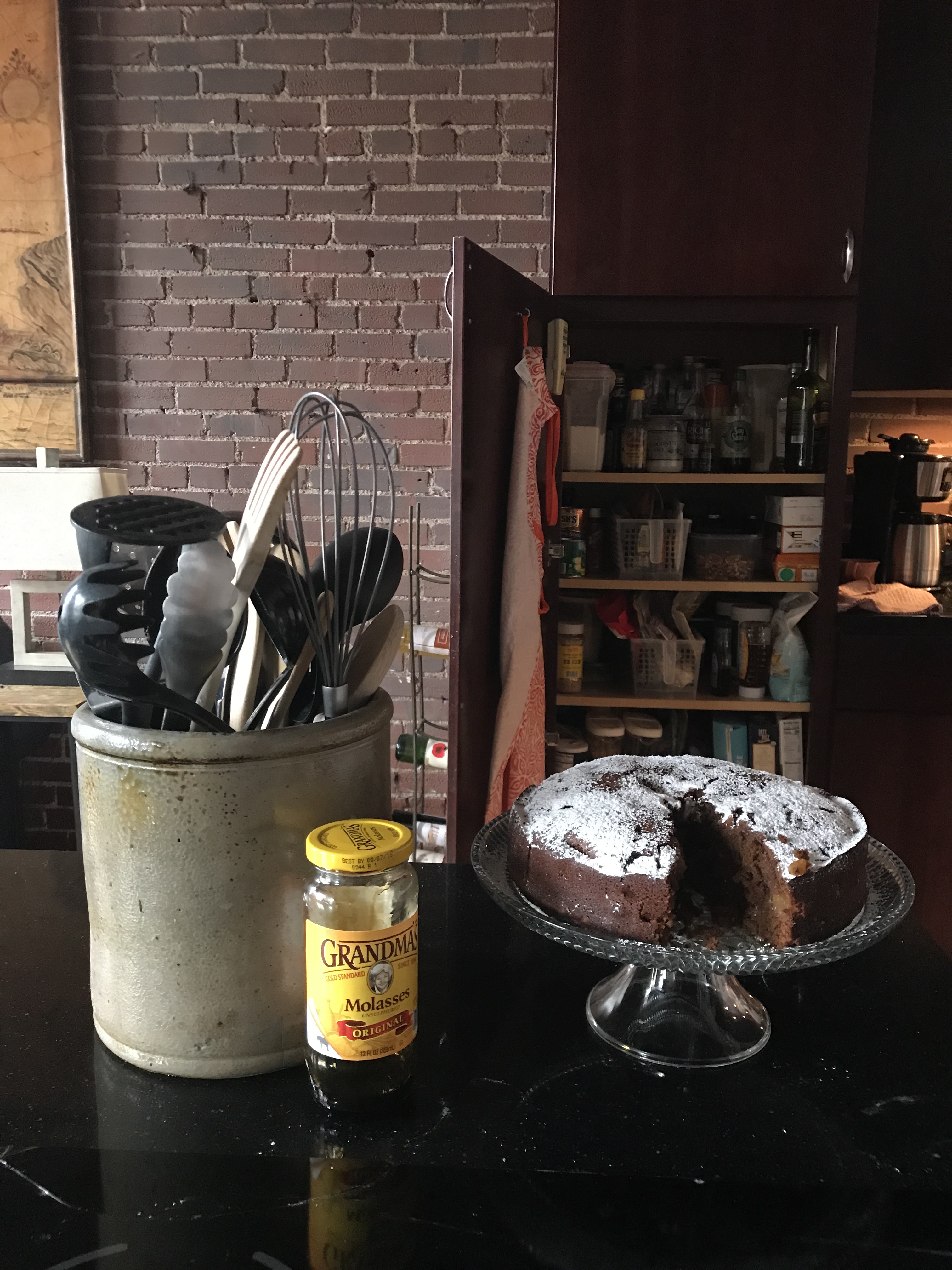
Molasses is an ingredient I always enjoyed incorporating into holiday baking with my girls, who loved gingerbread and gooey molasses cookies sharp with ginger. I decided to celebrate my clean pantry and the memories of happy Christmases past that the found molasses had spurred within me. I spent the next half hour or so reading recipes and examining other ingredients I had, looking for a recipe that would not require the purchase of anything new. I settled on a cake. In my pantry-purge cake, the molasses would be the star in tasty concert with a half-cup of golden raisins and three pink-lady apples just starting to soften and wrinkle in the back of my refrigerator’s fruit bin. The cake would be an homage to taking better stock of what I have, a ginger-strong nod to happy memories, and an ode to simple pleasures like molasses.

From the moment I poured the molasses into the measuring cup, I let the delicious syrup work its meditative magic. Never before had I employed such a satisfying and deliberate mindfulness in the making of a cake. When I pushed the cake tin full of the brown spicy batter into the oven, I could account for every minute I had spent in preparation. It is weird to realize how much daily life goes by for which we can make no accounting whatever. But it is also delightful to learn that you are capable of spending precious time living fully in a moment, even if what you are doing is baking a simple molasses cake.

My mindfulness that Saturday afternoon produced a cheerful glow in my attitude and a philosophical curiosity about how and why the hell I was finding meaning in molasses. The cake was pretty good, too. It was moist and warm with spice, and the light dusting of powdered sugar elevated the caramel depths of the molasses in no need of the cloying cream-cheese frosting I astutely edited from the recipe.

Busy and frustrated people might employ the old-fashioned phrase “slow as molasses in January” to express annoyance that another person in their way is going about some task with an insufficient amount of haste. But I think the expression merits a different meaning. To be “slow as molasses in January” is to be patient, to let life come to you at its own pace, and to be present for even the most humble of life’s experiences. It means that to full-stop it, to live in the moment, is to see value in the humble and beauty in the mundane.

Molasses might not be the metaphor for mindfulness, but on one Saturday in January it was mine. Letting this mindfulness in molasses happen was a victory. Because in my bumbling and stumbling journey forward through life, my human legs have often been running far faster than mindfulness allows, and I have missed far too much of the experience. If I slow it down like molasses in January, I know I will see much more of life’s interesting and beautiful terrain.

img_4045

Better than Angels

Many well-meaning people have told me that Mack is an angel now, in Heaven. That she is eating infinite quantities of sour candies, sushi, and Thai fried rice in a place where the weather is ever perfect for her open Jeep to drive down beautiful, tree-lined avenues, music blaring, with a car full of puppies. I do not doubt that religious belief eases the burdens of grief for religious people. Yet I cannot seek comfort in the magical thinking of religion. For me, death is terminal to the flesh and to the soul. I keep the spirit of Mack within me and allow her impact upon my life to guide me, going forward, but my grief is grounded in the painful reality that neither her body nor her soul inhabit any world. And so, in the absence of spiritual solace, I seek a more tangible comfort.

I have spent innumerable hours pondering this idea of angels, of the meaning of the people who pass through our lives and of the trauma their deaths inflict upon the living—the people they leave behind in the world to understand and to make peace with the fragility of being human. Losing Mack ripped open the flesh of my emotional vulnerability and offered shocking clarification of my own mortality and of the mortality of every single person I love and need. But losing Mack also uncovered, in the exposure of my bones, other lost people, living there, with me still, although long gone from the world of the living. In the parlance of the religious observer, I have three angels: Mack, my dad, and my maternal grandmother. But I have come to understand that the bold impression that each of these three marvelous humans made upon me and the tangible guidance they continue to provide me are much more powerful than any otherworldly existence they would inhabit if heaven was a place and angels lived there. But what does any of this babble mean, anyway, and why do I feel compelled to define Mack, Jim, and Kathleen as something other than angels?

There is a historical debate about whether upon Abraham Lincoln’s death, his Secretary of War Edwin M. Stanton consigned Lincoln to the “angels” or to the “ages.” If one subscribes to magical thinking—as author Joan Didion argues every grieving person does, at least at the immediate impact of a loss—then it is likely that perhaps all of the people present for Lincoln’s last breath, each of them grounded in Christian theology, believed Lincoln had joined the angels in Heaven. Certainly Mary Lincoln believed it so. But what we have learned in the 153 years since Lincoln’s death is that he actually resides with the living. He does not inhabit some ethereal plane as an angel, but rather he belongs to the ages, regardless of what Stanton might have actually said. Lincoln exists in the bones of America; just as Mack, Jim, and Kathleen exist in my bones. Lincoln is, for Americans, a folk hero—a tangible historical presence who corroborates our past, who by the example of his own leadership offers tools for leadership in the present, and who in his human worth provides inspiration for the future of America. Mack, Jim, and Kathleen are, for me and for my life, folk heroes—the tangible comfort I seek, because they corroborate my past, they by the examples of their own lives give me tools to navigate my life in the present, and in their human worth, and from their significance in my life, inspire me to gaze forward, onward, toward the future.

In looking back across three and a half years of the blog entries in Being Mack’s Momma Bear, I realize that what I have written is a series of “Mack-tales,” stories of Mack’s life and the influence she had upon the people who knew her, many told with some moral or inspirational purpose beyond the story itself. My individual stories about Mack are all true, but taken together, they read as folktales; and Mack, I think, reads like a folk hero. It is not my intention here to argue that Mack is a folk hero in the way that Abraham Lincoln is a folk hero. Rather, my point here is that we all have people we have lost who are so much more than angels looking down upon us from some kind of heaven, happy away from the ones who loved them, looking down upon mere mortals through some bright, heavenly light. And I also think it is good and useful, in fact it is a tangible comfort, to recognize the folk heroes we were so damn lucky to know and to keep them with us by telling their stories. Perhaps not for the ages, but for us and for our immediate families, as a way to make sense of life, of death, of the world around us, and of our fragile but beautiful human connections.

I am going to keep pondering this idea of folk heroes, and probably of angels, too. It is a topic, as yet unresolved in my brain, and about which I intend to write more. But for now I want to tell you about my first folk hero, my grandmother, whose name I gave as a middle name to Mack and whose stories I shared with my girls as they grew. My  grandmother died when I was in graduate school, and she was with me, tucked deep within my bones, throughout my doctoral studies as I gutted out soul-crushing seminars, grueling reading lists, and inhuman schedules. My memory of her grit and her sass offered me strength and solidarity from beyond her grave. I did not have any real sense at the time that she was with me or that I had attached so much purpose to my memories of her. But now I do, as it is one of those curious light bulbs that have switched on in my psyche, through the fog of my grief for Mackenzie. So on what would have been her 95th birthday, I give you Kathleen: a woman, a grandmother, a folk hero. See for yourself why she is so deep within my bones and how much of her folk-hero character and traits ended up in the bones of Mack, as well.

Kathleen was a hard-working, tough-talking woman who survived the depression, sacrificed during World War II, and suffered premature widowhood and early breakdown of her body and her health. She was a real-life Rosie-the-Riveter who swooned over Frank Sinatra and Elvis Presley. She was a diabetic addicted to sweets and to junk food. She was a house-dress-wearing, pocket-book-carrying granny who enjoyed pinching and teasing her grandchildren and wrapping them up in bone-crushing bear hugs. She had the delicate penmanship of an artist, the mouth of a dishonorably discharged marine, and she crocheted colorful blankets while watching professional wrestling. Kathleen did not bake pies and whisper; she worked in a box factory and told dirty jokes. She was crass and direct and devastatingly funny, full of chutzpah, contradictions, and complexities. She was true to who she was and how she felt and what she thought, and she never apologized for any of it.

Kathleen indulged my sweet tooth, once cheering me on as I devoured a Hostess Ding-Dong in one outrageously large bite. She appreciated and encouraged my spunk. She taught me to use my middle finger with authority, both literally and figuratively, and she showed me how to be bold in the big, bad world. She adopted my friends without putting on fake grandmother airs. She made card games uproariously fun, but she also made them dangerous, threatening to get those who bested her with her “bowling-ball grip” as she gestured over the card table, three angry fingers pointing skyward. First-time hearers of Kathleen’s unique and sometimes obscene vocabulary gaped, veteran hearers tittered, and everyone, in the end, understood that in speaking her truth in her own language, Kathleen had scooped them up into her bosom to love them, to boss them, to be herself with them, and to bear witness to their true selves, as well.

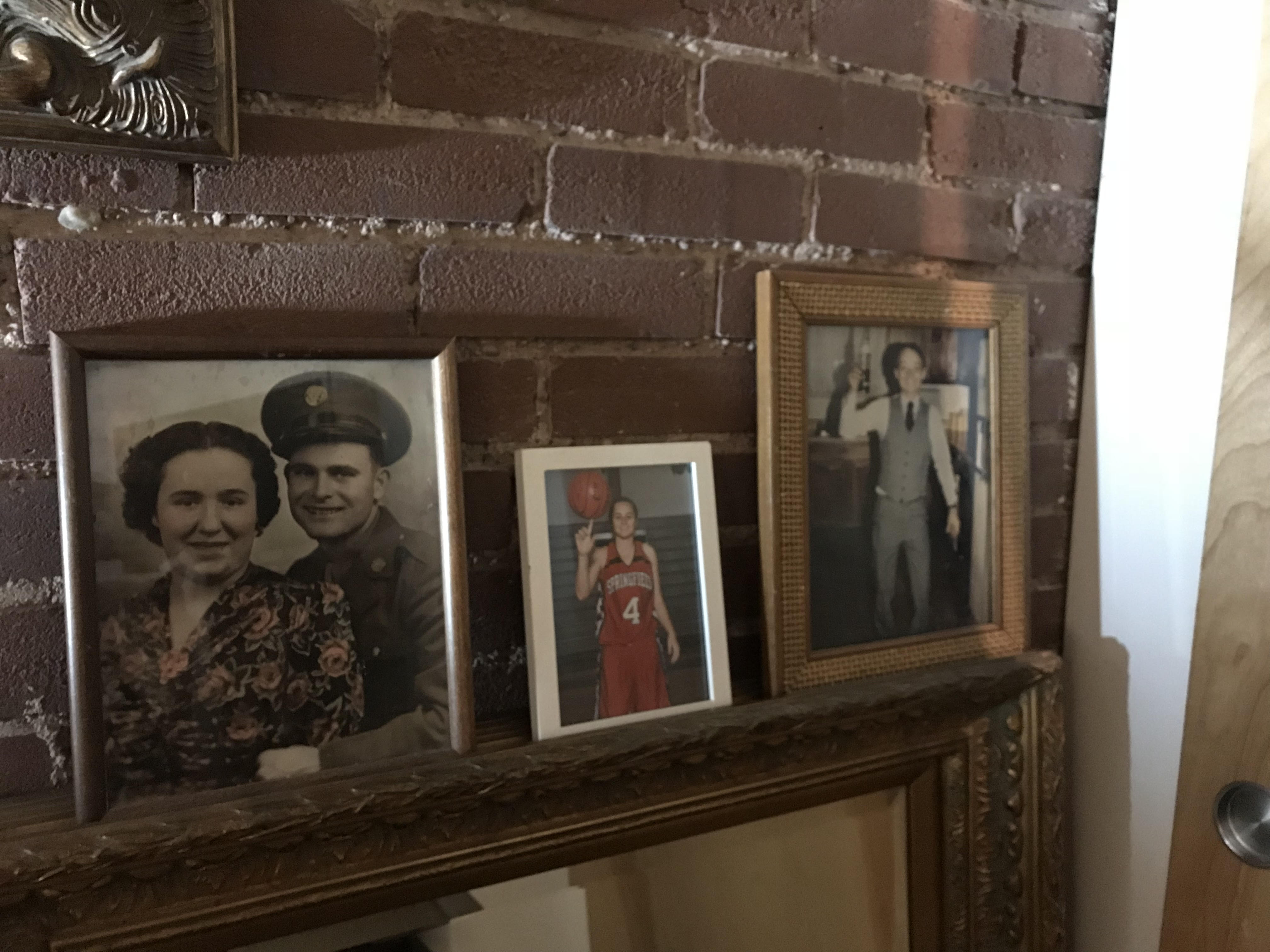
A 1943 photograph of Kathleen is one of three perched within the deep grooves of a giant framed mirror on the floor in my bedroom. In her photo, Kathleen is wearing a vibrant floral dress and is wrapped up in the arms of my handsome, uniformed grandfather who will soon be in Europe fighting Nazis. On the right is a photograph of Jim, my father, in 1981. Standing in my childhood kitchen, he is wearing a suit vest, tie, and an impish grin as he holds up a glass-bottle of Pepsi. In the middle photograph is my precious Mack in 2010. Clad in her red, high school basketball silks, bearing her lucky number 4, she spins a basketball atop her long, right index finger. When I propped up those photographs there, more than three years ago now, I had not given much thought to the intent of their placement. But now their purpose is perfectly clear. These are the photographs of my folk heroes, spanning nearly seventy years of time and history. Mack, Kathleen, and Jim are folk heroes. No different, really, than Abraham Lincoln, Johnny Appleseed, Paul Revere, or any other folk hero you might imagine–at least not to me. My memories and my stories of them are the folktales of my life, and they are my tangible comfort. They root me to my past and to my Indiana ancesters, they ground me in the present guiding me by the examples of the lives they led, and they inspire me to see a future, even if it is one without them.

And, that, my friends, as you likely already know, is precisely what folk heroes are supposed to do.
folk heroes

Kathleen and Clyde c1943

17 Limericks for Mack Day

Grief is a humorless companion; and life without humor is grim. While I am often unsuccessful, I do try every single day to find humor in the world, because I know it is the thing that Mack would most want me to find. Mack laughed and chortled and giggled her way through nearly every day she lived. For her, laughter was as essential as the air we breathe. She was the source of a great and wonderful abundance of the laughing I did for the twenty years I was lucky to know her. Mack’s joyful sense of humor was one of her greatest gifts to me and to everyone who knew and loved her.

Therefore, on this Mack Day, March 17, 2018, in honor of the twenty-fourth birthday of my happy and funny little leprechaun, I offer seventeen limericks. A couple of them are really good, some of them are OK, and most of them are pretty terrible. But I know Mack would love them all, especially the terrible ones. She would have laughed her ass off reading each one (out loud and in a goofy voice, of course), congratulated me on my ridiculousness, and then written a couple of her own. I think she would be happy to know that I laughed a little more than I cried while writing them. I also think Mack would appreciate, and maybe even take full credit for, my decision to pen so many damned limericks in the first place. So please, read the limericks along with me and with Mack and laugh out loud, especially at the terrible ones, as we all remember our silly and sweet, cheerful and magnificent girl.

Note: Each limerick is linked (on the heading) to the previous blog post that inspired it, so that readers might revisit old stories of Mack’s beautiful life.

Candy

There was a girl with cravings for candy

always keeping it close and quite hand

Loved the sour and sweet

Always needing a treat

And campaigning that sugar was “dandy”

Clothes

Mack found sweatshirts to be the most comfy

Tucked-in tails were so painfully lumpy

Shorts and soft tees

Free toes and bare knees

Were important for not being grumpy

Cool

Well liked and admired without trying

Mack gained friendship and fame without vying

Confident and cool

Goofy fun in school

Quirky, genuine soul, no denying

Food

Ordering Asian food was quite common

Mack loved her sushi, pad Thai and ramen

Spicy she’d order

Thai folks adored her

Loving their food with such happy abandon

Freckles

There once was a daughter McDermott

on whose face there was spot after spot

“Freckle monster am I!”

she cried out with a sigh

“Guess I’ll love all the dots that I got”

Friends First

Best friends were her favorite collection

Making careful and worthy selection

Not judging her buddies

but thwarting their studies

With much laughter and goofy distraction

Golf

She preferred flip-flops over her golf shoes

Comfort and irreverence was her excuse

For her golf was fun

Just a walk in the sun

A time to chill out with friends, win or lose

Hair

Most of her life Mack wore very long hair

Shimmering with sun, so fine and so fair

But never too keen

To primp and to preen

Finally cut it to suit her own flair

Jeep

She had an old blue Jeep that rattled

with a terrible clutch she battled

But she loved that old heap

only making her weep

on nights she was late and it tattled

Laughter

Mack always stood way out for her humor

Of which everyone was a consumer

She would chuckle and giggle

Tell bad jokes and would jiggle

Make you pee your pants along with her

Lazy Days

Mack loved to watch her TV for hours

Eating Funyons and sucking on sours

Glee, Parks, and Buffy

nothing too stuffy

because Sponge Bob’s the one who empowers

Lincoln

A girl from Springfield always shrinkin’

from sharing her town with that Lincoln

Mack decided that fate

gave her no choice to hate

the man who consumed Momma’s thinkin’

Mack-Like

To be like Mack is a damn worthy goal

Making best friends is so good for the soul

Relax, enjoy life

Be brave, cut the strife

And always laugh, chuckle, giggle, and roll.

No Worries

Mack wasted no sleep or time in fretting

About things there was no use in sweating

Preferring to chill

things happen that will

Besides, nothing should be so upsetting

Spiders and Insects

Mack detested all spiders and insects

Even lady bugs to her were rejects

She’d scream in fear

When they came near

And flee fast like she had mental defects

Wild Child

A tomboy, and crazy athletic

Her pace as a child frenetic

She would bounce off the walls

Never playing with dolls

and giving her parents a headache

Writing

Mack was a good feminist writer

Who wanted the world to be brighter

She had plans to create

Female leads to abate

Sexist bullshit and bias around her

Leprechaun

Mack Memo #5: Just Be Cool

A very cool math teacher Mack had in middle school assigned his students to construct an item that he could stand on without breaking. He was a big fella with a big sense of humor, and Mack thought it was just about the coolest homework she ever had. It was one of those rare school projects that she did not procrastinate, and she immediately engaged her Papa Bear and his carpentry skills to meet the challenge.block I cannot now recall the particular details of the assignment, but there were rules about dimensions and weight and solid objects did not qualify. Mack and her dad dug through the scrap wood in the basement, did some measuring and sawing, and came up with a hefty little step (measuring in at 11¾” x 5.5″ x 2¾”) with a big hole in the middle of it. Not satisfied that the bare wood did the successful design justice, Mack personalized it in Irish-green spray paint and some stick-on letters.

That green, math-teacher-holding block of wood sat around in Mack’s bedroom in Springfield for years (responsible for at least a couple of stubbed toes and a few creative screams of obscenities) and got packed up and moved to her bedroom in St. Louis, too. She displayed it on her desk, a funny reminder of a cool teacher. Now it occupies a corner of the bureau in my bedroom, a funny reminder of a cool kid. Every day, this unique artifact of Mack’s life catches my attention, and memories of her cool persona make me smile. When Mack applied those letters to write “Mack is Cool!” on the block, she was just being silly, putting her witty mark on a witty school project. But now those letters preserved on that green block of reclaimed wood forever encapsulate the spirit of Mack’s cool. Mack really was always so damn cool. But not just the too-cool-for-school kind of cool. Mack was also cool in the cool-as-a-cucumber kind of cool. And it was the refreshing combination of those seemingly contradictory cools that contributed so much to Mack’s charm and magnetism. It was also that healthy combination of cools that gave her astounding inner and outer peace. Mack exuded a cool confidence and lived her life with the easy calm of a warm, ocean breeze. Mack’s be-cool-because-it’s-all-cool attitude kept her even-keeled and happy and it also rubbed off on the people in the room with her. Mack-cool had a way of diffusing tension, lowing blood pressures, and making fast friendships.

This morning as my eyes rested on that green block of wood and the “Mack is Cool!” lettering, I said out loud: “You know what, Mack? Everyone in the world could use a whole bushel basket full of your brand of cool in 2017.” I could picture a crooked smile forming on Mack’s lips as she said: “Well, then just be cool, Momma Bear. It’s super simple. Just. Be. Cool.” But while cool came naturally to my sweet girl, I do not possess that gift, and I have lived long enough to know that it does not comes so naturally to most people, either. Because it is, actually, very difficult to be cool when the disagreements between people are fundamental. It is very difficult to be cool in the face of the political, economic, and social chasms that divide us. It is very difficult to be cool with people when there is no foundation of assumed facts and shared values to build bridges across such wide divides. I believe that all of these difficulties will become increasingly harder in 2017, because the incoming president thrives on those divisions between us and seeks so readily to maintain them. Since November, I have found it extremely difficult to keep my cool. But anger stands in where cool should be, and as is so very often the case, anger has accomplished nothing. In fact, my anger has settled into my bones and it has been making me sick. I really do not wish to spend 2017 angry and sick, so I need to get me a whole bushel basket full of Mack-cool. Like me, Mack would have been disappointed in the 2016 election and the divisive words and actions of the president-elect would have startled her. But Mack would have stayed cool. She never would have let anger settle into her bones and make her sick. “Just be cool, woman,” she would have told me. “Just. Be. Cool.”

So being Mack-cool in 2017 is gonna be my goal. I will no doubt fail at various points along the way and occasionally scream an obscenity or two at the news or Twitter, but I promise to emulate Mack as best as I can. I will try to get me some cool and keep the anger out of my bones. This does not mean that I will accept the political propaganda, the divisive rhetoric, and the hateful lies that have been so successful in robbing me of my cool. It just means that I will try to manage my responses the way Mack would have managed hers. Because holding onto anger really does make you sick; and all I really want to do anyway is just be cool like my Mack. I suppose it is entirely possible that if I find a little success in this cool endeavor, I might be able to make some small difference in the world. But at the very least, though, my weary bones will thank me for giving them a lighter load to carry.

Mack Memo #5: No matter what happens, no matter what is said, always be cool. Cool looks good on you. Cool influences friends and wins restful slumbers. Just. Be. Cool.

Life on the Monkey Bars

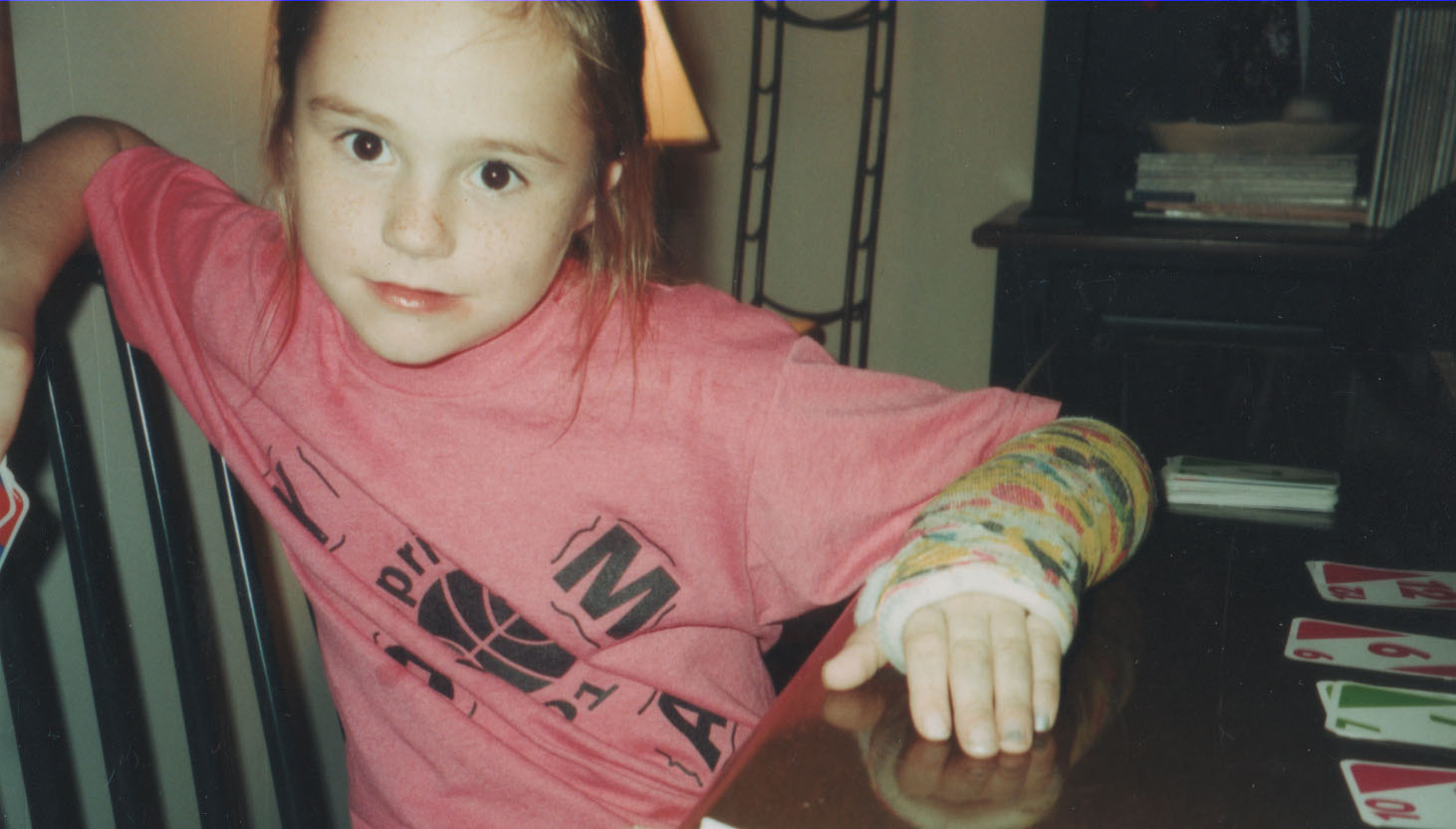
In the fall of Mack’s second grade year, she fell off the monkey bars during recess and broke her arm. When I arrived at the school to pick her up, she was sitting on a plastic school chair in the office, and the playground monitor, a woman named Rachel whom I had known for many years, was supporting Mack’s arm on her clipboard. Mack was not crying and, in fact, she and Rachel were giggling, no doubt sharing some sports-related playground secret. But I almost cried when I bent down to inspect her arm. Although the skin was not broken, Mack’s poor little radius bone was grossly protruding upwards, clearly snapped free from the wrist. Mack looked up at me with those deep, warm, and brown eyes of hers and said, “Can I get some candy for this boo-boo?” Rachel looked at me, shook her head and said, “Not a tear. Just plans for candy.”

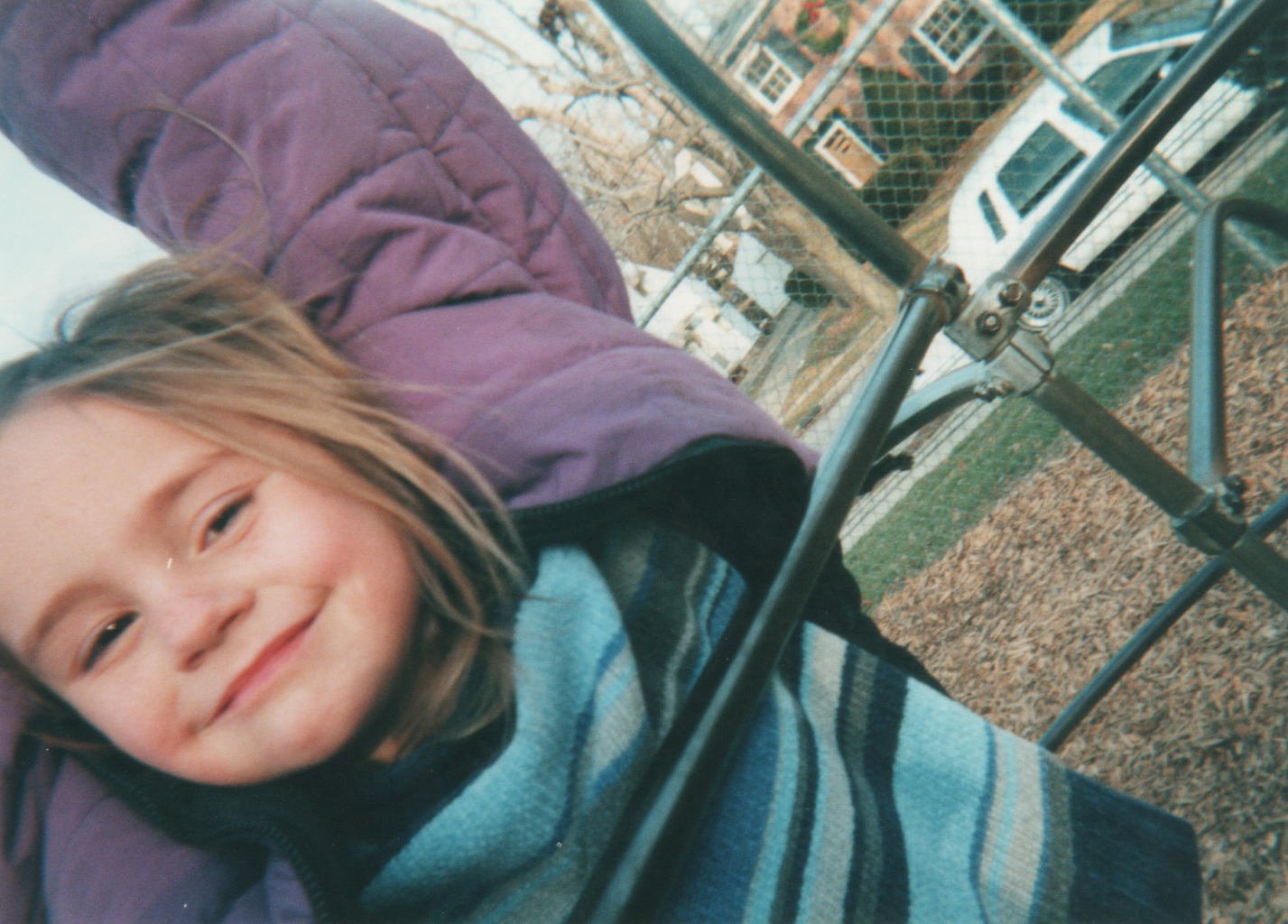
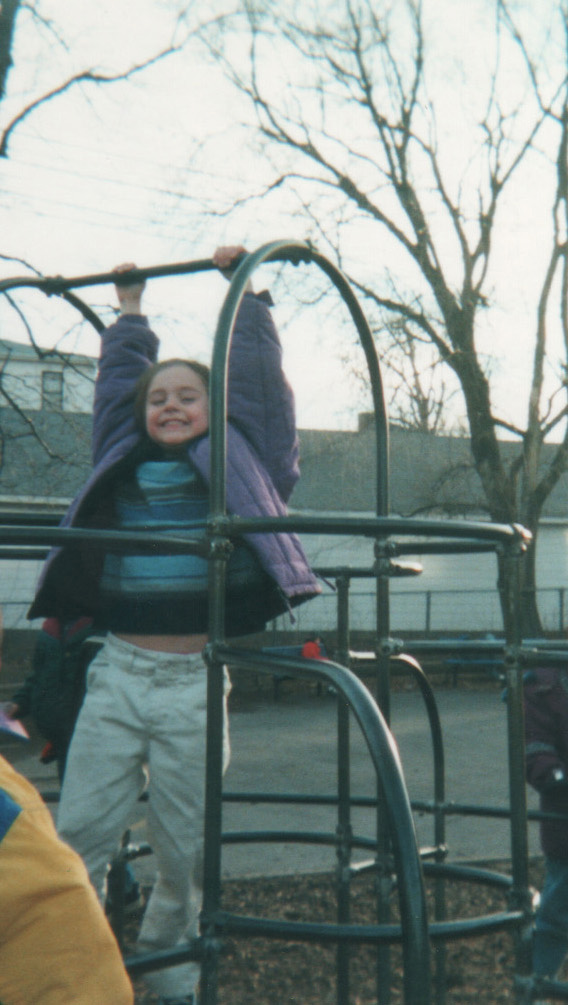
Mack never cried about that badly broken arm, not from the physical pain nor from the disappointment of the premature end to her tackle football season. She did not complain about the discomfort of the cast, and, in fact, she bragged about her colorful choice for the first large cast and wore the smaller purple cast that followed like a badge of monkey-bar honor. With the exception of a good punching of her sister, who laughed at the woolly arm that emerged when the purple cast came off, Mack kept that broken arm perfectly in perspective. As was typical, she never dwelled on her problems, big or small. And, perhaps most importantly, as soon as that cast was off, she was right back on those monkey bars. It was always her inclination to take in stride inconveniences and disappointments, and she never allowed life’s bumps and bruises to replace her joy for a thing with fear.

I recognized those qualities of Mack’s character at a very early age, and I admired them, partly because they were so unique in a little kid and partly because I was incapable of naturally emulating them myself. Mack always was a bigger human being than her Momma Bear. She put her seriously injured arm in her stride. She kept calm and carried on with her life as if the pain and the inconvenience was of no consequence. She never hunted for sympathy or felt sorry for herself. In contrast, when an old, rope-hung window smashed the three middle fingers of my prominent hand, I wailed like a baby, demanded sympathy from anyone who would listen to the story of my injury, and complained at the inconvenience during the entire healing process. It became a family inside joke for many years afterwards that I sure did talk a lot about those smashed fingers of mine.

This fall, I suffered a serious professional and personal disappointment that knocked me off of my feet. Earlier in the year, the Lincoln Presidential Library in Springfield seized control of the Papers of Abraham Lincoln, a project for which I had worked for twenty years, and forced me out of my scholarly editing position in November. True to form, I cried, ranted, and raved about how unfair it was that being a long-serving, exemplary employee with a project I had helped to build ended up being worth so little. My appointment is with the University of Illinois Springfield and not with the Library, so I was not losing a paycheck or benefits, just being reassigned. Instead of feeling lucky that I still had a job, I took to feeling very sorry for myself, moping around, casting blame, and holding a whole hell of a lot of negative energy in my soul.

Then I thought about Mack’s broken arm, or rather her gracious handling of the injury. I pictured that sweet little kid sitting there on that school chair, her grotesque wrist quietly  balanced on that clipboard, and those big brown eyes, free of tears, as she asked me for candy. I remembered how Mack happily cheered on her football team from the sidelines during the Super Bowl victory from which that broken arm had kept her, never moping or feeling sorry for herself for missing the opportunity to play that day. And I remembered how she popped right back up onto those monkey bars just as soon as her arm was healed, because it was not in her nature to do otherwise.
broken-arm-4

Mack understood that life’s bumps, bruises, and disappointments were a part of the journey, and dwelling on them and sucking the people around you into the vortex of your self-pity is a really rotten way to spend a day. Given what I have learned about unexpected tragedy, genuine personal loss, and the cruel companion that is grief, I should not need a refresher course in perspective. But, alas, I do. Frequently, I admit. Unlike my precious Mack, my sense of calm and perspective is an ugly and imperfect work in progress. I needed the memory of Mack’s arm and her incredible grace, and it was just the slap upside my head that I needed. Now instead of moping about my lost position, I am pouring my enthusiasm into my new challenge at the University, helping develop a plan for a campus institute for Abraham Lincoln Studies. The example of Mack’s brave endurance and fearless resolve also inspired me to take a risk and make a creative application for a part-time, scholarly editing position at the Jane Addams Papers Project. On December 9, I accepted the position, which offers the exhilarating challenge to study a different historical era for me and explore a new professional path. Mack no doubt would have made a crack about how it was past time for me get out of Lincoln’s grill, and I can hear her vociferous approval of my new scholarly focus on an important humanitarian and feminist.

What I had at first interpreted as a nasty, unexpected, professional curve-ball, I now see as a big, fat softball coming in across the middle of the plate. Mack is, as always, coaching me to hit the ball out of the park. My latest Mack-reality check helped me to not only put the disappointment in my stride, but also to get back up on the monkey bars. Of course, I am uncertain about what the future of my new professional opportunities will hold, but I know I have the heart to give them my best effort. And with Mack swinging on the bars next to me, smiling from ear to ear, I will endeavor to keep the bumps, bruises, and disappointments along the way in the proper perspective.

monkey-bars

monkey-bars-3

Shut It Off

Anticipation of the impending two-year mark of my life without Mack has infiltrated my bones and made me unsteady on my feet these past days. In an effort to regain some balance and to face the grim week ahead, I need Mack to guide me. So I have taken yet another journey through Mack’s beautiful brain by spending time with the precious book that Mack’s adoring father assembled just months after we lost her. The spirit of our Mack dances (Irish jigs, actually) off of each of the priceless pages of Mack: Her Life & Words (http://mackmcd.yolasite.com/), reminding the reader of her quirky wit, her gracious and kind character, her uncompromising belief in equality and justice, her love for life, and her uncommon wisdom.

This morning, I was reading out loud her poetry. It is undisciplined, and it is raw. It is not the stuff of literary giants, but it has a beauty and a quiet wisdom that is uniquely Mack. One particular poem might in some ways now seem prophetic, but this morning as I repeated it half a dozen times or so, it was, very simply, pure and human truth. A sage epistle from my sweet girl. A gentle reminder to find the sun.

Shut it Off
By Mackenzie Kathleen McDermott

It’s all okay
The sun is out
But hidden behind generous clouds
On a lazy day
Soon to be replaced by lazy stars

Then all at once
The world collapses
The clouds turn mean
And the sun retreats
To mourn the ashes of kin
A touch is in order
Some simple relief from the gripping reality
As the world dims
But there’s a head on those shoulders
So give it all you’ve got
Then shut it off

Move quickly
And hold tight to false hope
Cling to the smallest of rocks in the stone
Just make sure you don’t look down
Because letting go is much harder than pretending

Shut it off
There’s much more pain that love can bring
Than just a body in a box
So shut it off

And then it’s almost okay
The sun is out
But hidden behind generous clouds
On a lazy day
Soon to be replaced by lazy stars
Shut it off
It’s not that hard

freckle

As I myself cling to the smallest of rocks in the stone, I can assure you all that under some of life’s cruel circumstances it is, actually, quite hard. But for my Mack, I will always try harder to find the sun.