Copying the Masters

I have more talent with words than watercolor, and since I will probably never meet the 10,000 hours required for mastery of a skill, I will likely remain a more accomplished writer than painter. Yet I feel more artist than writer these days. I am more compelled to paint than to write. I am less interested in applying a honed skill than practicing a new one. I surprise my serious self by being so glad to play and to laugh at my painting blunders. Creating art, imperfect as it may be, is balm and vitamin to my evolving, aging spirit, a more nourishing and colorful expression of my existence in this autumn of my life. Art inspires my inner child, rejuvenates my aching heart, and checks my ego at the door of my Archive room, where I paint. It both heals and challenges me.

When I open the watercolor paints, spritz them with water, and consider the blank paper, I feel no pressure to create, no striving to be good, no fear that what emerges on the page might be terrible. In fact, I welcome the terrible. I enjoy the mistakes and happy accidents. I laugh out loud at my feeble attempts at noses and fingers and mixing a bright and perfect shade of purple. It is the practice of art that nourishes my soul, not the art (or anti-art) that emerges from the water and pigment on paper.

As I know that anyone who writes regularly, whether they ever publish or not, is a writer, I know that I am an artist, no matter the level of skill I possess now or have the capacity to attain. To sit down most days and draw, paint, or collage something into existence is what makes me an artist. To create ANYTHING with an open heart that makes someone feel something is a creative expression. Bouquets of flowers from the garden arranged in a vase. A home-made meal cooked with love and intention. A craft cocktail, garnished with flair. Daily doodling in the margins of the engagement calendar. All is art and the creator an artist.

When I began watercolor painting three years ago, a suggestion of my therapist to practice the art of letting go, I never anticipated that art would become as important to me as writing. I immediately loved painting and felt the physical healing of the practice, but I believed it would be a passing fancy. I have never been very good at sticking out activities that do not immediately feel easy. Watercolor is willful, and it frustrated the persnickety editor in me, but it soon became a dance, a playground, a messy field of weeds and wildflowers, cartoon figures and a belly laugh. Painting makes me feel like a child drawing with sidewalk chalk in the sun.

As an artist I want to gently improve my painting skills, not with a mind to sell or exhibit my work, but rather for the enhanced pleasure of creating art. I want to better mix colors, to learn to paint without penciling out a crummy sketch first, to trust the water more, to lean into abstract representations of what I see, and to feel content to paint with my imperfect, grieving, laughing heart.

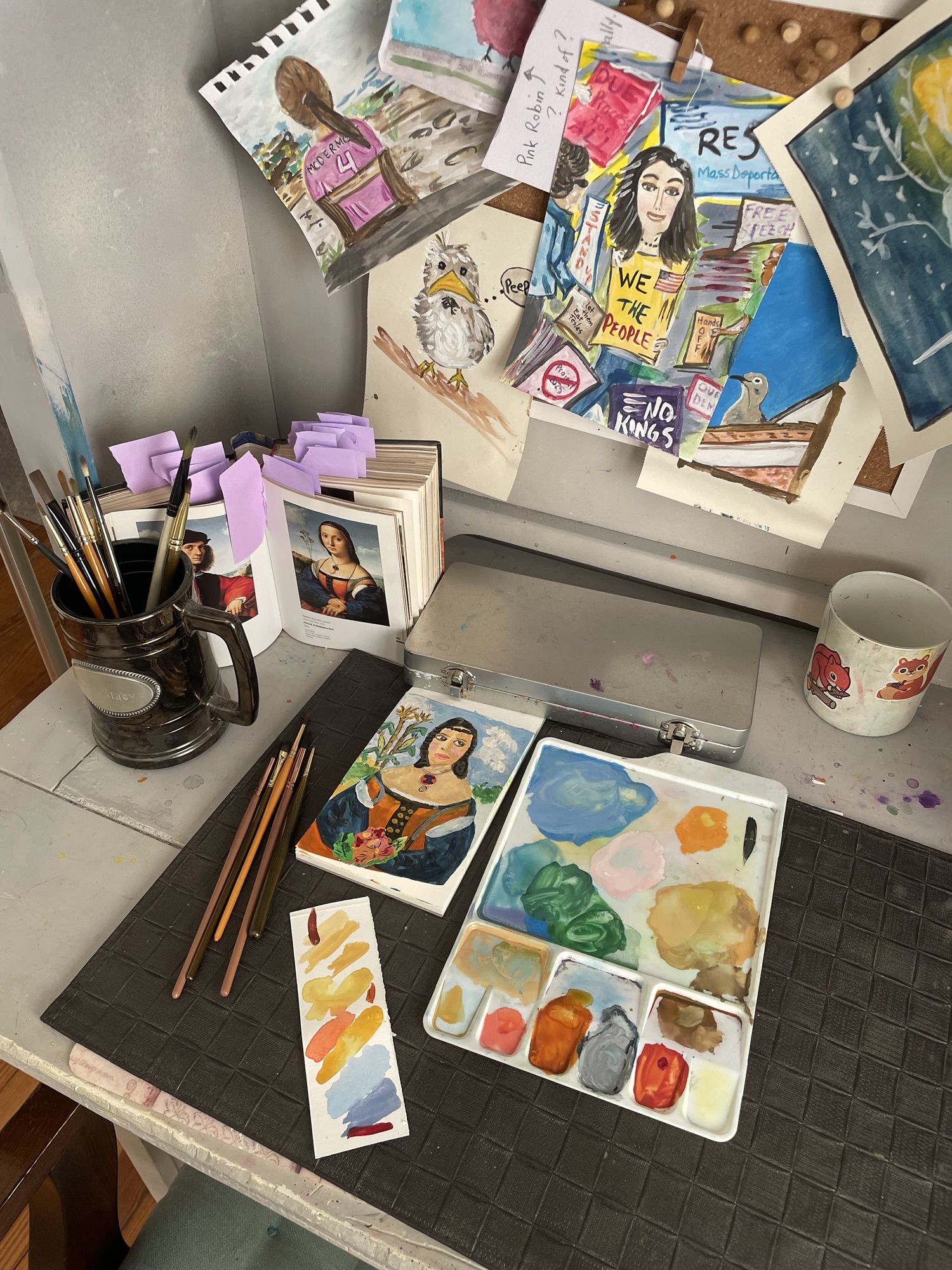
To this end of honing skills, I recently began a lighthearted but practical short project. In a 4″x6″ sketchpad of fifteen watercolor pages, I am copying fifteen paintings by master artists. From The Little Big Book of Art, a favorite publication that I have enjoyed for years, I selected fifteen paintings to copy; or, perhaps, reference would be a better word for such an unskilled, untrained artist such as my humble self. The idea is to paint what I see, practice mixing colors to match the paintings as they appear in my little book, and to gain confidence with the paint and the brushes. The small size of the paper was intentional, the purpose to complete each painting within an hour or so, no plan to rework or retouch. No pressure to succeed. No striving to get my representations even close to my idea of perfect. No fear of miserable failure.
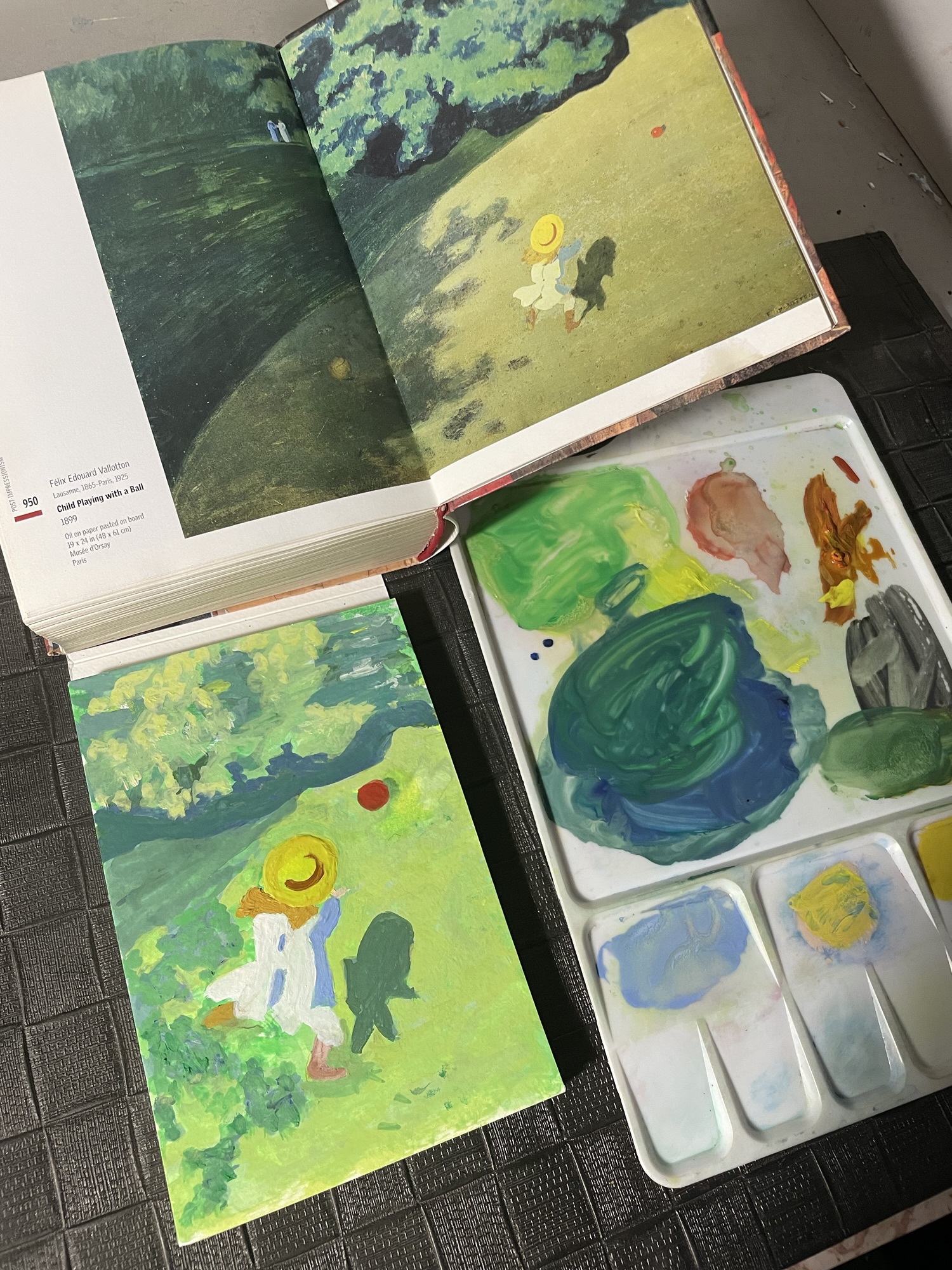
So far so good on all counts. I have tackled three thus far, and it has been a blast. I am using a set of jelly gouache watercolor paints with which I had failed to bond. It was a material choice that reduced expectations and put me even more at ease with the audacious idea that I could paint copies of great paintings. I am using paints I was wasting, a $1.99 sketchbook, and devoting minimal time to the project, and so nothing to lose and only learning (and humility) to gain.

Child Playing with a Ball (1899) by Félix Edouard Vallotton (1865-1925) was first. I started with this one because it seemed the easiest of my selections to approximate. With its dreamy park landscape and impressionist figure I deemed it a realistic goal. No faces or fingers to fiddle with, no detailed objects more complex than that simple red ball. It was not more difficult than I thought it would be, because I knew that every painting I selected would be a lofty challenge. Yet it surprised me in unexpected ways and proved a perfect first attempt. It taught me that it can be better for me to paint without a sketch. My grossly imperfect sketches often box me into an intention that is ill-conceived in the first place, and they sometimes limit the expression that pools upon the paper. I will still do my cartoon-like and illustrative paintings by drawing them first, but now I will attempt more free-flowing work with ease and confidence. My pointy elbowed intentions with jagged pencil lines is not the only way for me to express my creative spirit.
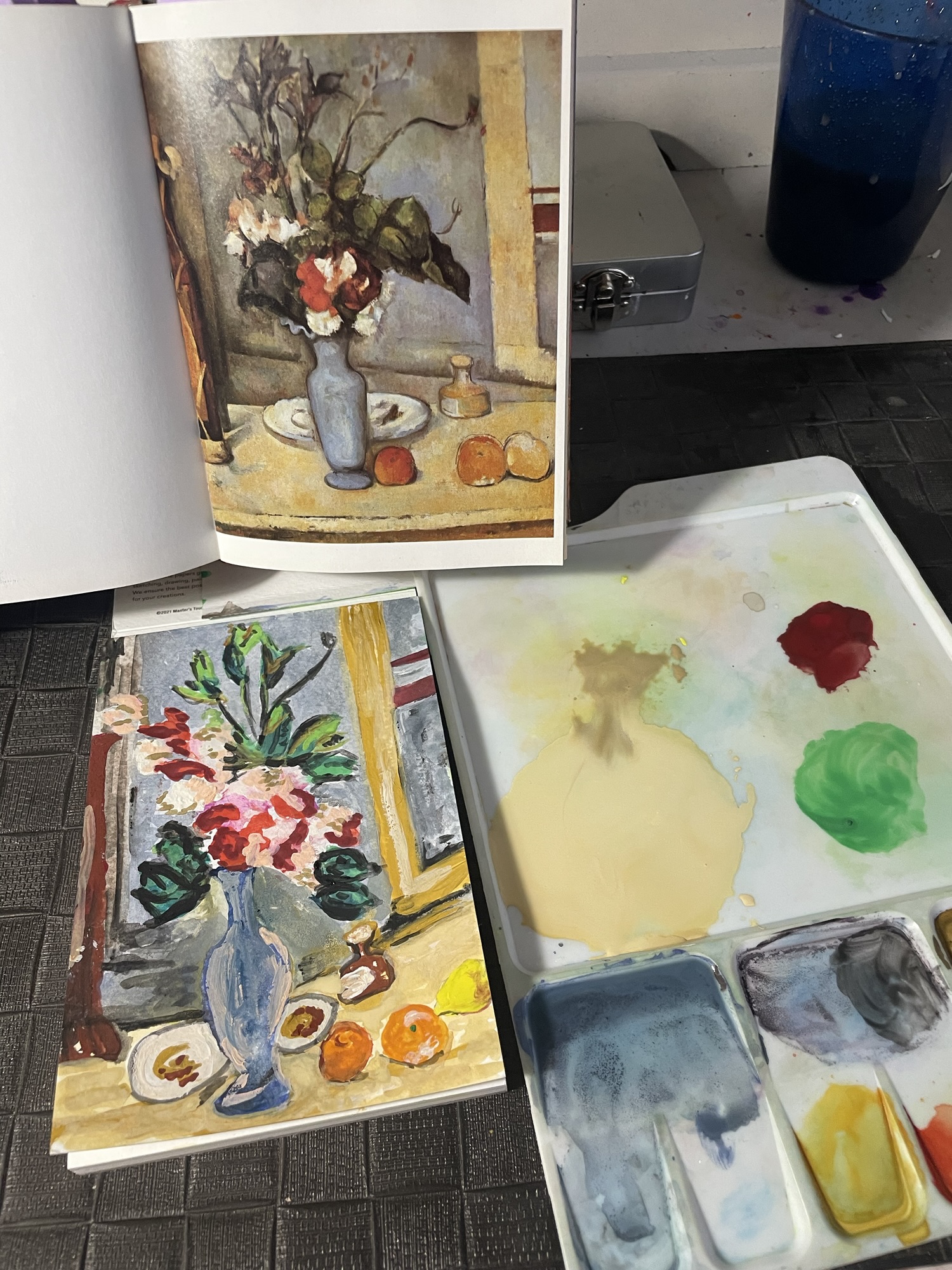
The Blue Vase (1889-90) by Paul Cézanne (1839-1906) was my second painting, and such a delightful hour spent. Objects are so much easier for me than people. My colors don’t match, my perspective is askew, my flowers are a different species entirely, and the arrangement possesses its own ratio of blooms and leaves. Yet I did, indeed, paint a blue vase on a table, without penciling it in first. The bottle is a bottle and the fruits are fruits. I struggled to create different values of grays. I learned that mixing reds is a wonder and will never again rely solely on the red in my pan set of watercolors. I also discovered that while still life is still not my inclination, I am going to give it a good chance and experiment with painting still life with my unique sense of humor and perspective.

My third attempt was the Portrait of Maddelena Doni (1505) by Raphael (1483-1520), and the best thing I can say about this painting is that I laughed all the way through it. I struggled with Maddelena’s nose and her dress and the wispy tree in the background. Her stupid headband was an unexpected trial. I tried and failed three times to paint her hands using mixed shades of pink and tan and brown; then I cheated and tried to draw in her hands with pencil and paint over them, which failed even more miserably than the first two attempts with just paint. Finally, I threw up my hands and collaged a bouquet made of my own painted collage paper and happily placed it over her disastrous blob hands. I also painted a bulky cornstalk in the place of that damned delicate tree. And then I giggled as I embraced with cheek and aplomb the subject’s orange and blue dress and made her an alum of my own alma mater.
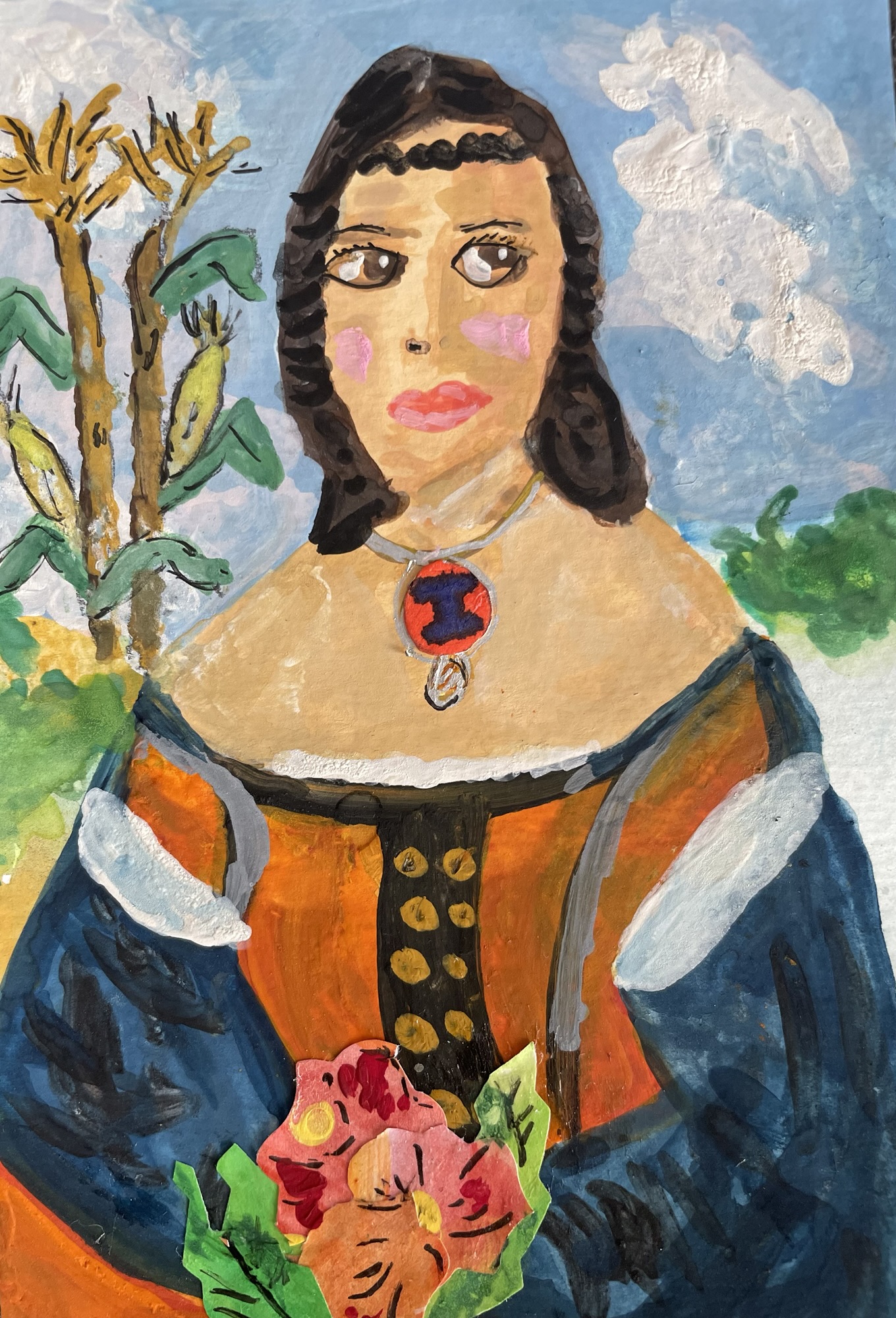
I may have been trying to paint a copy of a Raphael, but what I produced was my own little piece of terrible, wonderful art.

I am in love with this ridiculous project and delighted with the practice and the learning. It is absurd and audacious, perhaps, but it is a liberation. Art is, after all, just an expression of a thing through the eyes of one person. Even if it starts out a “copy” it becomes, in the end, a unique expression of the artist who sat down to make it with her own two hands. The first three paintings showed me that I should with the remaining twelve paintings represent them rather than copy them and generously paint them in my own voice. I still intend to mix colors with the intention to match, represent in some way the subject or the scene of each painting to the best of my limited ability, and keep to my rule of no pencil sketching. However, I have license change it up, skip or even give up on parts (like hands), and add a bit of whimsy (like collage) if inspiration blooms.

Side-by-side with the paintings of the masters, my paintings are nothing to write home about. Then why in the hell are you writing about them, you ask? I answer by saying that my painting of Maddelena Doni (2026) is all Stacy Lynn. It has the expressive large eyes I always paint, a characteristic nose-ish, and my sense of humor. It is art. It is my art. Because as I said before and repeat here with emphasis, art is anything that makes a single person feel something, even if that single person is the artist herself.

And this artist is feeling free and inspired.
Headlines from the Birdfeeder

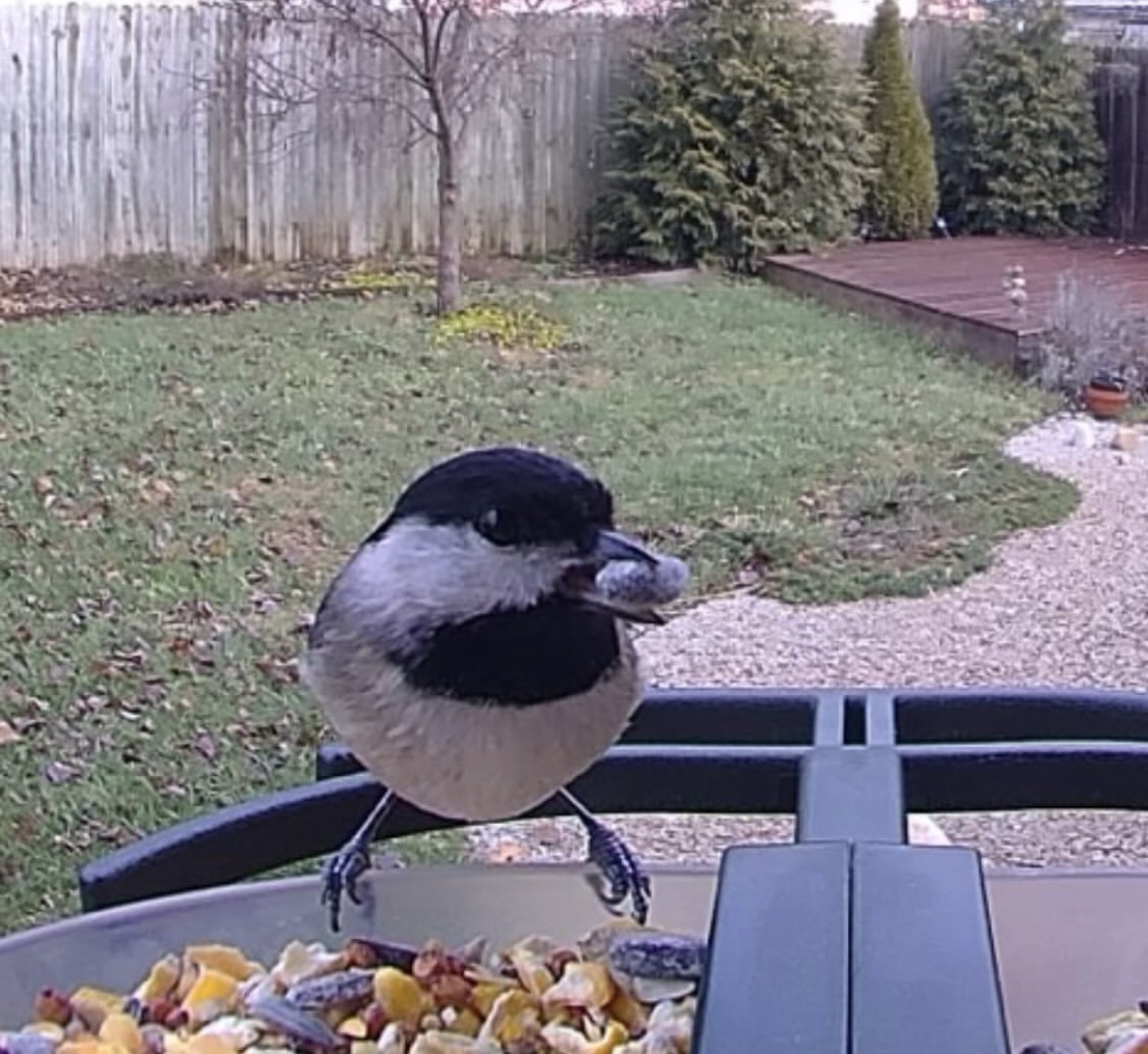
My daughter Savannah bought me a birdfeeder camera a couple of Christmases ago, and I am not yet tired of it. Every single day of my life, the pictures it captures fill me up with joy. They make me laugh and make be wonder. They tug at my heartstrings, delight me, and spark my creativity.

When the birds land on one of the perches in front of the seed bin, the camera makes a little click that gets their attention, and for a split second they often gaze right into the lens as if posing. The camera captures gorgeous, jaw-dropping, hilarious portraits. It documents movement and life in my yoga garden. And the pictures remind me that most days I don’t have to venture beyond my little corner of the earth to feel at one with the universe.

I anthropomorphize everything. Dogs, squirrels, plants, my car (I love you, Mary Arizona, especially now that you are paid off and all mine!). Everything has feelings to me, even the blue plate I broke last week in the sink. My empathy knows no bounds, and I have made my peace with this odd fact about myself. I used to suppress this tendency and only talk to squirrels, for example, when I was alone. Our society makes you feel weird for caring about the feelings of animals (especially when people around you are eating them). They make fun of you for cooing to the flowers in the bouquet you bought at Aldi and naming and talking to your car, although I know lots of people who have named their cars and talk to them when the roads are slick or the heater is slow to get warm.

But I will apologize no more. Just last night I felt sad for the calf in a food picture my sister sent me (why she keeps sending her vegetarian sister pictures of the animals she is eating is a topic for another blog!). I no longer care what people think of me for feeling the wilt of the tulips in my yard, for worrying about a sparrow being picked on, or for crying over a dead red fox squirrel in the road.

My warm embrace of the emotional connection to all living things, past and present, has come to live in my newfound joy of artmaking. It is alive in the writing of my recent book Loving Lincoln. It was validated by the intensive yoga training I just completed. And it is manifested each day in my reactions to the life captured on the birdfeeder camera, which, I admit, has taken my anthropomorphizing of birds to a whole new level.

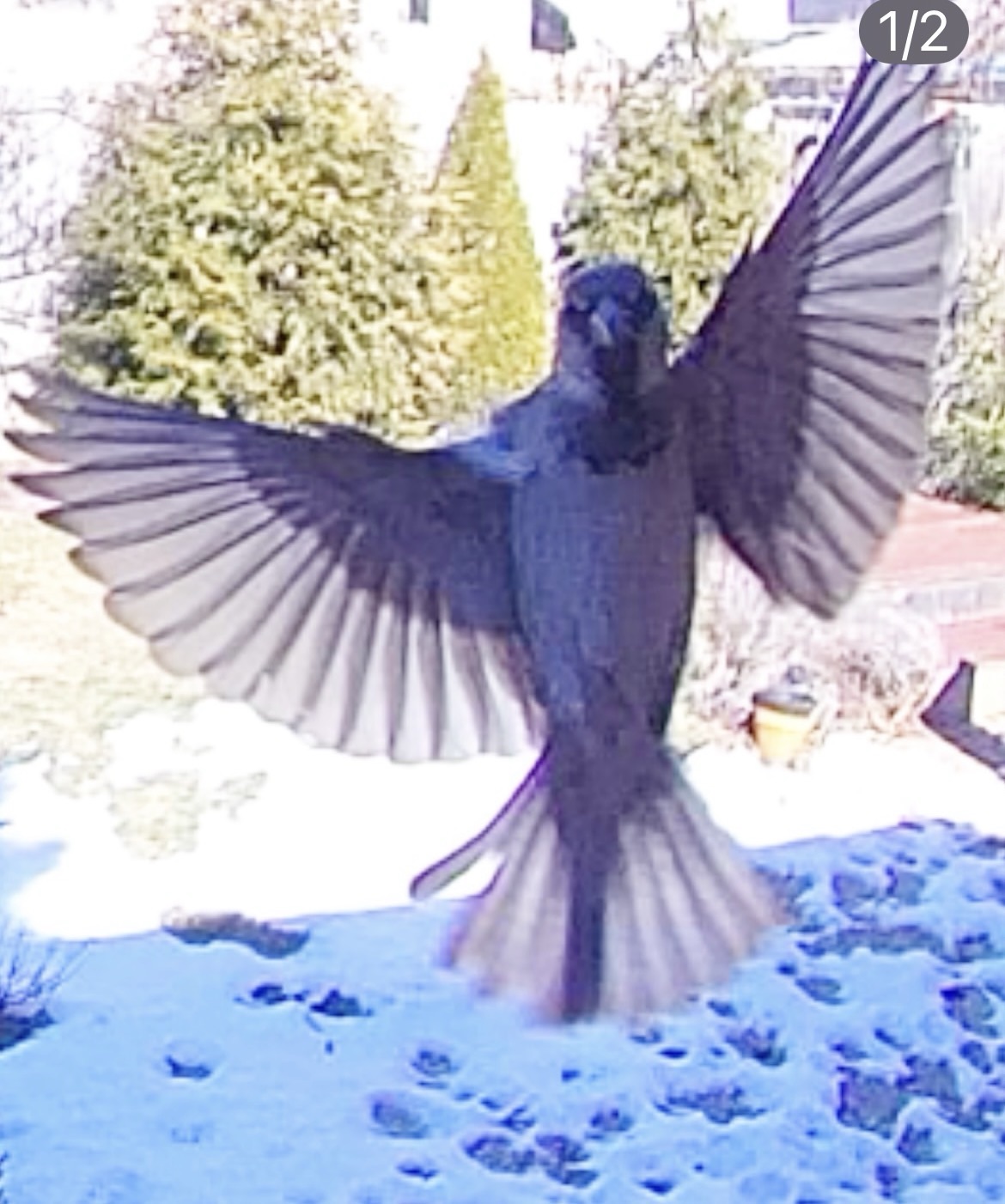
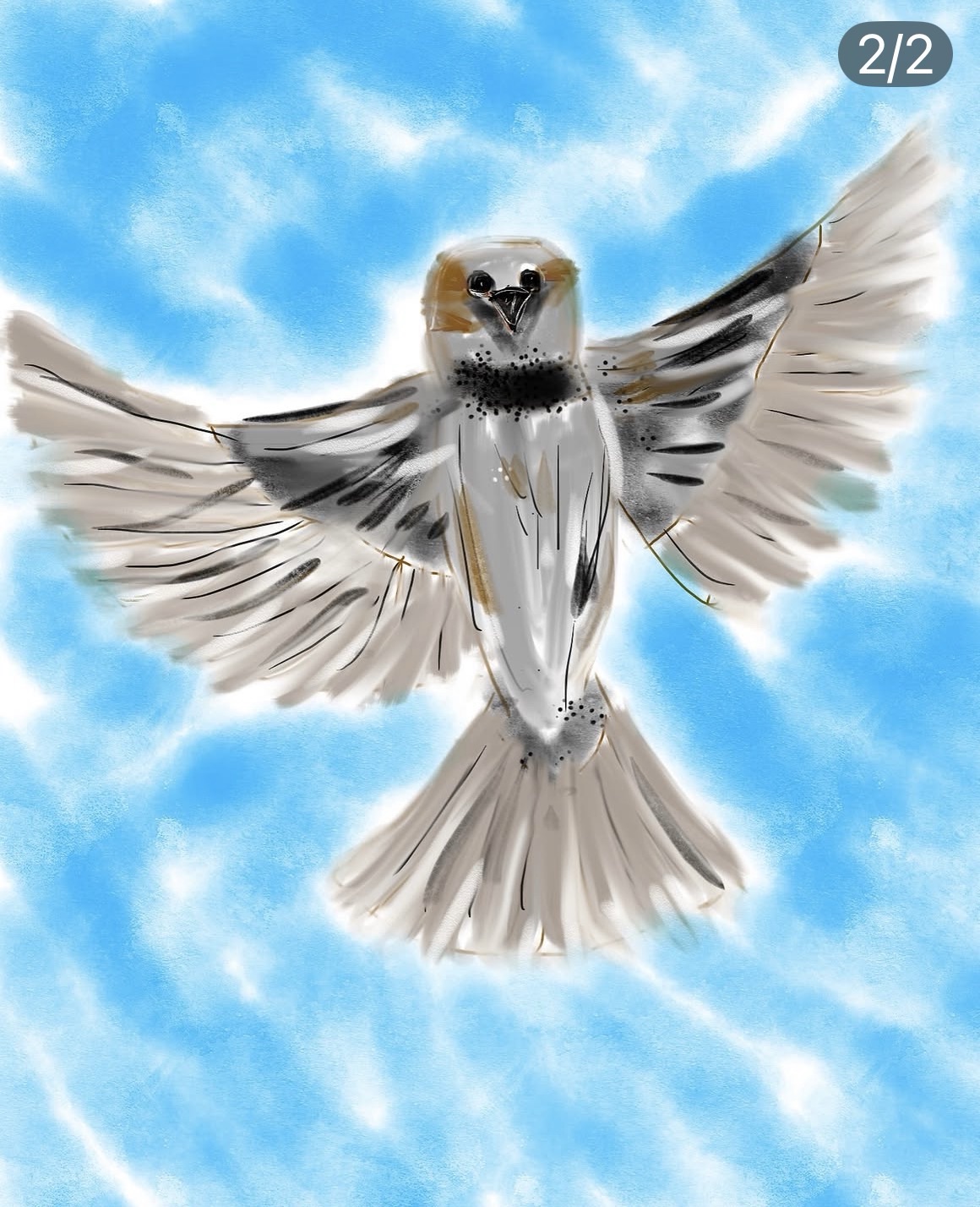
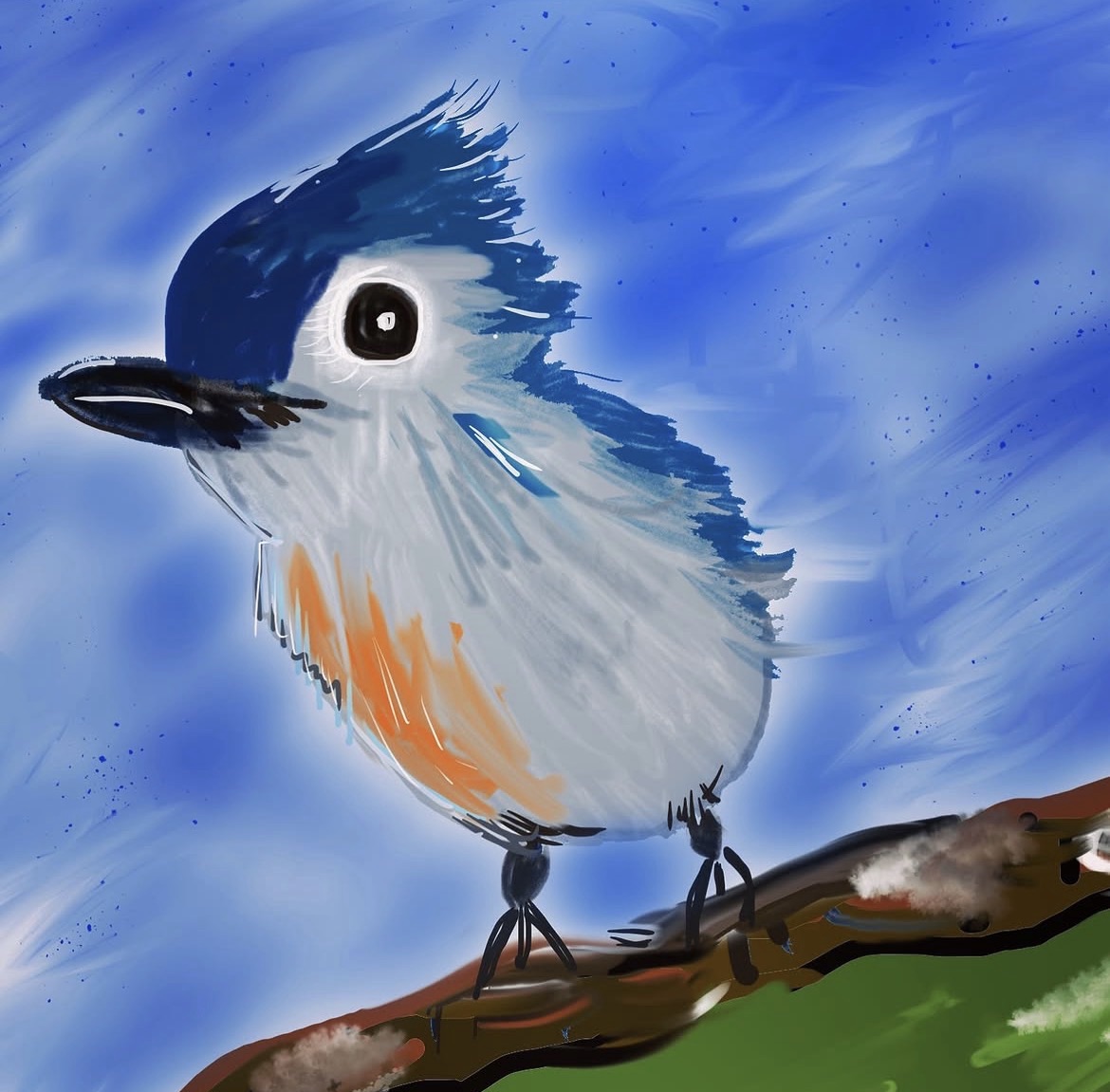
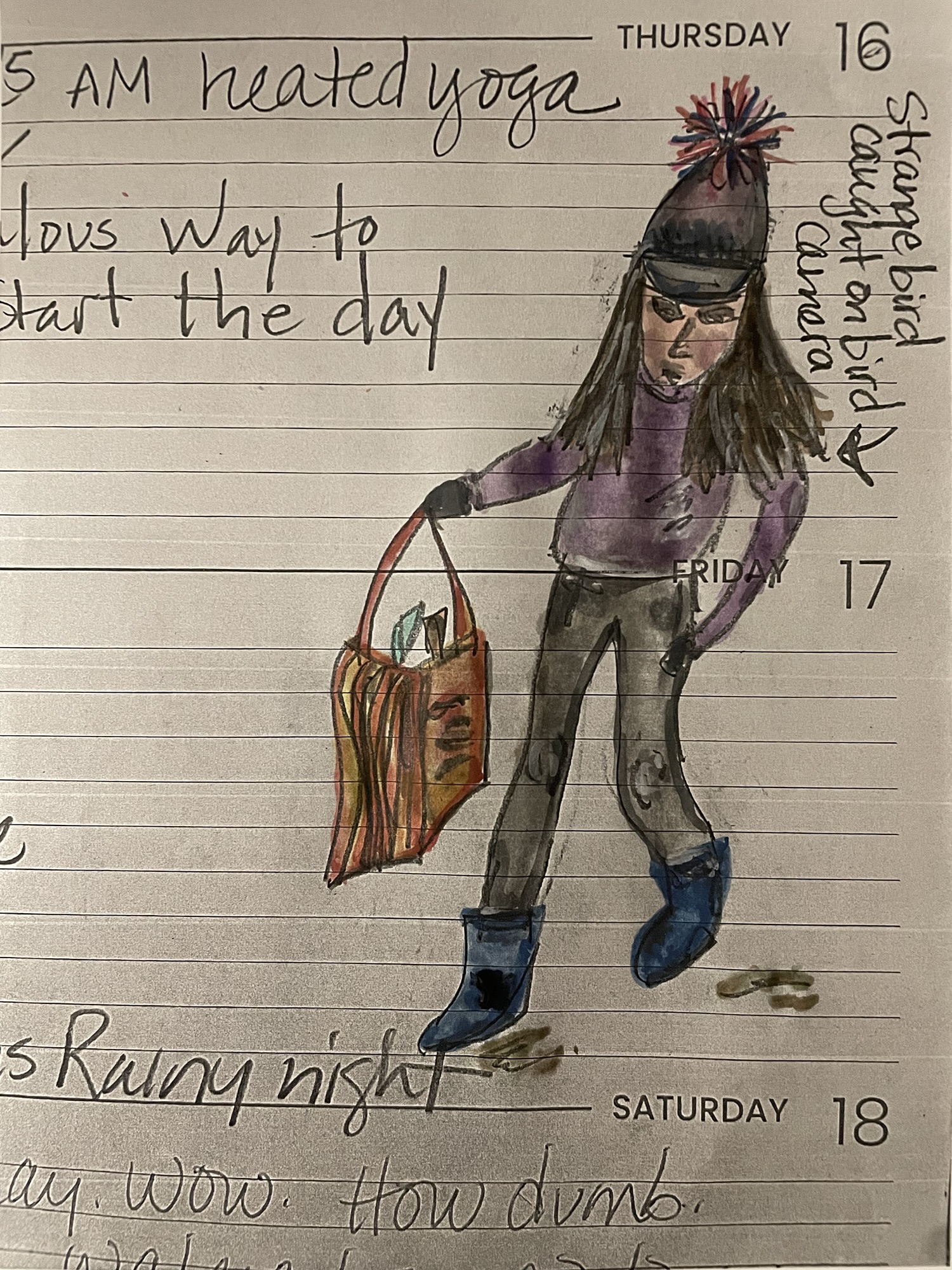
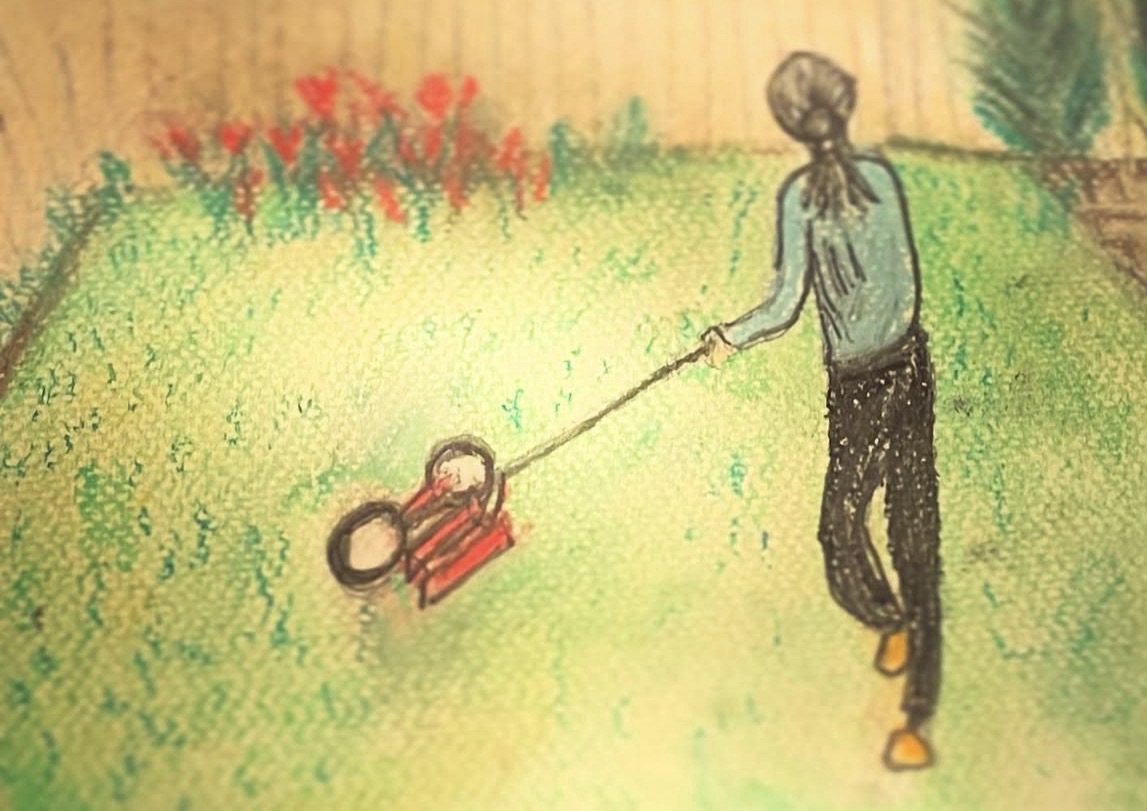
The camera has inspired art.

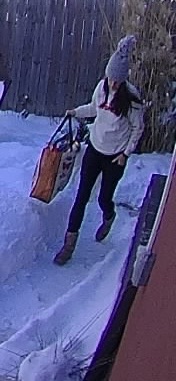
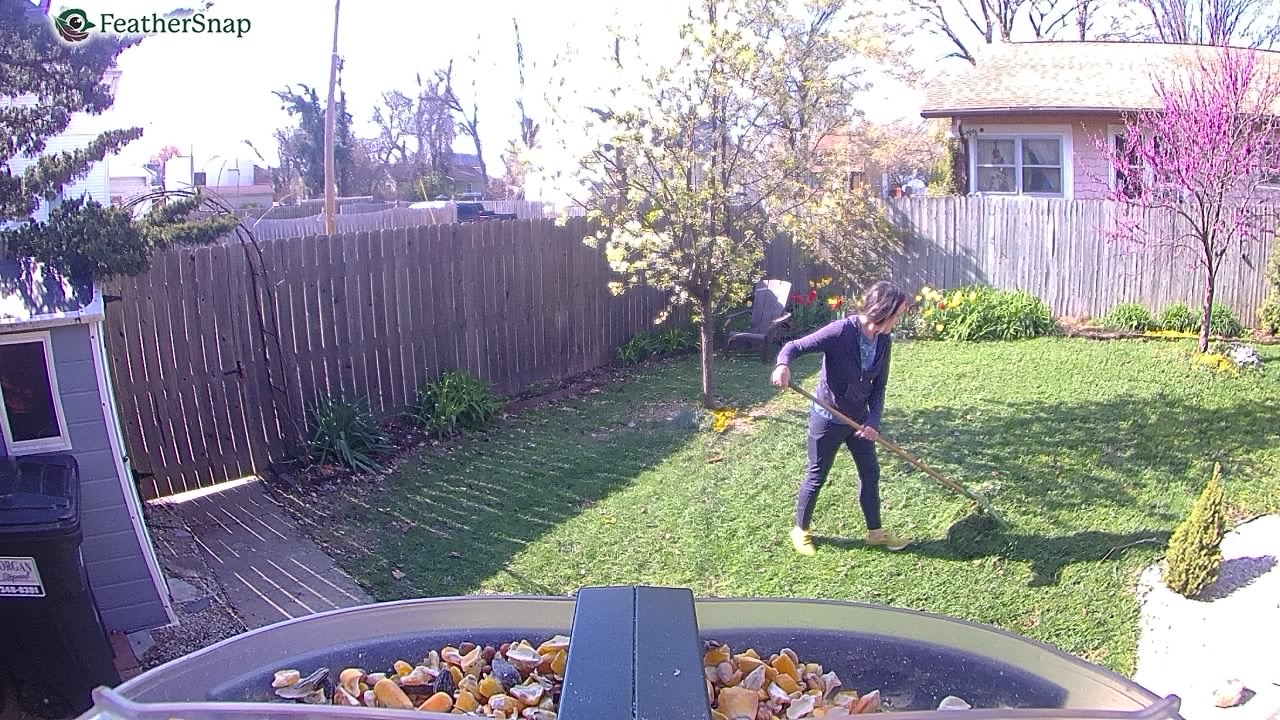
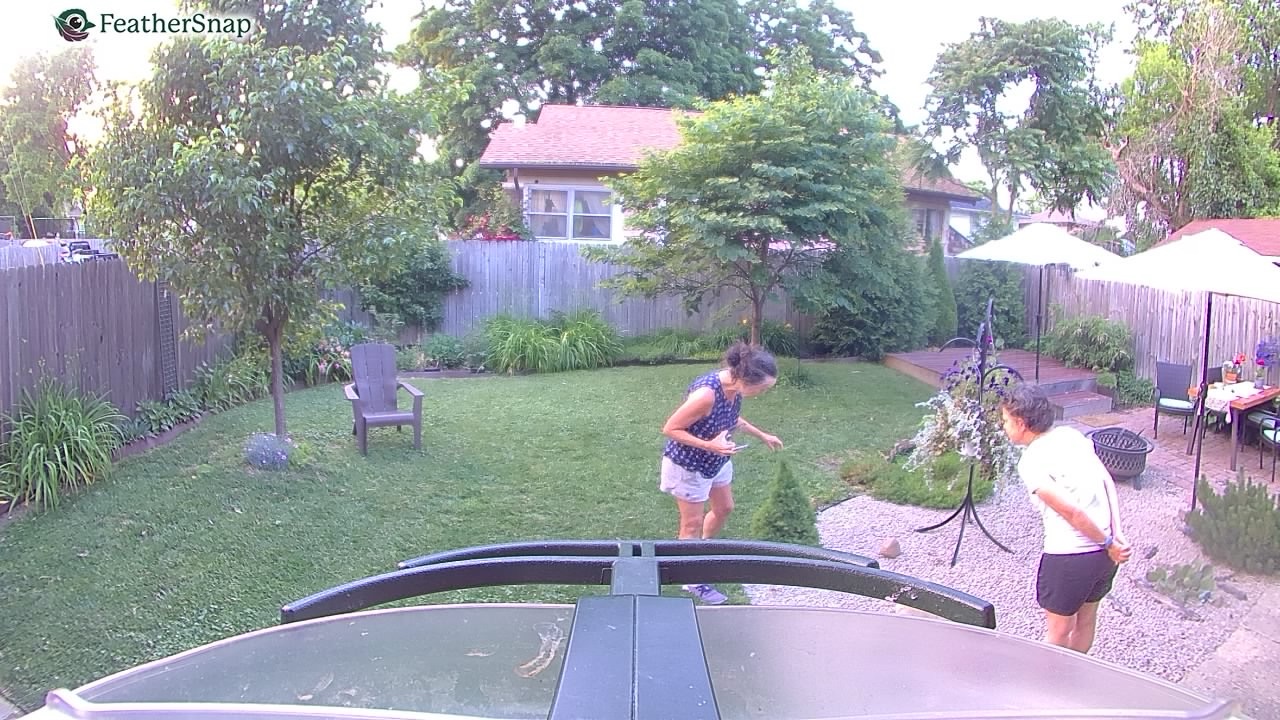
The camera captures me out in the yard, which is always good for a laugh or a piece of art.

The camera also inspires stories. The photographs captured by the birdfeeder camera are often scenes from real-life human (I mean bird) drama. The birds land and fly away, jockey for position, tweet and squawk at each other, box out, rebound, defend, and dine peacefully. All walks of life. All colors and colorful personalities. I feel like the birds want me to write their stories, although not all of them would agree, I suppose, with my interpretation of the facts.

Here are a few headlines from the last few months…

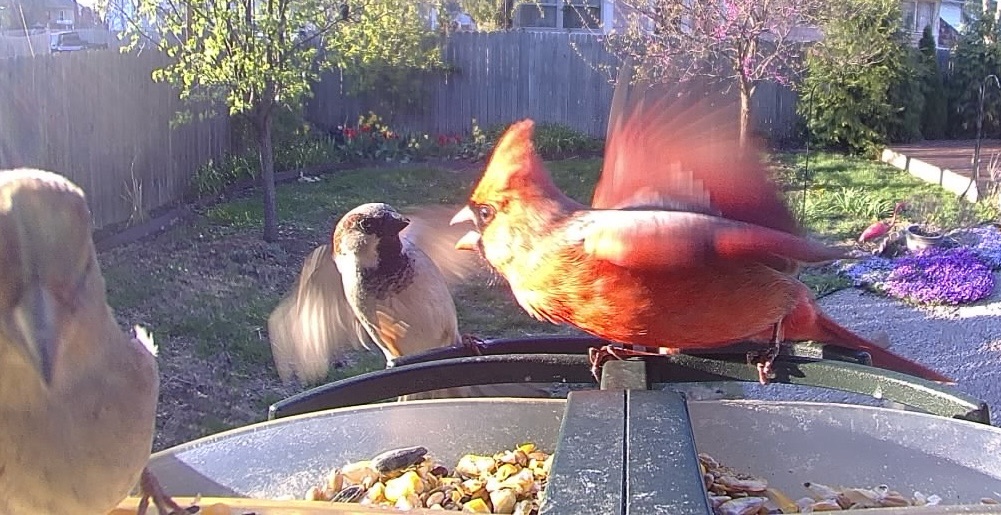
Obnoxious Cub Fan Gets Served

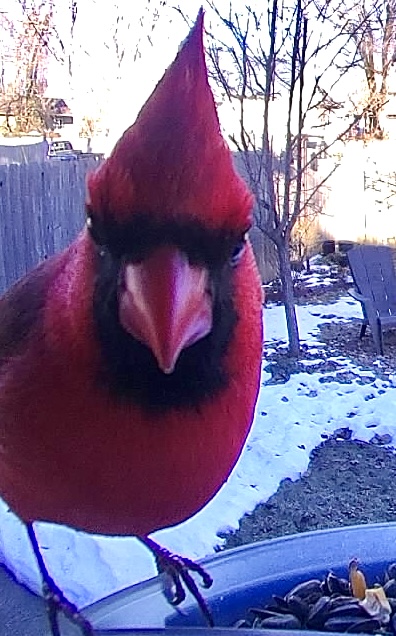
Jack Sparrow, the neighborhood baseball bully picked the wrong Cardinal to trash talk this evening. He’s had run-ins before, but the dinner seeds got a little bit jammed down his throat this time. Talk about just desserts, they’ll be talking about this take-down in the backyard eastern redbud for months. No comment or defense from Jackie Sparrow, who witnessed the altercation. Just look at her, looking on, pretending not to know him—everyone in the trees knows she can’t take that husband of hers anywhere. 

Move Over, Blue-footed Booby

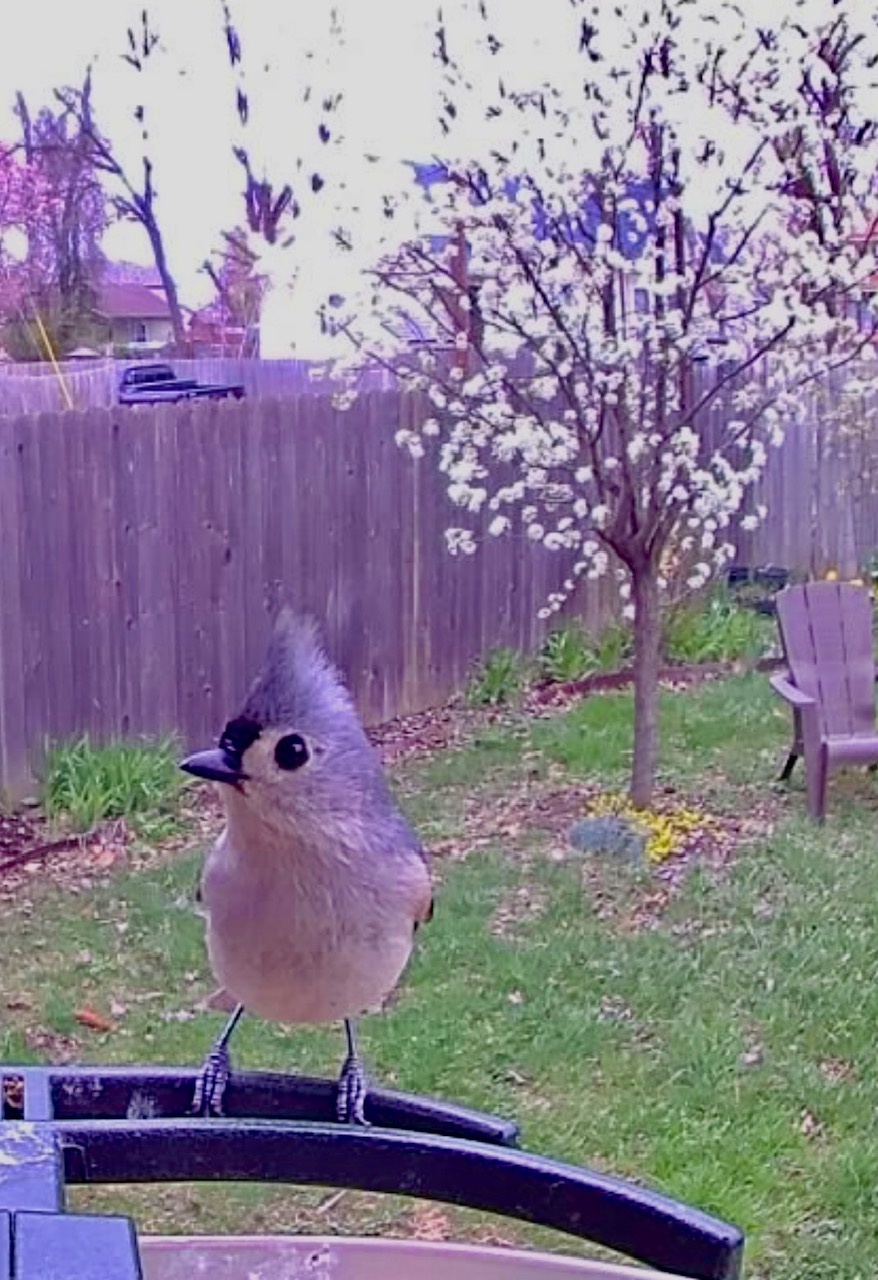
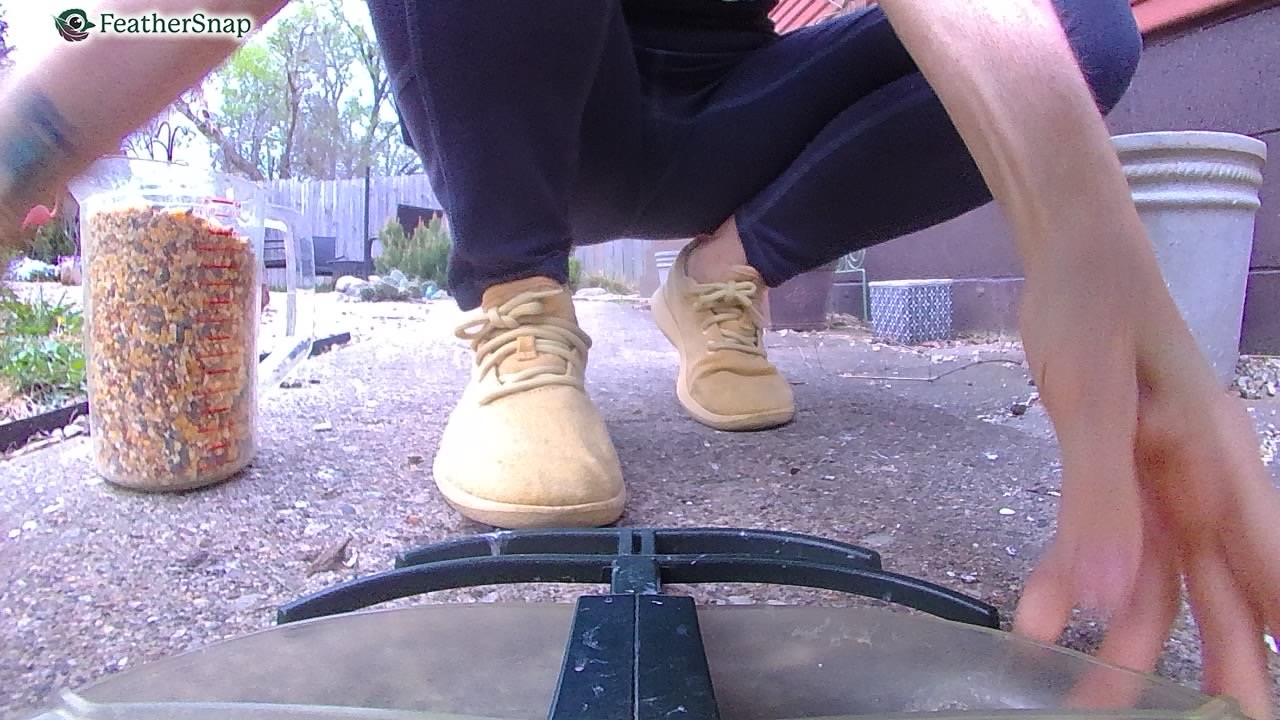
There is a new Yellow-footed Old Bird in town who is the talk of Monroe Ave. gossip. Five pairs of morning doves have been hanging around lately just hoping for her to make an appearance with that strange and wonderful big jug she keeps in her crop. There are also reports of house finches, titmice, wrens, cardinals, and the odd blue jay stopping by regularly in hopes of getting a peek and a taste, truth be told. There is a crow who watches from high in the oak tree two houses down, cawing loudly to alert the bird world to the arrival of the Yellow-footed Old Bird. And a red-bellied woodpecker dining on suet was overhead telling the downy woodpecker on a nearby branch: “The blue-footed booby is no longer my favorite other bird!

Near Miss at Stace-Place International

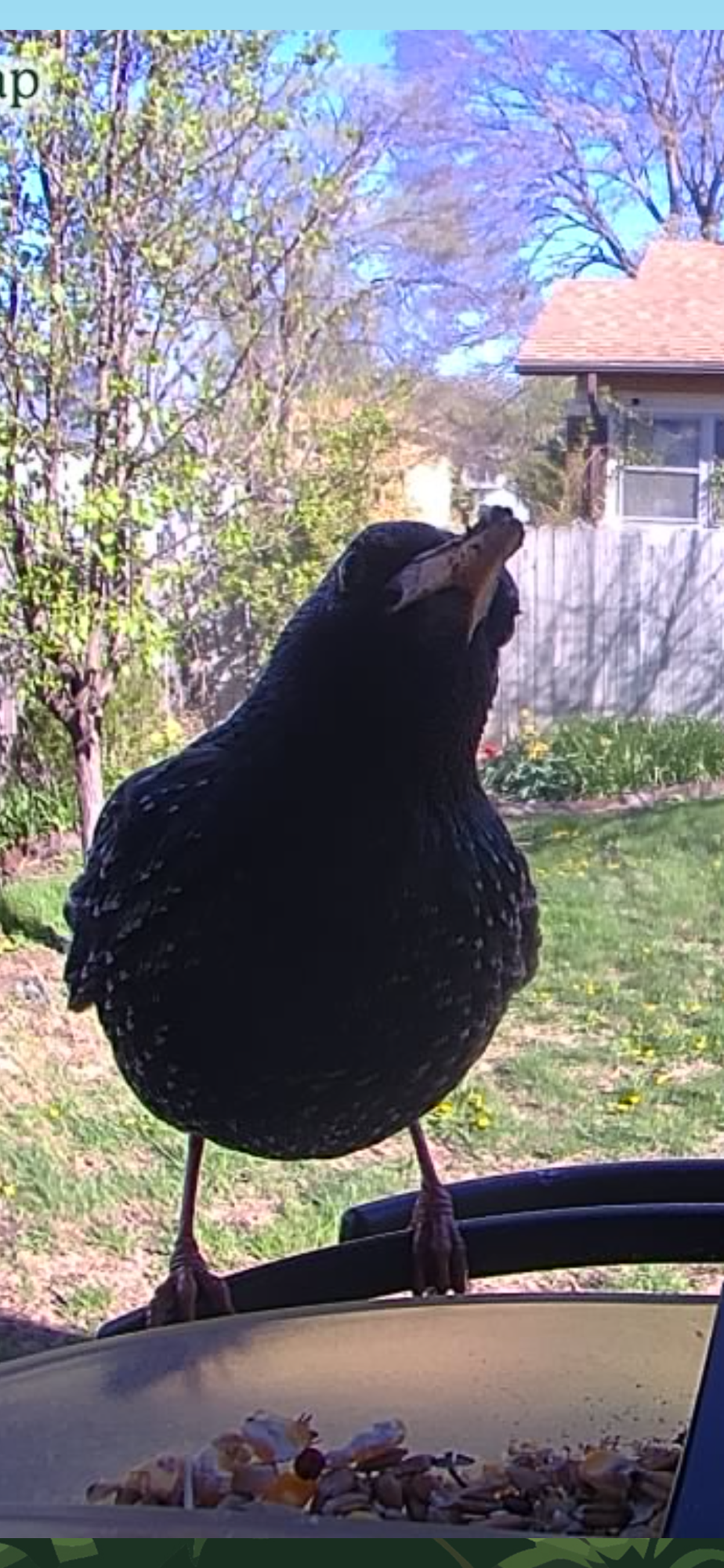
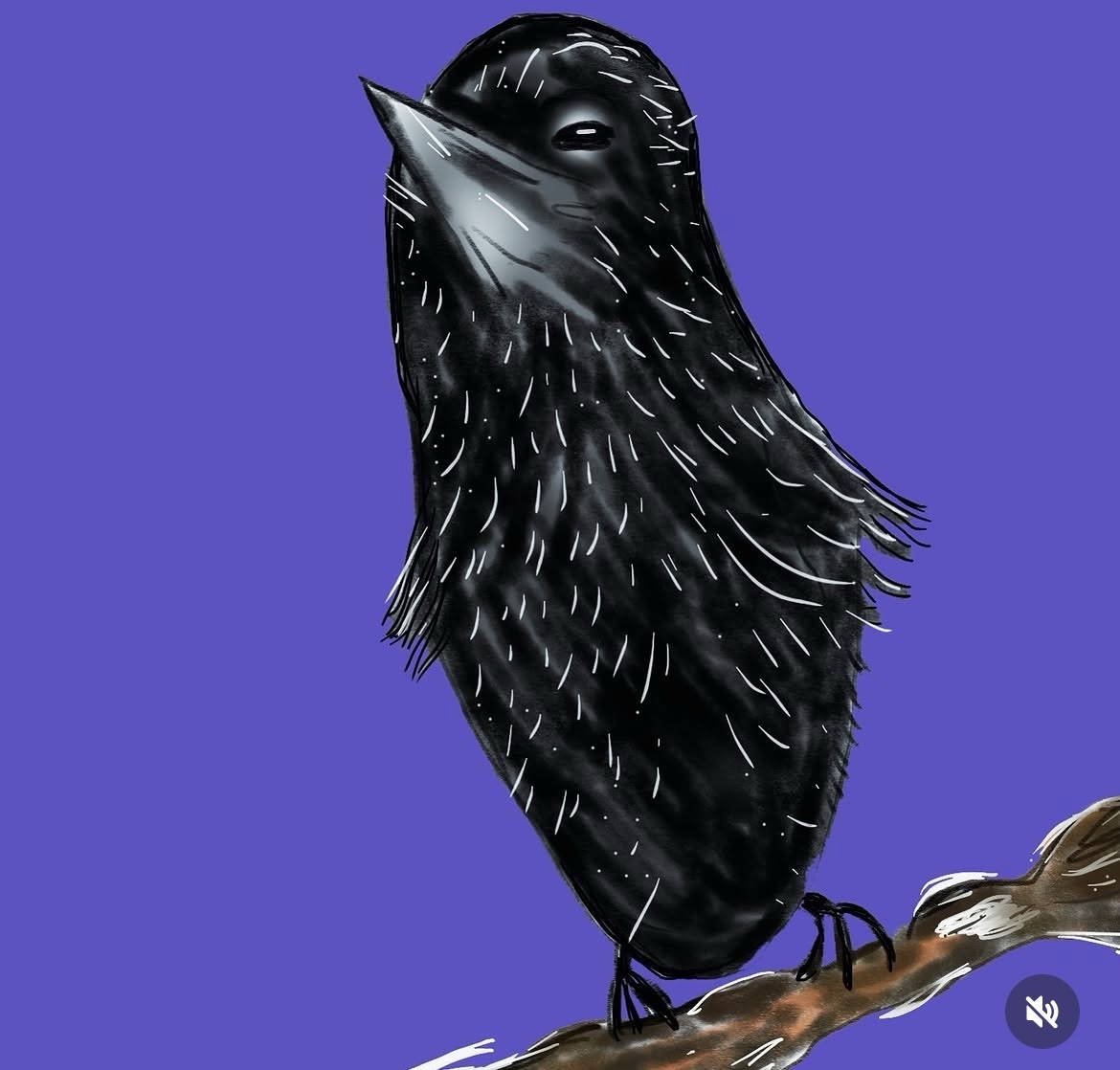
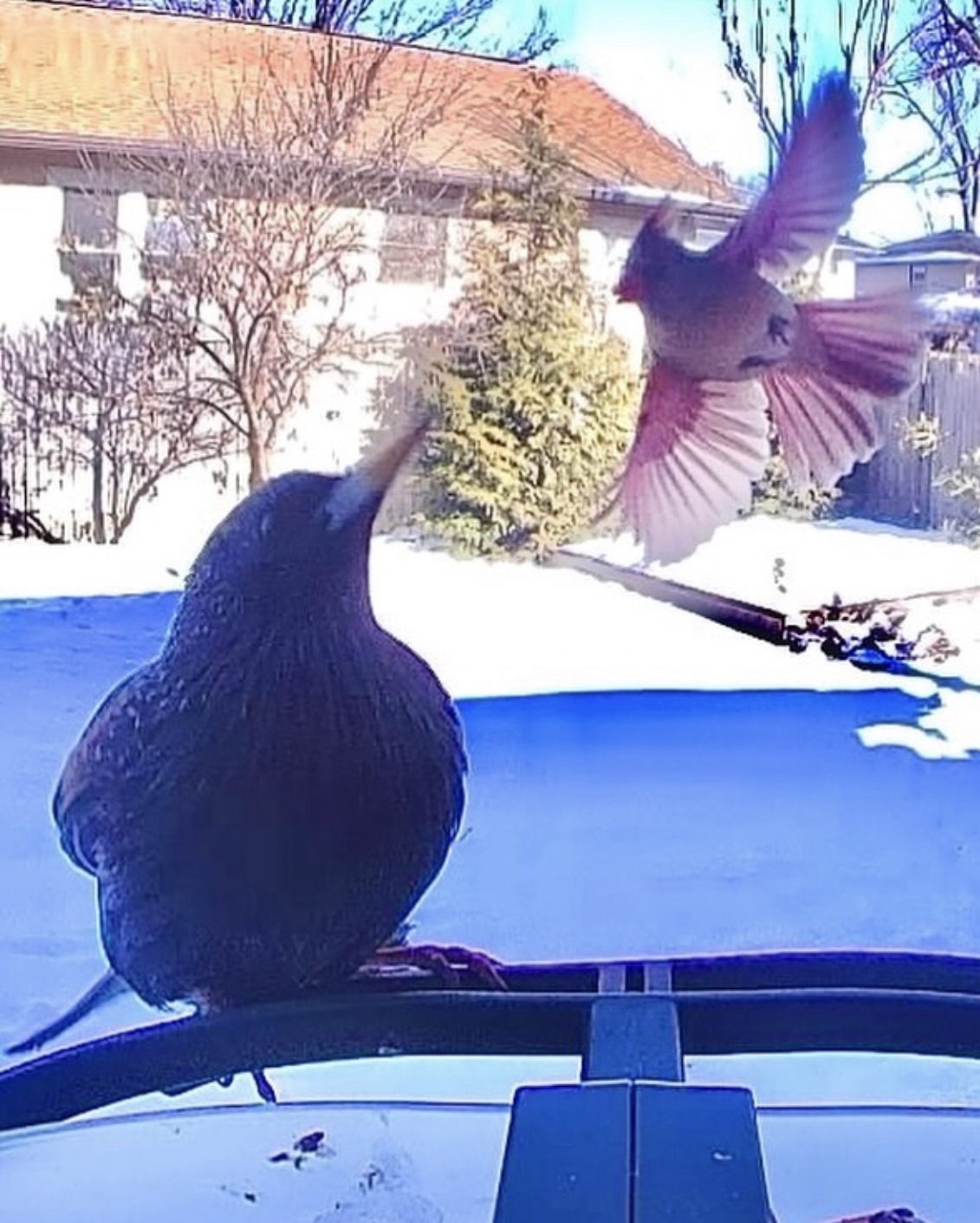
A Northern American Cardinal had to make an emergency landing today at Stace-Place International. He was coming in from the rotting sumac tree, flying low across the fence, when he noticed an obstructed perch. “It was like a big black blob there,” said Cardinal, “All I could see was black and sparkling flecks like stars!” The European Starling who had been hogging up the perch told authorities he was not, in fact, trying to create an international incident. He was just trying to eat a couple of seeds in peace. The Cardinal landed safely on a Cedar branch resting on a garden shed. No one was hurt in the incident, and no tickets were issued.

Domestic Disturbance at Stace-Place

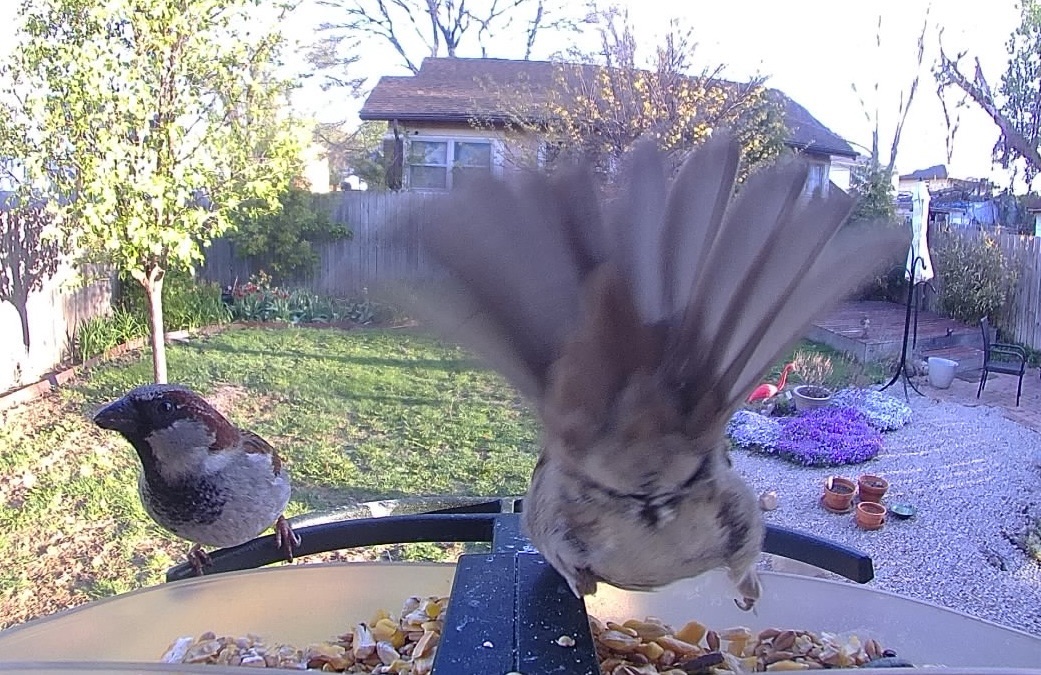
“Jesus, Phyllis, I’m trying to eat here,” screamed Mr. House this morning, as the sparrows gathered for third breakfast (or was it pre-lunch?). Witnesses told a reporter quick on the scene that Mrs. House did seem a little randy. “It is spring, you know,” said the chickadee, “We’re all feeling it right now.” The pair of mourning doves on the ground below the feeder were not interested in sparrow TMI, though, and flew off to a nearby fence to cuddle and coo in private. Once the authorities arrived, Mr. and Mrs. House were peacefully eating with the other sparrows, and no one was willing to take time from the meal to offer any more details of the kerfuffle.

Lady Cardinal Finally Wins

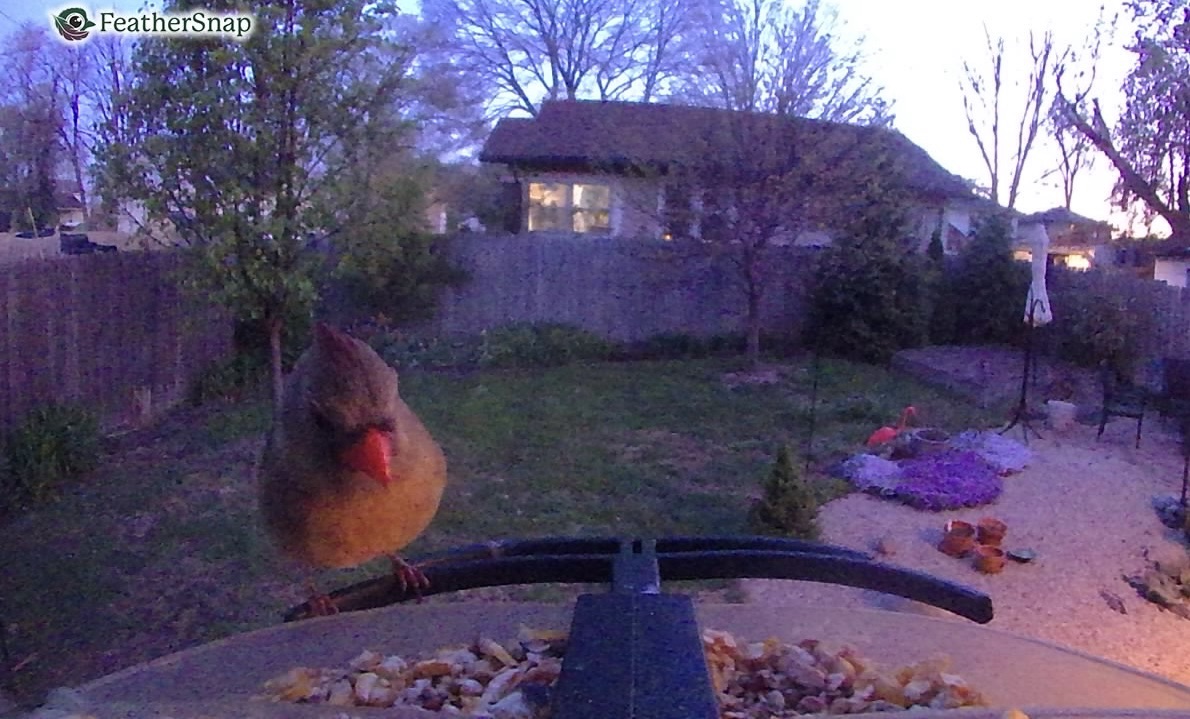
Yesterday morning all the neighborhood was abuzz with the news that Mrs. Cardinal had finally beaten Mr. Cardinal to breakfast. 6:00 a.m. on the dot, was her winning time. “It was still kinda dark!” chimed the titmouse, who was up early to catch a flight to a birdfeeder down the block. Mrs. Cardinal was so pleased with her accomplishment, she could barely eat, she said. But she did eat, oh, yes, she did, and and later reported: “Best seed I ever had, and I will see you here first tomorrow and the next day and the next day after that!” The crow in the oak tree just squawked. “Fat chance, orange beak.” Sadly, the crow was right, and Mrs. Crow had to eat crow the next morning. Mr. Cardinal arrived at 5:59 a.m. to take back the win. Mrs. Cardinal later admitted to friends, however, that she was really much happier sleeping in and waiting for the morning rush. “Eating alone in the dark is no fun at all!”

Hello, you!

Young Sparrow Monopolizes the Photo Booth

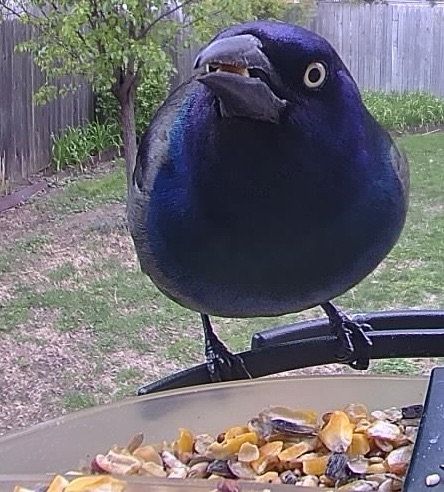
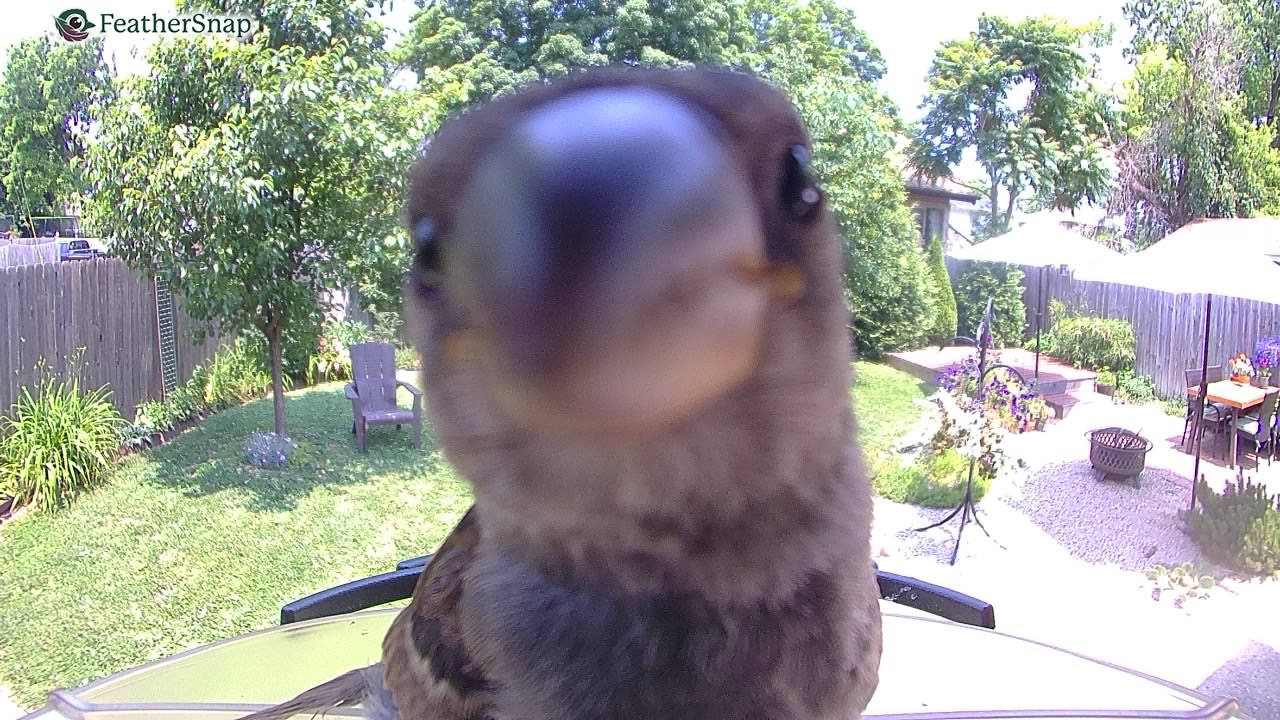
Yesterday afternoon, a young house sparrow parked herself in front of the camera in the Stace-Place photo booth and refused to leave. She just kept sitting there, setting off the sensor, smiling and cheesing and leaning in too close. The grackle offered to move her, but all the women (a wren, a cardinal, and four house sparrows) said to leave her alone. “She deserves a little time to feel good about herself,” chirped the lady starling, “We’re all feeling the stress this spring.” The lady finch added: “Yeah, with global warming and crazy orange politics and schizophrenic Illinois weather and that insane young cooper’s hawk trying to take us all out, we women could all use a little “me” time.

Past Lives: Lincoln Scholar

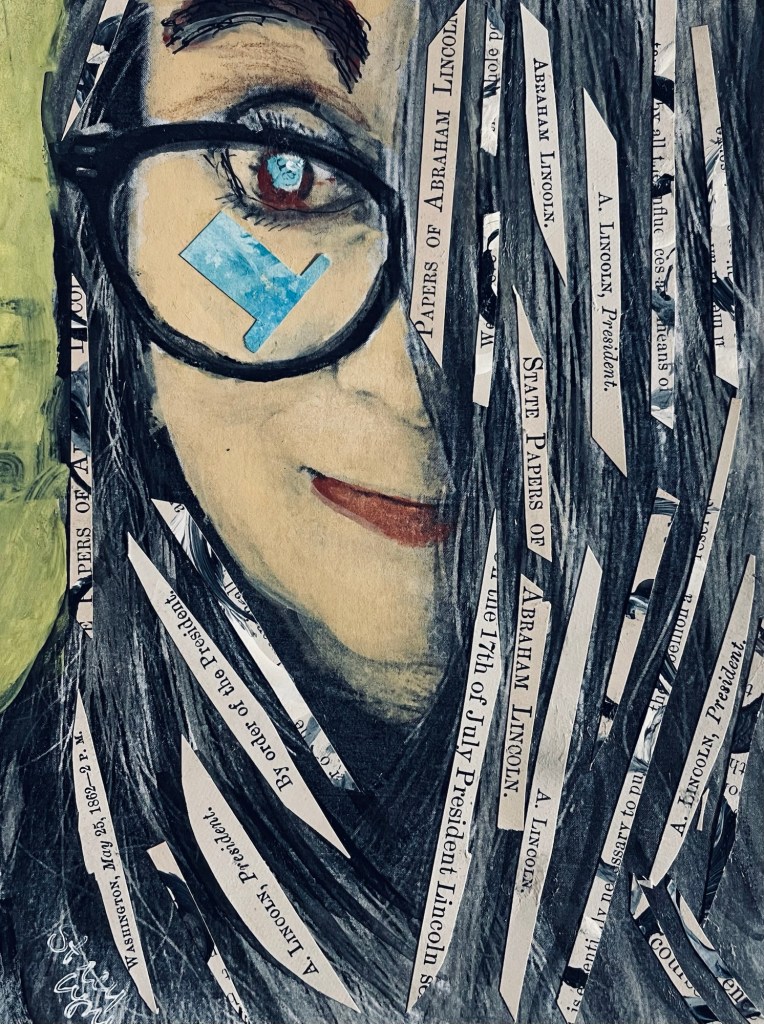
Studying yoga is teaching me to let go, to stop clinging to the past, to acknowledge but also to release old versions of myself. This mixed-media self-portrait is the first of a series I am calling Past Lives, representing identities that served me and shaped me, but no longer rule me nor define my inner peace. Through Svadhyaya (Sanskrit for self-study), I am doing the hard work of finding and speaking my personal truth.

I was a Lincoln scholar for thirty years, I edited his papers, wrote a biography of his wife, appeared in documentaries, served on boards, and delivered dozens of lectures and speeches. Studying Lincoln paid the bills, provided my growing family with health insurance, and allowed me to collect some of the best people. Studying Lincoln was a joy and a privilege.

Yet being a woman in Lincoln studies was not easy. I was unwelcome. My focus on the women in Lincoln’s life and my defense of his wife Mary Lincoln sometimes made me a pariah. There were painful experiences during my tenure as a Lincoln scholar and, in the end, when the Papers of Abraham Lincoln fell apart, it was devastating.

I have no regrets about any of it, because all of my experiences led to the publication of Loving Lincoln: A Personal History of the Women Who Shaped Lincoln’s Life and Legacy. Published in 2025 by SIU Press, it blurs the boundaries of biography and memoir, history and personal history. It was written straight out of my heart, the most creative project I ever accomplished and some of the best writing I’ve ever done. All of my experiences in Lincoln studies made the writing of such a creative work possible, and I am grateful for all of it. I am the woman and scholar I am today because of my imperfect professional relationship with Lincoln studies and my inspirational relationship with Abraham Lincoln, the second coolest American hero.

However, as I work to release my true self, live in the moment, and face a different future than I previously imagined, I need to let go. Now that I have published my book on Abraham Lincoln and given voice to my unique perspective of his life and his legacy, I am ready to move on, to turn my entire professional attention to Jane Addams, the coolest American hero.

More shedding to come, more identities to process and to release. More art and more writing, too. And, most importantly perhaps, more grace.

Balloon Hats Are Art

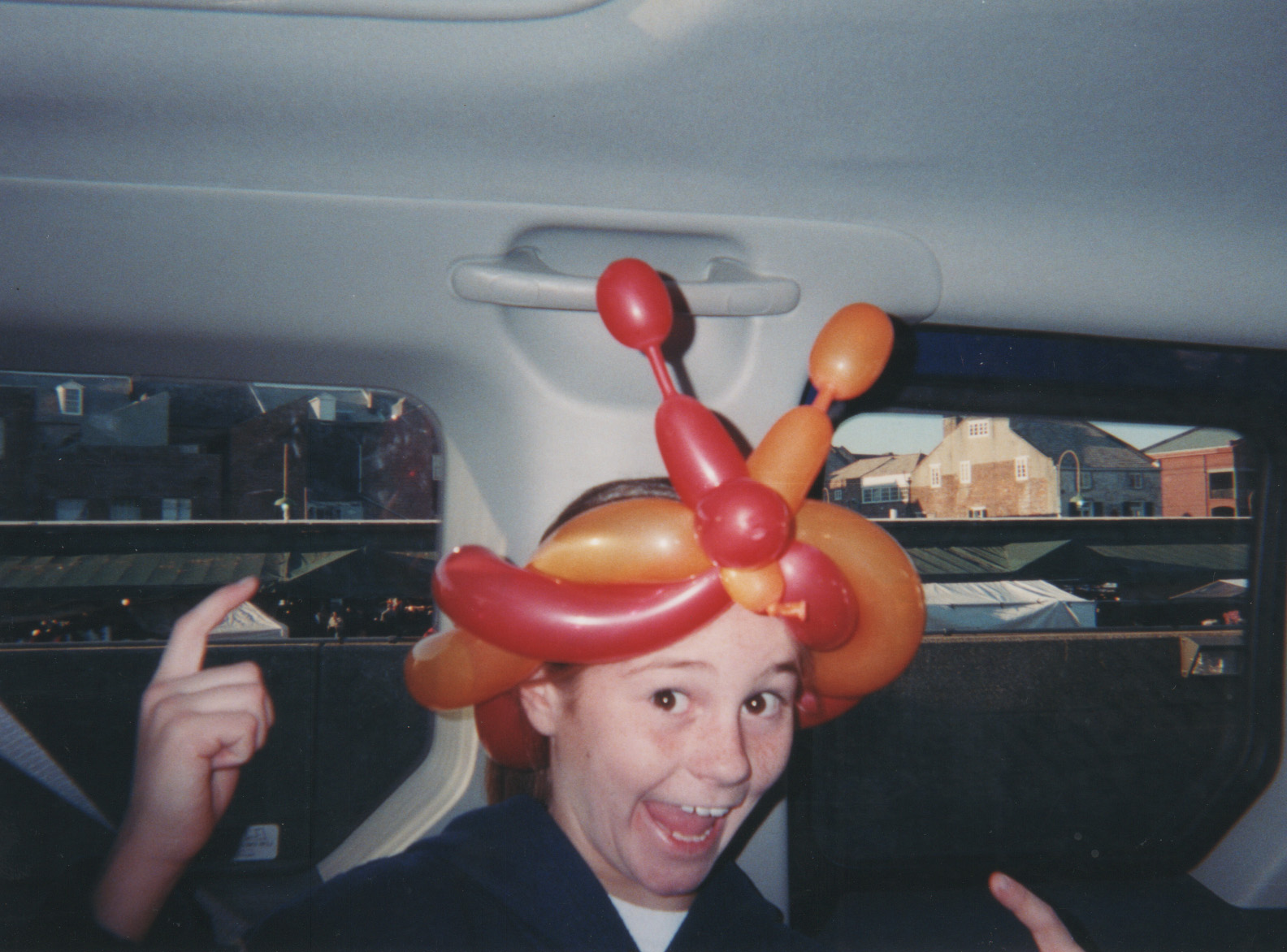
Walking around in downtown St. Louis this Independence Day weekend, I saw a couple of kids, about 10-years-old, skipping next to their parents. The entire family was decked out in Cardinals gear, they were all a little sunburned, and they were laden with stadium souvenirs. Most noticeably, however, this brother and sister duo were laughing and acting nuts, enjoying life while wearing balloon hats. When I saw those silly red, white, and blue balloon hats, Mack’s freckled face popped into my vision and my memory time machine took me straight back to New Orleans, December 2004.

Mack was 10. She had just hopped into the back seat of our boxy and blue Honda Element, and just before closing the wide-open suicide doors, I snapped a classic photograph of her. She was laughing and acting nuts. She was over-the-moon, because she had won an important argument with her dad, and she was proudly sporting her championship trophy atop her little head. We had just spent several hours wandering the streets of the French Quarter and Jackson Square, listening to music, eating beignets, and enjoying the performance artists. Mack had been fascinated by a flamboyant man making balloon animals and hats. She set her sights on a hat. Her dad said “no, no, no,” arguing that it was an overpriced and impractical souvenir. “No, no, no, Daddy-O,” she argued. “It is art, and I need it.” Of course, he caved in, like he always did. And Mack chose a red and orange monstrosity with antenna-like balloons sticking straight up in the air. Mack beamed in that hat, just like those two kids beamed in their patriot variety. For Mack, those contorted balloons were the perfect end to a great day.

balloon hat

It was simple things like balloon hats that lit up Mack’s world, and I am so glad her dad and I frequently indulged her in her child-like pleasures. It did not take much to make that kid happy, and although that damn balloon hat blocked the rear-view mirror, drove her sister crazy, and deflated long before we made it home to Springfield, Illinois, it was a highlight of the trip for Mack. It also left us with the cherished balloon-hat photo that now so beautifully captures the spirit of my lost girl.

When I saw those happy kids proudly sporting their patriotic balloon hats, my heart had smiled for three reasons. I remembered my Mack in her own balloon hat when she was just the same age. I was happy that those two little kids knew how to fully enjoy a simple and silly pleasure. And I was so glad that those parents had purchased ridiculous air-filled hats in spite of the fact that they were likely way overpriced and stood little chance of making it home. I just hope at some point in the day, one of those parents captured a photograph of balloon-hat bliss on the faces of their kids, like I was so lucky to capture on the face of my sweet girl.

Maybe those kids had not used the same balloon-hats-are-art argument that Mack had used back in 2004 to claim hers, but those kids (and likely their parents as well), understand the value of a few cheap balloons fashioned into a glorious and artful hat. Balloon hats are art, people. Pure and simple and true.