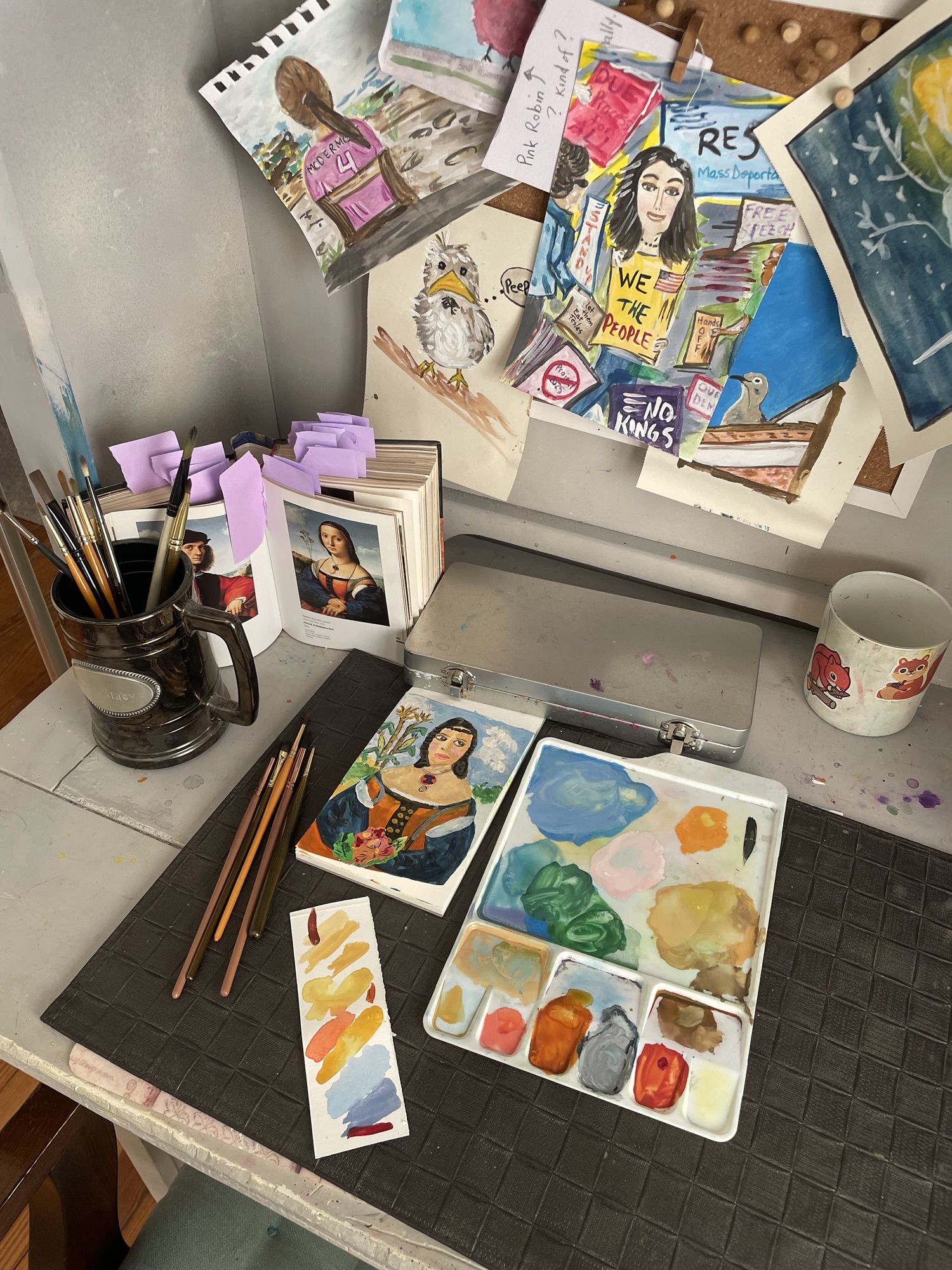
I have more talent with words than watercolor, and since I will probably never meet the 10,000 hours required for mastery of a skill, I will likely remain a more accomplished writer than painter. Yet I feel more artist than writer these days. I am more compelled to paint than to write. I am less interested in applying a honed skill than practicing a new one. I surprise my serious self by being so glad to play and to laugh at my painting blunders. Creating art, imperfect as it may be, is balm and vitamin to my evolving, aging spirit, a more nourishing and colorful expression of my existence in this autumn of my life. Art inspires my inner child, rejuvenates my aching heart, and checks my ego at the door of my Archive room, where I paint. It both heals and challenges me.
When I open the watercolor paints, spritz them with water, and consider the blank paper, I feel no pressure to create, no striving to be good, no fear that what emerges on the page might be terrible. In fact, I welcome the terrible. I enjoy the mistakes and happy accidents. I laugh out loud at my feeble attempts at noses and fingers and mixing a bright and perfect shade of purple. It is the practice of art that nourishes my soul, not the art (or anti-art) that emerges from the water and pigment on paper.
As I know that anyone who writes regularly, whether they ever publish or not, is a writer, I know that I am an artist, no matter the level of skill I possess now or have the capacity to attain. To sit down most days and draw, paint, or collage something into existence is what makes me an artist. To create ANYTHING with an open heart that makes someone feel something is a creative expression. Bouquets of flowers from the garden arranged in a vase. A home-made meal cooked with love and intention. A craft cocktail, garnished with flair. Daily doodling in the margins of the engagement calendar. All is art and the creator an artist.
When I began watercolor painting three years ago, a suggestion of my therapist to practice the art of letting go, I never anticipated that art would become as important to me as writing. I immediately loved painting and felt the physical healing of the practice, but I believed it would be a passing fancy. I have never been very good at sticking out activities that do not immediately feel easy. Watercolor is willful, and it frustrated the persnickety editor in me, but it soon became a dance, a playground, a messy field of weeds and wildflowers, cartoon figures and a belly laugh. Painting makes me feel like a child drawing with sidewalk chalk in the sun.
As an artist I want to gently improve my painting skills, not with a mind to sell or exhibit my work, but rather for the enhanced pleasure of creating art. I want to better mix colors, to learn to paint without penciling out a crummy sketch first, to trust the water more, to lean into abstract representations of what I see, and to feel content to paint with my imperfect, grieving, laughing heart.
To this end of honing skills, I recently began a lighthearted but practical short project. In a 4″x6″ sketchpad of fifteen watercolor pages, I am copying fifteen paintings by master artists. From The Little Big Book of Art, a favorite publication that I have enjoyed for years, I selected fifteen paintings to copy; or, perhaps, reference would be a better word for such an unskilled, untrained artist such as my humble self. The idea is to paint what I see, practice mixing colors to match the paintings as they appear in my little book, and to gain confidence with the paint and the brushes. The small size of the paper was intentional, the purpose to complete each painting within an hour or so, no plan to rework or retouch. No pressure to succeed. No striving to get my representations even close to my idea of perfect. No fear of miserable failure.
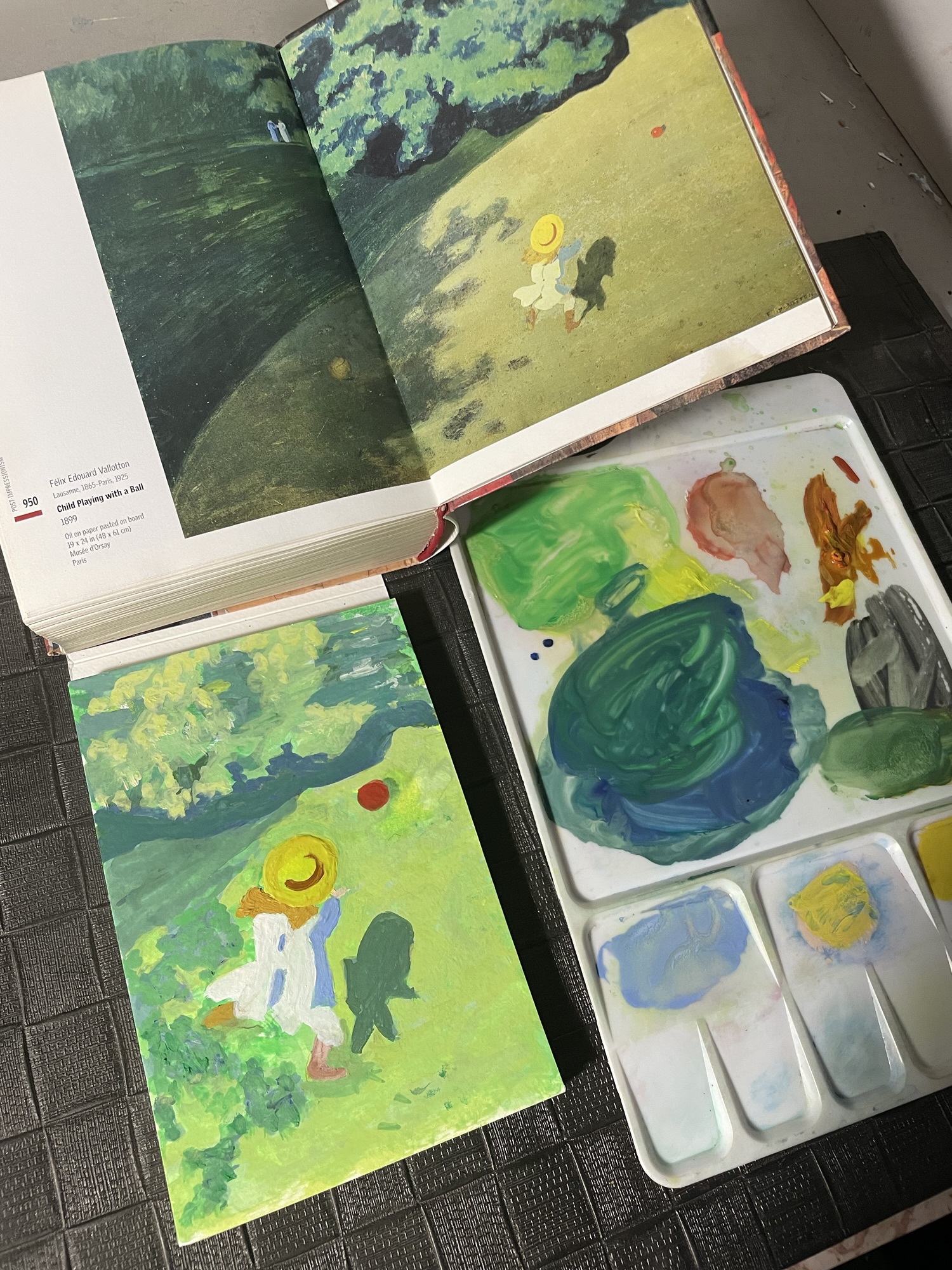
So far so good on all counts. I have tackled three thus far, and it has been a blast. I am using a set of jelly gouache watercolor paints with which I had failed to bond. It was a material choice that reduced expectations and put me even more at ease with the audacious idea that I could paint copies of great paintings. I am using paints I was wasting, a $1.99 sketchbook, and devoting minimal time to the project, and so nothing to lose and only learning (and humility) to gain.
Child Playing with a Ball (1899) by Félix Edouard Vallotton (1865-1925) was first. I started with this one because it seemed the easiest of my selections to approximate. With its dreamy park landscape and impressionist figure I deemed it a realistic goal. No faces or fingers to fiddle with, no detailed objects more complex than that simple red ball. It was not more difficult than I thought it would be, because I knew that every painting I selected would be a lofty challenge. Yet it surprised me in unexpected ways and proved a perfect first attempt. It taught me that it can be better for me to paint without a sketch. My grossly imperfect sketches often box me into an intention that is ill-conceived in the first place, and they sometimes limit the expression that pools upon the paper. I will still do my cartoon-like and illustrative paintings by drawing them first, but now I will attempt more free-flowing work with ease and confidence. My pointy elbowed intentions with jagged pencil lines is not the only way for me to express my creative spirit.
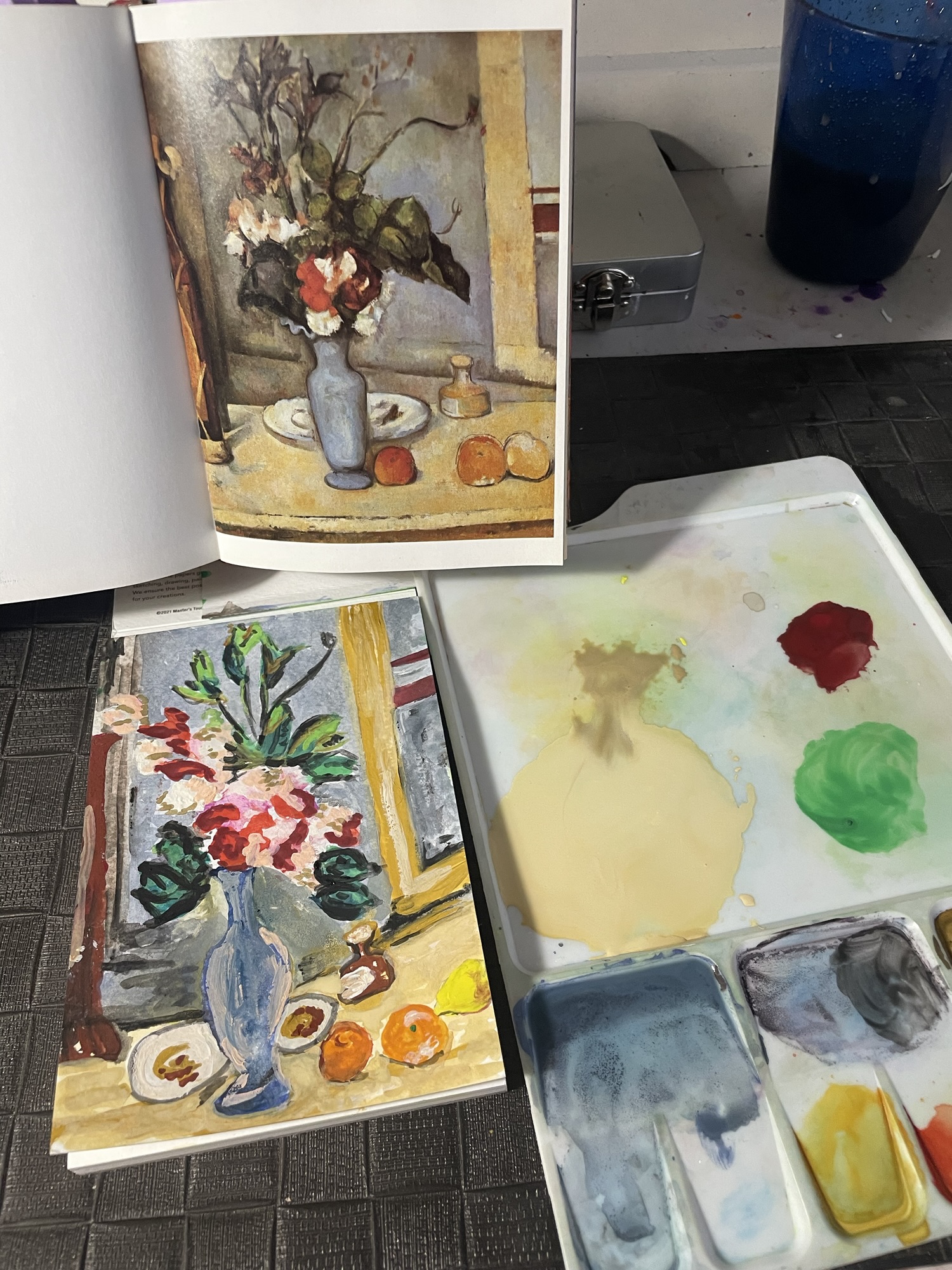
The Blue Vase (1889-90) by Paul Cézanne (1839-1906) was my second painting, and such a delightful hour spent. Objects are so much easier for me than people. My colors don’t match, my perspective is askew, my flowers are a different species entirely, and the arrangement possesses its own ratio of blooms and leaves. Yet I did, indeed, paint a blue vase on a table, without penciling it in first. The bottle is a bottle and the fruits are fruits. I struggled to create different values of grays. I learned that mixing reds is a wonder and will never again rely solely on the red in my pan set of watercolors. I also discovered that while still life is still not my inclination, I am going to give it a good chance and experiment with painting still life with my unique sense of humor and perspective.
My third attempt was the Portrait of Maddelena Doni (1505) by Raphael (1483-1520), and the best thing I can say about this painting is that I laughed all the way through it. I struggled with Maddelena’s nose and her dress and the wispy tree in the background. Her stupid headband was an unexpected trial. I tried and failed three times to paint her hands using mixed shades of pink and tan and brown; then I cheated and tried to draw in her hands with pencil and paint over them, which failed even more miserably than the first two attempts with just paint. Finally, I threw up my hands and collaged a bouquet made of my own painted collage paper and happily placed it over her disastrous blob hands. I also painted a bulky cornstalk in the place of that damned delicate tree. And then I giggled as I embraced with cheek and aplomb the subject’s orange and blue dress and made her an alum of my own alma mater.
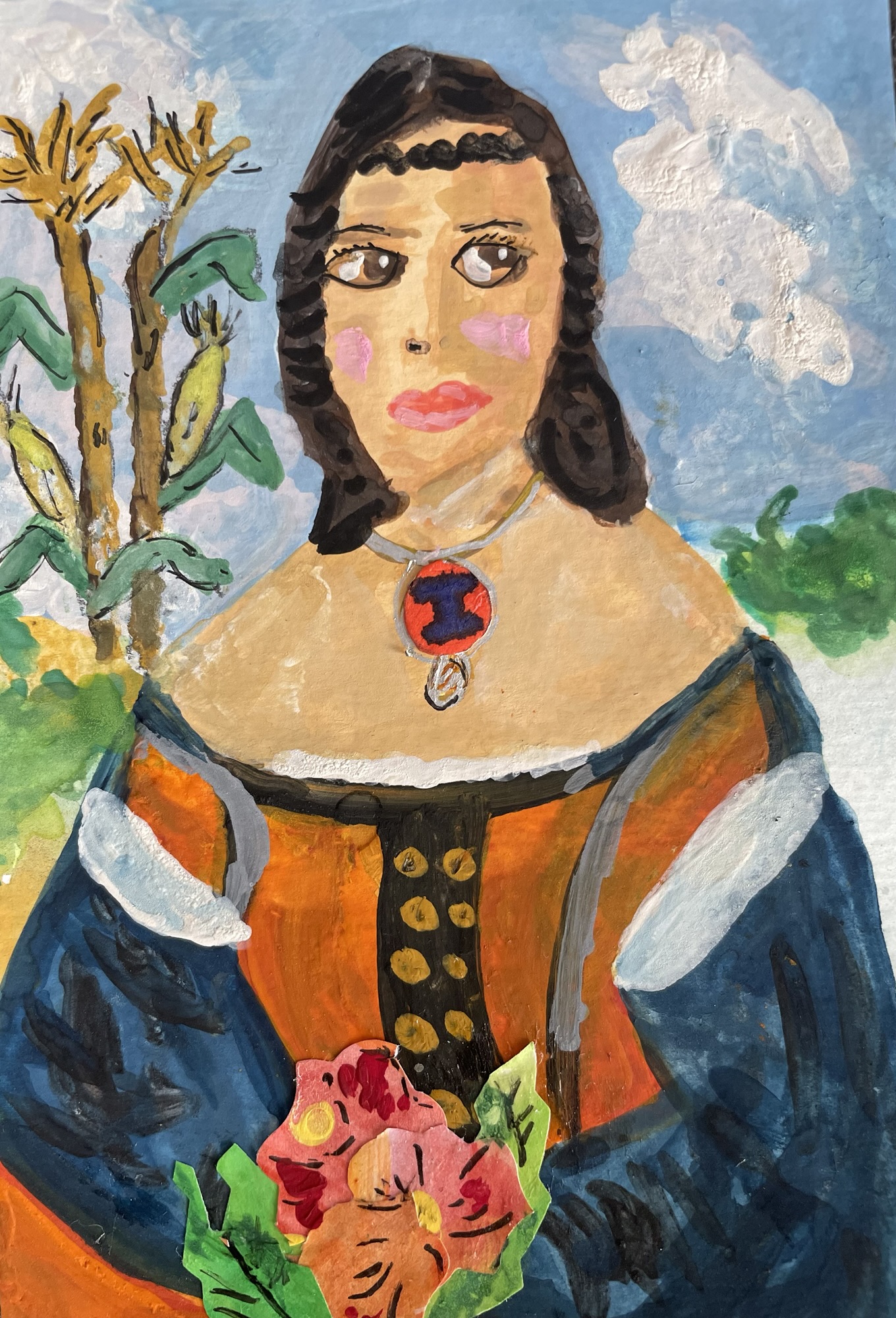
I may have been trying to paint a copy of a Raphael, but what I produced was my own little piece of terrible, wonderful art.
I am in love with this ridiculous project and delighted with the practice and the learning. It is absurd and audacious, perhaps, but it is a liberation. Art is, after all, just an expression of a thing through the eyes of one person. Even if it starts out a “copy” it becomes, in the end, a unique expression of the artist who sat down to make it with her own two hands. The first three paintings showed me that I should with the remaining twelve paintings represent them rather than copy them and generously paint them in my own voice. I still intend to mix colors with the intention to match, represent in some way the subject or the scene of each painting to the best of my limited ability, and keep to my rule of no pencil sketching. However, I have license change it up, skip or even give up on parts (like hands), and add a bit of whimsy (like collage) if inspiration blooms.
Side-by-side with the paintings of the masters, my paintings are nothing to write home about. Then why in the hell are you writing about them, you ask? I answer by saying that my painting of Maddelena Doni (2026) is all Stacy Lynn. It has the expressive large eyes I always paint, a characteristic nose-ish, and my sense of humor. It is art. It is my art. Because as I said before and repeat here with emphasis, art is anything that makes a single person feel something, even if that single person is the artist herself.
And this artist is feeling free and inspired.