Opening apologies: what started out as a short blog post about one day in my life has become a short treatise on anxiety. Heaven help the grossly pensive woman alone during a winter weekend.
Oxford English Dictionary
Anxiety [noun, early 16th century; Latin anxietas] 1 The quality or state of being anxious; uneasiness, concern; a cause of this. 2 Med. A condition of distress accompanied by precordial tightness or discomfort. 3 Earnest or solicitous desire for a thing, to do something. 4 Psychiatry. A morbid state of excessive; or unrealistic uneasiness or dread.
Anxious [adjective,early 17th century; Latin anxius] choke, oppress: see ANGUISH 1 Troubled in mind about some uncertain event; concerned, solicitous; being in disturbing suspense. 2 Distressing, worrying; fraught with trouble. 3 Full of desire and endeavour; eager for a thing, to do something.
Anguish[noun, Middle English; Latin angustia] straits, distress, narrow, tight; squeeze, strangle: see ANGER n., ANGINA. Severe bodily or mental pain, intense suffering. [verb] to distress. 1 Distress with severe bodily or mental pain. Now chiefly as ANGUISHED [Middle English]. 2 [intransitive verb] Suffer severe bodily or mental pain.
A Dictionary of American English
On the anxious seat, in a state of uneasiness; troubled. 1839 Knickerbacker [N.Y.]. XII. 345. He did look as if he had been on “the anxious seat,” as he used to say, when things puzzled him. 1862 Stowe Pear Orr’s Island II. i. What a life you did lead me in them days! I think you kep’ me on the anxious seats a pretty middlin’ spell. 1865 Atlantic Mo. XV. 454 Almira … had long been upon the anxious seat. 1887 Francis, Saddle & Moccasin 226 Oh, the boys kept him on the “anxious seat” for two or three days, and that cured him [of card-playing]. 1894 Congressional Record Feb. 2382/1, I am glad to see so many gentlemen on the “anxious seat.” 1906 N.Y. Evening Post 4 Jan. 4. All the men present were on the anxious seat, seeking to learn whether their new judge was ‘easy’ or ‘tough.”
I woke up that morning in a state of uneasiness. By 10:00 a.m. I was in distress. By noon I could no longer sit still at my desk. My heart was pounding so hard in my throat that I feared I would choke on it or that it would burst right through the small hollow of my neck. My pectoral muscles were jammed up against my collar bone, and I could hear the whoosh of blood in my ears. The sound tingled and tapped on the skin of my reconstructed left ear where it attaches to my face.
I stood up and began my coping ritual of pacing and ringing my hands and clutching at my chest. My entire body was being squeezed in a menacing invisible vise. Heart attack crossed my mind at the exact moment I made eye contact with the sweet, heart-melting face of my chihuahua. Bug can almost always calm me, but this was not a troubled mind out of control. This feeling was not unrealistic dread, it was a response to my body in serious trouble.
My sister was out of town, so I texted a neighbor. She took my blood pressure. Twice. Very high, she said. I had no idea what the numbers meant but I could feel the surging of blood in every vein. I could hear my heart screaming.

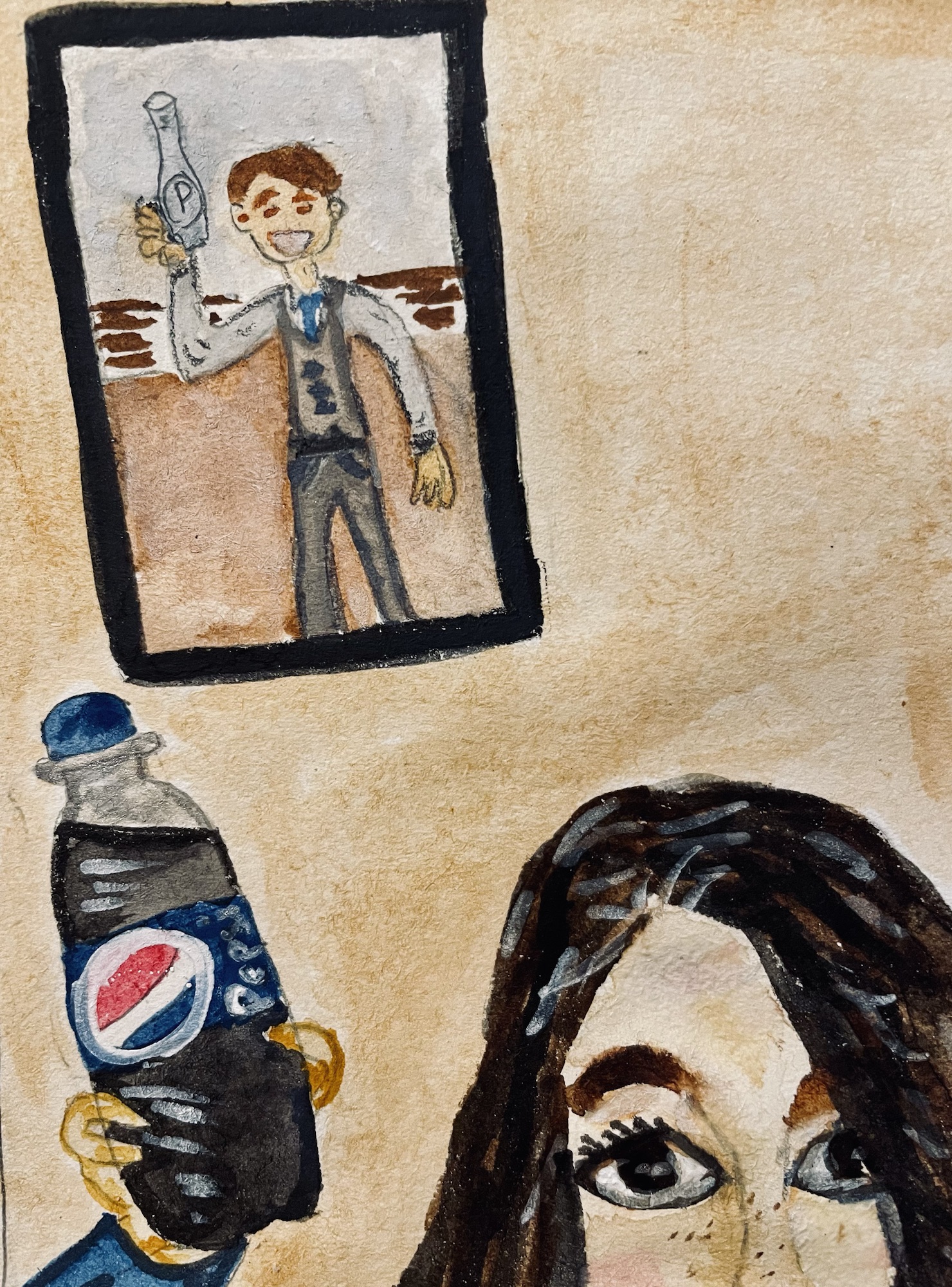
Anxiety Is Real began as a failed watercolor painting and ended as a moderately successful digital drawing. A metaphor for my life as a work in progress!
Prompt care. EKG. Nitroglycerin tablet under my tongue. A Xanax. Blood pressure almost immediately easing. My sister arrives, which calms me further. The doctor comes back in, her face is concerned which is concerning to me while I wonder why I no longer think I am having a heart attack as her hand presses down on my own, telling me she’s called an ambulance. EMT’s hook me up to wires and the ambulance delivers me five minutes later to the hospital ER, where a beautiful male nurse whispers that I am in good hands. I say this is all ridiculous. I am fine. I must be, right? Or is that the Xanax talking? Another EKG. Chest x-ray. Blood draw. Blood pressure cuff on a fifteen-minute cycle, a monitor of my vital signs quietly beeping. My sister tries to sneak a photo of the beautiful male nurse. We laugh. I am calm. My heart is not pressing against the small hollow of my neck. It is resting in my chest where it belongs. I am not going to die today, even as all the wires attached to my body are no picture of good health. The attending physician enters the room.
Your heart looks good. No evidence of a heart attack. I think you’ve experienced a rather severe panic attack. Has something happened? Are you under a lot of stress or worried about something in particular?
It was November 15.
Ten days after the election.
Yes. The fucking election.
I said it out loud. And no one in the room contradicted me.
**********
The first time I remember experiencing a condition of distress accompanied by precordial tightness or discomfort I am six. A first grader on the school bus, I am silent and watchful, a nervous observer of the noisy chatter and laughter all around me. But there is a little boy crying, and I think, why is he crying? Should I be crying? Should all of us be crying? I notice that my heart is beating hard against my throat and my arms feel impossible heavy.
I think in part because I was a worried child, I became a determined and cerebral child, a self-disciplined and serious child, a skeptic always asking questions, collecting information, believing or hoping or begging that knowing would give me power to quiet my worries. I was a mother hen to my friends, always counting them and watching for loose gravel when we rode our bikes in the subdivision. My dad called me a nervous nelly and a worrywart. My mom often told me to calm down before I worried myself to death. My grandmother once said that if I didn’t stop it and breathe, I’d give myself a damned heart attack.
I became an adult believing I was responsible for my dread, that it was incumbent upon me to swallow it. There is no blame in this statement, because although anxiety was a recognized ailment in clinical psychiatric terms in the 1970s and 1980s when I grew up, such mental and emotional struggles were not everyday topics for discussion. As a kid, I had no way to define or understand the anxiety I frequently felt and, in fact, my privileged, middle-class childhood with luxuries like my own room, competitive gymnastics, and summer vacations to Disneyworld, made me believe I had no good reason to worry.
Lincoln biographers have written that Lincoln’s greatness was fueled by his melancholy. I am on the fence with regard to this historical interpretation while at the same time harboring a personal belief that my anxieties, at least a little, fueled some of the qualities that made me a relatively successful and accomplished human being. As I lived my first thirty years as an adult on the anxious seat, and accepting that perch, I developed healthy (and less healthy) copy strategies. My anxiety manifested itself in detailed organizational tactics, long-term planning, thoughtful assessments of life choices, close surveillance of my daughters, the creation of sophisticated spreadsheets and complex to-do lists, and self-disciplined goal setting. My husband saw me as a control freak, and he wasn’t wrong. I was trying desperately to control what I believed I could control and sometimes to freak level and with freaking-out ferocity. Control freak was another negative moniker, like nervous nelly, that I accepted with my desperate efforts to ease the dread I felt in my body about all of the bad things that could happen to me and my loved ones.
Control never fully soothed my unease, however, and, in fact, it sometimes exacerbated it. I still worried about death, the safety of my kids when they were away from me, family members and friends driving on freeways with semis. I fretted about tornadoes and wild animals outside in the snow and the kids that didn’t make the basketball team and melting polar ice.
Even the healthy strategies I developed only masked the anxiety. I didn’t know it then, but I was trying to hide the pathology of my distress instead of facing it head on and eyes wide open. All of the self-control I mastered within my life and all the pushing aside of all my distress and worry with excessive doing could not protect me from my greatest dread. And when my darling Mackenzie died and life as I knew it unraveled, forty-eight years of living had taught me nothing about how to survive the anxiety her death and my unbearable grief wrought upon my body, my mind, and my spirit.
That all seems like a lifetime ago now. I am not that woman anymore. I am altered, and my life is fundamentally different. My struggle with anxiety, however, did not die with that woman standing in the ruins of her life. As I had to collect new strengths to survive grief, so too I had to reevaluate my relationship with anxiety. And so, in the end, even the anxiety embedded in my DNA has, in many ways, shifted.
For five years now, I’ve been in therapy, wrestling with my worries and gaining acceptance and knowledge about how my brain is wired. A daily practice of yoga and meditation is teaching me that even a person like me who so easily leans into a morbid state of excessive and unrealistic dread, has the power to find inner peace. Simply having the words to define my unease and to better understand it has been a sweet release. I no longer blame myself for feeling anxiety. I no longer call myself a nervous nelly. In basic terms, my struggles with anxiety are no different than my struggle with seasonal allergies. While it is my responsibility to be as mentally and emotionally healthy as possible, I no longer blame myself when all of my best strategies fail me.
Whereas a good spreadsheet will always help me quell a particular financial worry, an orderly house inspires my calm and creativity, and a fastidiously kept calendar gives me confidence in my abilities to navigate the chaos of modern life, sometimes the outside world gets in, dammit, and I am, ultimately, only human. Anxiety is not who I am, but I am a person who experiences a level of anxiety that can make me unwell. To live with it gracefully will always be a work in progress.
The trip to the ER in November was not at all graceful. It was terrifying and humbling and life reaffirming. (And that short ambulance ride was all kinds of expensive). But the caring health professionals who saw me through that panic attack and my wonderful therapist have helped me see that medication can be a useful tool and that given my proclivity to sit in an anxious seat, my trauma and grief, and the very real political and planetary uncertainties, I am doing okay. In the two weeks since the inauguration, I have experienced several days of heightened anxiety, particularly stressing the threat that changing federal policy poses to my livelihood and my life’s work.
In last week’s therapy session, I expressed a feeling of guilt not only about all the health care consumed for a panic attack but also for having the luxury of all this naval gazing when so many less fortunate people are in real jeopardy. A holdover from my childhood that my life is too lucky to feel debilitating dread. My therapist reminded me that the anxiety I feel is as real as a heart attack and that I can help no one if I am unwell. She also urged me to consider the idea that my anxiety over the election and all of the chaos and uncertainty since the inauguration is exacerbated by my empathy and heightened concern as a historian for the wellbeing of my country.
She is not wrong to refocus me in this manner. There are real worries in the world AND I am a person wired to worry and vulnerable to unrealistic dread. Thus, my unfortunate trip to the emergency room. It is much easier for me to feel the pain of empathy, however, than to breathe through anxiety, even as I must admit that I worry so much in part because I care so much. Still, empathy was never my problem. Empathy did not cause my panic attack in November, and it is not the reason I have been sitting on the anxious seat these past two weeks. The reason I am anxious is because my messy beautiful imperfect brain is misfiring. Knowing this doesn’t make my brain better, but it makes me feel better, if that makes any sense at all.
It is absolutely true that all of the processing of anxiety I have done over the past five years has been worth the effort, even as I could see that it failed me in November. I understand myself better than I did five years ago. I am more accepting of my human imperfections, and I honor every experience. From the stresses of writing a new book to the worry I am feeling about promoting the book beginning this summer and from the dread that sometimes creeps in late in the night to a troubled mind that makes me spin out the worst political and historical consequences of a disastrous election, as distressing and uncomfortable it all might be, it only becomes debilitating anxiety in the manufactured mess of my dear old brain.
Anxiety. Anguish. On the anxious seat. All of it is me and it isn’t all of me. When anxiety rises in my body, it is real and it is emotionally and physically painful. It is not a figment of my imagination. It is my struggle, part of my story, a colorful descriptive inset on the perfectly ordinary crazy map of my life. And the only difference between me and so many other people I know who experience anxiety (it is a common struggle in our society) is that I find solace and affirmation in writing about it. I have a lot of fears, trust me, but sharing my truth is not one of them. I share because it gets the sharp edges of hard experience out of my body and there is always the chance that I will reach someone out there in the world who thinks she is all alone. Okay, so that can be my excuse for this anxiety treatise. These are anxious times, and I believe a lot of us are feeling anxious.
I wonder. If all the people sitting on an anxious seat all alone decided to sit together on one giant anxious seat, we might just have evolutionary power to rewire the future.




 Being Mack's Momma Bear