Mack, Compassion, and America

I haven’t written a post on this blog for too long. I’ve been busy. An edited volume for my work at the Jane Addams Papers. The promotion all summer of my own book Loving Lincoln. An intense yoga-training course. And doom scrolling because the world is crazy and I am so damned sad about it. Yet this is the hardest time of the year for my personal grief, and I need to write. Last Saturday morning, Mack popped up louder than usual. She knew that I was overtired and faltering.

And so, Mack and I have been on a weeklong retreat together in my mind, and she’s got me thinking. About me a little bit, but mostly about the crazy world that is making me sad. Her presence in my thoughts and in my aching heart space has me pondering where we are and who we are in America. About what I revere about my country. About what I would change if I could change anything to heal all the fractures I see. About what we all need to do to get through this shocking, terrifying time in our history.

I am grateful to Mack’s good spirit for inspiring the conversation and making me find my words. She’s good at that, my Mack, at nudging me back to my writing, my remedy, the only way I know to untie the emotional knots of my fragile, beautiful condition of being human.

Deep breath in…

Long sweet exhale…

Now, let’s talk.

**********

Every single human being wants and deserves a comfortable place to live, good food, and good health; they want to be able to pursue a productive passion, to be safe, and to feel a sense of belonging. All human beings want those simple comforts and pleasures for their families and for their friends.

Compassionate human beings also want those simple comforts and pleasures for ALL people—no matter their gender, race, religion, politics, sexual orientation, economic situation, or immigration status, and no matter that we might not know those people or understand them.

Selfish human beings care only about themselves and their own kind and are willing to demonize others to allegedly protect themselves and those they define as worthy.

The United States is not perfect. It has never been perfect. As a historian of the American past, I could regale you for hours with stories about how we grossly failed to live up to our ideals. Yet the United States of America, a nation of dreamers and immigrants and brave free-thinkers, is a great country because of its diversity, ingenuity, eclectic variety of souls, and lofty, albeit sometimes faltering, aspirations. American democracy—despite all the ways it could be better, despite all the ways it has left people behind—is the best form of government on the face of this earth.

Why else do so many immigrants dream of life in America? Why has the United States for the last 80 years been such an inspirational force throughout the world? Our freedoms and our Constitution, yes. Our legal and educational institutions, yes. Our affluence, yes. But in great part the reason the American experiment has endured and inspired freedom-seeking people around the globe is because America is a free country made up of mostly generous, kind, and hard-working people. People who want to live their own lives in peace and let other people live their own lives in peace. People who care about the wellbeing of their communities, their states, and their country. People who want to feed starving children around the world. People who want to help people facing catastrophes like hurricanes or genocide. People like my working-class American grandfather, who put his body in harm’s way and endured the horrors of the battlefield to liberate Europeans from the Nazis.

I am not willing to give up on America, and I think most Americans are not ready to give up, either. But as our country is imperfect, so is our politics. Political discourse is ugly right now and political norms have been broken. I know many people are feeling fear and despair; and that fear and despair is not crazy, it is real. The political party in power rejects democratic standards of negotiation and compromise, and it has committed itself to policies that protect only like-minded people, rejecting an ethos of compassion for the vulnerable people among us. The opposition party consists of many individuals who have taken far more than their fair share, have clung too long to their power, and have propped up companies and policies that have harmed people, even as they have voted to ensure the basic human rights and comforts of the vulnerable.

I am an unapologetic political partisan; I have always been a liberal Democrat, and I believe with all my heart and my brains that if we want to save our country from the authoritarian threat we are facing, we need to elect Democrats to public office at every level of government. It is abundantly clear that the party in power disrespects the Constitution and is trying to dismantle our democracy. The Republican Party is an existential threat to American democracy and to our inspirational standing in the world.

We are in a full-fledged political crisis. But I also believe that this is not merely a political crisis that we are facing. This is a moral crisis. This is a humanitarian crisis. This is a fight not only for freedom and democracy and justice for all people, but it is also a fight for the soul of America.

Good Americans look out for their neighbors, and they care about people they don’t know. If we are going to save our democracy and write the next, better chapter of our democracy, we need to remember that at the root of everything we do for good in the world is love and compassion and the idea that all human beings deserve security and dignity and peace to pursue their own, individual happiness.

If you believe that some people because of their immigration status or their gender or their difference in any way makes them unworthy of rights and compassion, then you need to have your version of a come-to-Jesus meeting. If you are demonizing others to make yourself feel better about the deportations or to justify your hatred of mythical liberal demons, you need to look in the mirror to inspect yourself for horns. If you are supporting political candidates who believe due process and the rule of law don’t apply to all people equally, then you need to ask yourself if you really wish to live in a democracy at all.

Because here is a little truth for you: there will ultimately be no freedom for you if there is no freedom for your neighbor. Your right to pray to your god or to love who you love or to pursue your happiness in peace is impossible if you stand in the way of another person’s right to pray to their god or love who they love or pursue their happiness in peace. If you support leaders who hurt people and talk about human beings like they are animals or monsters, you are no better than they are.

I don’t wish to deny you your American right to advocate for immigration reform, for example, or to reduce or reform government agencies and policies. I believe in democracy and free speech and the civil exchange of different ideas. But when you advocate for the things you want at the expense of humanitarian concerns and, in the end, at the expense of your own humanity, you will fail every time to create anything that is lasting and good.

If we are going to save our democracy and move forward with a bigger and bolder vision of what American democracy can be and could accomplish, which I think we will do, we have to start from a base of compassion and human decency for all the people in our country right now, whether they are citizens or not. For the sake of our human souls as well as for the soul of our democracy, we need to take care of people who are living in fear of our government, who are in danger of losing their freedoms and their American lives. We need to fill up our bodies with love, despite our vast differences, and stand up to the authoritarians who are trying to destroy everything that is good in America.

And, here’s the thing about authoritarians: every damned one of them is a bully. And bullies are cowards. They are weak, and they have to punch down to feel good about themselves. All we have to do is declare our allegiance to every proverbial little kid who is getting pummeled for his lunch money. It might be scary, but if all the good and compassionate Americans stand up and stare down the bully, the bully doesn’t stand a chance in hell of survival.

The path forward won’t be easy, but it is very simple.

Do you want to be a bully or a protector of the bullied? Do you want to live in a democracy that cares about people or a dictatorship that doesn’t care about anything or anybody?

Like I said, this is a moral crisis. This is a humanitarian crisis. This is a question about who we are in our hearts as human beings and who we are and will be as Americans.

I know what side I am on. Do you?

Mack Day (no. 11)

She is still here, my Mack. She resides in my heart. She dances daily in my thoughts. She is every four-leaf clover. I tell her all the big stuff and the hard stuff and the stuff about which I know not what to do. Her good spirit laughs with me, cheers me on, and gives me courage in the dark. I will always need her, like I need water and air and doughnuts.

Mack Day, her birthday, is always a bad day and a good day. My tears and longing for her are more bitter, but I also celebrate her joy of being a leprechaun, quarter Irish and born on St. Patrick’s Day. As I have done eleven years now, I will take Mack Day to grieve my girl and to give myself space and a little extra grace. To sob alone and feel in my bones the loss of her. To eat something decadent for her. To belly laugh at least once for her.

This year is a discombobulating year of contrasts for me, and I have been thrown off balance.

As a historian supported by the National Endowment for the Humanities, my livelihood, health benefits, and life’s work are in jeopardy. The assault on American democracy, the dismantling of our government, and the turning away of our country’s core values are making me physically and emotionally unwell. As a voter, what is happening enrages me. As a woman and a mother, I am horrified. As a human being who cares about the vulnerable people among us, I am terrified. And as a historian of American history, I am profoundly sad.

If Mack were here today, she would have wisdom for me to better navigate my anger, horror, terror, and sadness. She had this way of diffusing catastrophe, of redirecting negativity, and soothing anxiety. Her wit and her silly songs could walk me back from every ledge.

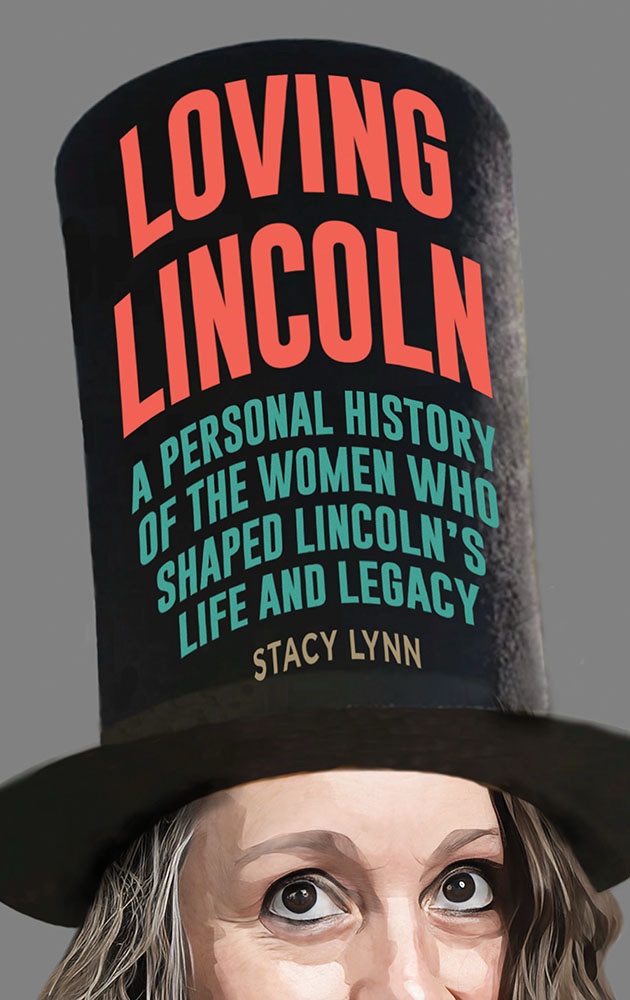
As I am missing her ever so keenly in this difficult historical moment, so too is her absence a fresh heartbreak as I meet my own personal, triumphant moment. I would do anything to have Mack with me to celebrate in April the publication of my new book Loving Lincoln, the deeply personal and most important creative achievement of my life. Oh my, would she have loved the cover of this book. It would have produced one of her famous cackles, and she would have been so proud of her Momma Bear and the book, giddy that her kindergarten drawing of Abraham Lincoln was published within it. I can hear her voice in her favorite refrain, “Lincoln is dead, mom, you know that, right?”  

There are few things in this mortal life we can control. While I must face this Mack Day alone, I will go forth into the sunshine as best I can, with Mack’s good cheer in tow. I will let the tears flow (sorry, my dear girl), but I will also raise a Guinness. To Mackenzie Kathleen McDermott, I am grateful you were here. I was damned lucky to have such a daughter, a bright light who touched the lives of every person who knew her.

As I have always done, I will hug Mack’s spirit close to my heart, keep her quiet wisdom in my mind, and let her joy put the spring in my step. But perhaps during this year—this unbalanced, terrible, joyful year—I will find new ways for Mack to guide me, to inspire me, and to sally me forth through all the darkness and all of the light. And no matter what happens to me or my job or my country, I will endeavor to be good and to be true. To locate a new and lasting peace of mind. To honor Mack’s faith in me. To do justice to all she was and all she taught me.

Cheers and peace and happy Mack Day.

Mack poking fun of the scholarly nature of my first book, The Jury in Lincoln’s America, in 2012.

Out of Words

I have not been writing much this year. I am not quite myself, and I feel a little adrift.  Writing has always been my creative outlet, and since my daughter died my emotional release valve. Writing is how I understand the world, process pain, document joy, try out crazy ideas, and express thoughts I could never say out loud. It is frustrating to lose a tool that keeps me sane, but it occurred to me the other day that there is a good reason why writing is eluding me. I know why it took me the better part of a day to write a blog post for work and why when I sit down to write in the evening the blinking cursor stares me down.

I am out of words.

Writing is giving me a holiday because my brain is tired. I spent the last half of 2022 and all of 2023 preparing a 900-page edited volume for the Jane Addams Papers and writing my own book about women and Abraham Lincoln. Of course I am out of words. I used them all up!

And it is true I am not quite myself without them. I am adrift. But I am only a little adrift, which is to me, to quote Lincoln, a matter of profound wonder. I have been doing okay without writing for these first two months of 2024. I have been calmly weathering my missing words because I have a second tool to keep me sane. Watercolor.

Last July, my therapist suggested watercolor. We are working on my obsession with control and the anxiety that overtakes me when I don’t have it. She believed watercolor might help me feel the power of letting go, that learning to go with the flow of the water and the color making their own way across the paper might show me how calming it can be to loosen my grip. As a bonus, she was certain watercolor could compliment my writing.

I was skeptical. I am an old dog and afraid of new tricks. I assumed painting would frustrate me. I am not artistic, I said. I can’t draw, I said. Failure will make me sad, I said.

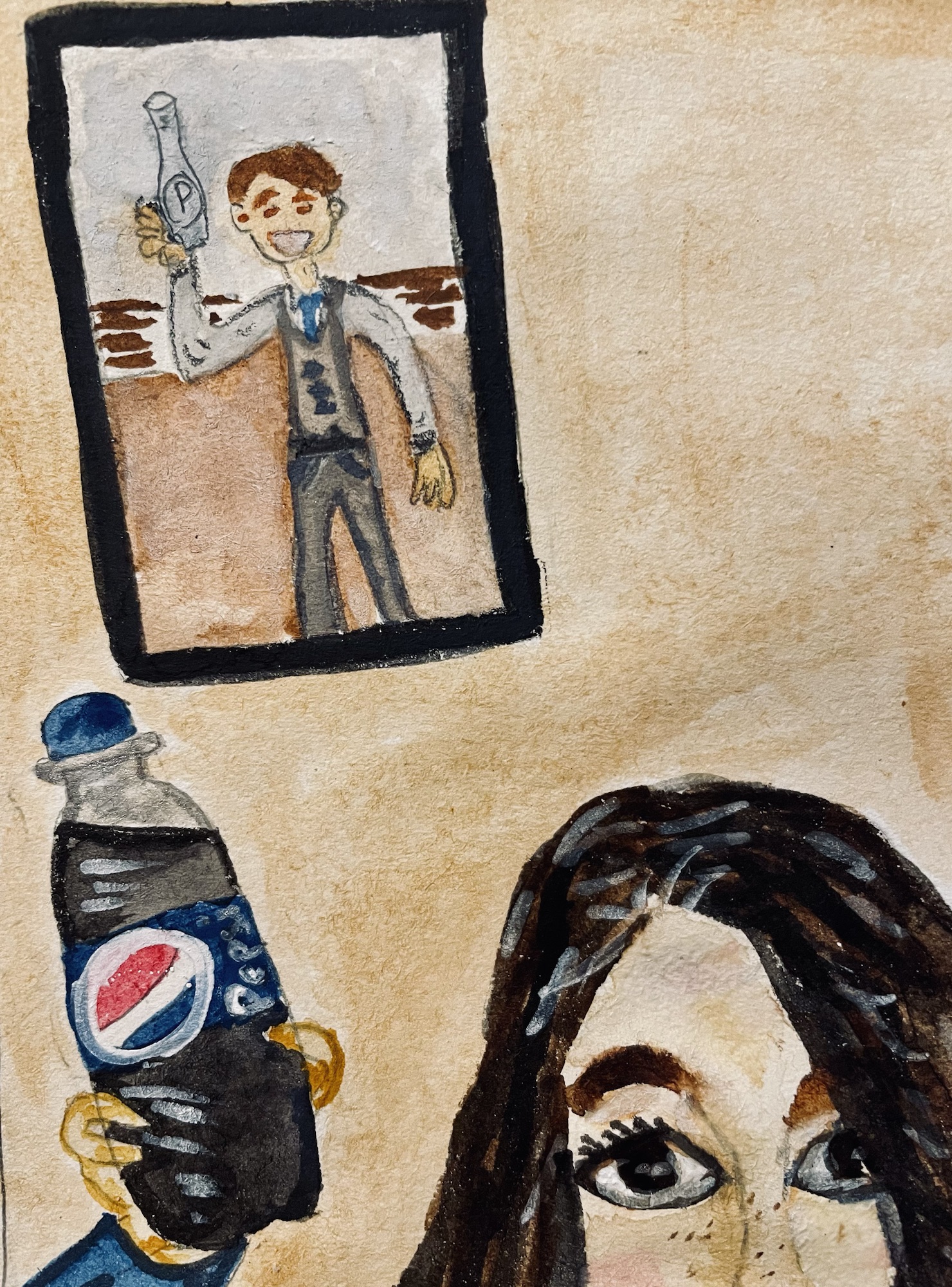
On my first day of painting, I ate all those stupid, doubting, self-defeating words.  And I have been painting ever since, completing, thus far, nearly 100 small watercolors. I do let the water and the color have a say, and I love the imperfect paths and the unexpected visions they reveal to me. I admit I try to control the water and the color more than my therapist would like, but I am learning to let go, becoming chill with imperfection, and laughing all the way. When I sit down to paint, I am as calm as I am when I sit down on my yoga mat. For a half hour or so I express myself in color instead of words; and there is so much joy in every silly, little painting I produce. In fact, I laugh deeper down in my belly at my failures.

I haven’t been writing this year, this is true. But I have been painting. And I am learning that expression is sometimes silent. I am discovering that painting is another way for me to understand the world. In my watercolors, I have documented joy, tried out a couple of crazy ideas, expressed some thoughts I could never say out loud or even write, and processed a lot of pain about by daughter, my dad, and my dog. Painting has become a part of my soul.

But enough already, missing words. I want to pursue the idea that watercolor might compliment my writing. Come back now please. I need to write. I feel you close as I write this post, and I want you back. Now, please. I want to introduce you to watercolor.

Mine All Along

Since April I have been writing and writing and writing, hard at work on my unusual biography of Abraham Lincoln. Nearly 80,000 words have flowed from my fingers, revealing the need within me to get my relationship with Lincoln and the field of Lincoln Studies out of my body and safely onto the page where it will no longer be unfinished business. Fits and starts, this writing, as strange to me as this biography-slash-memoir-slash battle cry, because everything I write since Mack died is hyphenated with battle cry. Writing this genre-bending book has been a scary struggle, artfully melding history with personal narrative has posed new challenges for me. I am making progress, but the process has been messy and painful. I’ve lost myself and my way a dozen times these past five months.

There have been crazy flurries of frenetic writing, words flowing onto the page like refreshing cold water gushing from a garden hose on a hot summer day. However, progress has often been followed by historic droughts, which leave my mind and my heart parched and thirsty for the words that will not come. Words abandoning me and my fingers sitting idle on the home keys are new experiences for me. I’m not used to these dry spells. I have been lucky in my writing life, rarely blocked or conscious of writing, the writing itself a joy and the research or preparation for writing the difficult task that paralyzes me. I’ve always been a weird historian that way, and I do not like this new feeling of writer’s paralysis.

Yesterday, when I was supposed to be writing on a free-and-clear Saturday reserved for working on the book, I was instead sitting on my porch, rocking and staring out into the front garden. As I was working up the nerve to return to my computer and risk another rejection from words, the mail arrived with a neatly addressed envelope postmarked Kirksville, MO. I knew my writing was done for the day. Because I also knew the letter was a handwritten thank-you note from the latest Truman State University recipient of the Mackenzie Kathleen Memorial Scholarship. The eighth such letter. The eighth scholarship bestowed on a creative writing student at Mack’s alma mater. These letters are a solace. Eventually. After good a cry and a little distance. First, however, they must do their damage. They must crack open the wounded side of my heart, scabbed over since last year’s letter arrived. The scholarship is a beautiful legacy to my beautiful daughter, but it is a starling reminder of all the life my baby has missed since the previous scholarship recipient was named.

Dammit. It never gets easier. It gets different, but it stays brutal, hard, and unforgiving.

This is why, for me, writing and grief and life have been braided all together into a thick strand of rope. Some days the rope is around my neck, threatening the breath within my body. But most days the braid is a lifeline. Thankfully, I have learned not only to see that lifeline but to take hold of it and let it save me. The arrival of this year’s letter coinciding with my cursing the failure of the writing was a reminder that life is the reason and should also be the respite.

Aha.

I think right now I am struggling because for the first time the writing threads of my braided lifeline are loose or a bit frayed. For eight years the writing has supplied the tension necessary to hold my weight, allowing the balance of grieving and living to be less burdened. I am far less adept at striking a healthy balance without the writing. I need the writing, and it scares me that the words have failed me. I understand these truths. I accept them. But I also know that writing this very personal biography of Abraham Lincoln has stirred up a brand new cocktail of emotions, opened old wounds, and triggered doubt. My work, my writing, my life, Mr. Lincoln, and my darling Mack are tangled up all together in this project, and I took for granted the power of the writing to make sense of the knots.

And so, on a day of writer’s block and the arrival of a letter, I gained some clarity. I have no answers, really, and the doubts they do linger. However, I have named the trouble and it is mine, not the writing, to tackle. A dear friend who is also my writing therapist recently told me I needed to step away from the writing in order to play. In other words, I need to let life carry the heavier burden of my braided lifeline.

The trouble is that I have not been so good at living these long eight years without my girl. I have rarely had the energy or the mindset for play. Work and writing, along with yoga, have been my saving graces. My challenge now is to lean into living, which a recent long weekend away with four of my oldest and dearest friends showed me I can do with energy and with joy. I need to cut myself a little slack and live. I can no longer take the words for granted, because it turns out my Lincoln book needs more of my own grit. I have been confident in this unusual writing project of mine, but I have doubted my ability to do it justice. The fear, I think, has scared off the words that have always flowed naturally and unencumbered. If I want to complete this project—and more than almost anything I’ve ever attempted I want to complete this project—I need to dig deeper. I need to locate in my bones the belief that my life is the power, not the words or the writing.

My life is the reason this unusual biography of Abraham Lincoln is possible. My knowledge and my experiences will guide me if I let them. Mack and the grief and my writing texture the story I want to tell and need to tell, but the living must fuel the narrative. Because this is a story of my life, and I cannot tell it on autopilot. I need to be present for the process and remember that I have all I need to do the work. I still have a full year before the manuscript is due. I have 80,000 words already. I have the historical expertise and a damn good story to tell. There is time to find myself in this project, to make sense of what I have written thus far, and to write what will be needed to complete the story. If I let myself live while I’m looking for the truth this work requires, the words will come. They will arrive when I am ready to summon them, because I they were mine all along.

Write, Rest, Repeat

I am a writer. And writers write. That’s what we do.

I put pen to paper or fingers to keyboard nearly every day of my life. In my profession as a scholarly editor, I write annotations and blog posts. As a historian, I write articles and books. As a grieving mother, I blog my emotions. As a wannabe poet, I assemble words in pretty collections of my feelings and observations. As a diarist, I release my pain and share my joy on the pages of a journal. I share my wit (ha ha) and wisdom (ha ha ha) on Instagram. And true to the old-fashioned soul I am, I pen handwritten letters to my friends.

Along with my flesh and my bones, I am words. Words are me. Writing steers the ship of my life across both smooth and roiling waters.

Currently, I am working on a book project. A biography of Abraham Lincoln told through the biographies of the women in his life. I am telling the stories of his mother, his lovers, his wife, his female friends, and some of the women who were his legal clients and political constituents. I am seeing Lincoln through these women’s eyes, as well as through my own, which are cast in the light and the shadow of being a woman myself. I can write this new biography of Abraham Lincoln. I edited Lincoln’s papers for twenty years, published widely on his life and times, and wrote a biography of Mary Lincoln. I have the Lincoln chops to complete this project, and I have the advance contract to prove it. However, this book project is a challenging one. It is personal. The doubts creep in, and I get scared. The fear of failing a brilliant idea, my unique perspective, and my creative approach to tired old narrative biography beats a cacophonous rhythm inside my chest.

I am a writer, yes, I know. Writers write, and that is what I am doing. But writing is hard. It tests your mettle. It is not always catharsis. It can also be a pesky task or a wretched responsibility. At times it is a chore much like washing the dishes. There are some days you get on with it and wash the damn dishes. There are some days you need to let the dishes stack up and go outside to play in the sun.

When the fears and the doubts push aside the confidence and determination it is time for a break. All writers know this is true, even as it is hard to admit it and give yourself permission to do it. I denied my need for a break for a month or so, head down and straining against the reality of it before fessing up and throwing up my hands, prescribing myself a two-week rest. A hiatus. A vacation I never take, but a vacation that was as imperative as air. Stepping away and going away would be deep breathing.

I spent the second week of my book vacation in Washington, D.C., where I communed with the spirit of Mr. Lincoln on the National Mall and at Ford’s Theatre. I spent time with family and friends, enjoyed great food, walked my legs every day to happy exhaustion, and consumed beautiful cocktails and gallons of sweet sunshine. Most nourishing to my writer’s heart and my ever-grieving soul was serving as moderator for the Lincoln Ideas Forum on Grief and Loss at President Lincoln’s Cottage. Mack’s spirit was with me, and so was Abraham Lincoln’s. The public program made me good nervous, allowed me to talk about Mack, evoked cleansing tears, sealed a new friendship, and introduced me to four people who know as well as a I do that grief is the flipside of love, that it is natural and universal, and that in our grief-averse society we all need to do better bearing witness to the suffering of others.

I spent two weeks tending to my heart and my brain and my body. I’ve communed and connected and breathed. I am refreshed and revived. The doubts and the fears are moving away, making room for the full bloom of confidence and determination. It is time to return to the book. To get back to work. To put my fingers to the keyboard.

I took time to sit among the tulips in the sunshine.

Now it is time, again, to write.

Writing away the Shadows

The Winter Solstice, which I passed with a small group of lovely (vaccinated and boosted) new friends, was, as it always is, a charm against my onset-of-winter melancholy. Though the prairie winds blow cold, now that the days are slowly lengthening as we stretch our way to spring, I am okay. I am well, I promise, but I need to write a few bitter shadows off my heart.

I have survived another set of holidays. Another four seasons. Another year without her, my baby girl, my Mack. I have passed another 365 days of missing her grin and her giggle and her light against my darkness. This year was not easy. Nor was it easier than last year, or the year before that. It is not getting easier, despite the promises of well-meaning people trying to make me feel better. For me it will never be easy. It will just be different. Different the way summer feels different with every additional year between the human I am now and the human I was when I was barefoot and ten in the backyard of childhood.

I know myself well enough to accept and to admit that from Thanksgiving through Christmas, I am the worst of me. Sorrow, anxiety, and impatience override joy, productivity, and peace. The short days and long nights and my false cheer for the holidays and my shame for humbug plague me, and they will, I suspect, forever conjure the ghosts that haunt me. My grieving-mother sadness is the primary source of my melancholy, of course, but I also suffer from Seasonal Affective Disorder, which rubs like course sandpaper against the raw edges of my grief. This is an annual torment, and it always takes me three cycles of the moon to accept the end of warm and joyful summer.

Yet this December I leaned sadder than usual. My divorce being finalized and my beloved dog Pepper’s health problems cast menacing spells against my spirit and made the melancholy debilitating for a number of days. Burying a female house sparrow who died on my porch on December 19 made the last two days to the Winter Solstice a moody struggle. And although I have tried to keep other negative emotions in check, I have also been angry and filled with despair. My fury and frustration rising with every new report on the climate crisis, deadly tornadoes in December, and the pandemic going on and on and on because so many selfish Americans falsely believe that public health policy is a violation of their individual rights.

“What about my individual rights,” I screamed as I paced through my empty house these past few weeks. “Don’t I deserve during my hardest time of the year to be surrounded by people without having to worry about my health and the possibility of making my loved ones unwell?” Family and friends are my medicine against grief, and this fucking pandemic has withheld in large measure the remedy that sustains me.

And then there was the added insult of writer’s block.

In early November, I began a new scholarly project, which during my struggle season was unfortunate timing. At the beginnings of big projects when I am setting my head to a difficult task, the intellectual power that effort requires zaps my energy, stealing away the creative power I usually ration so well for my personal, therapy writing. The writer’s block this year has been as difficult as anything to endure. Writing is my solace, especially when I am at my worst, in my seasonal doldrums, when I need most to turn my emotions into words and sentences, paragraphs, prose, and bad poetry. This year that coping mechanism failed me. Next year, I will be more cognizant about keeping safe the ration for personal writing, because although I make a great many mistakes, my grief has made a good student of learning what I need to survive the difficult and beautiful condition of being human. Already with the packing away of another year of holidays, made as joyful as absolutely possible by my good and cheerful sister Tracy, and with my new project well underway, my attitude is brighter even as I pen this last blog essay of 2021.

You see, I really I am okay. I struggle, yes, but I am capable of finding my way back home. Now that I have written away the bitter shadows, I feel lighter. I am lighter. Even as my head is filled up with the brains of a cynic who ascribes no tangible value, no magic, to the turn of the New Year, I am hopeful I will find purpose and peace in 2022. Perhaps it is simply the pleasant surprise of my survival of another year which has provided this shift in perspective. I forget sometimes that I can do hard things, and when I am reminded that I can I am grateful. Gratitude frames my mind to see the long winter in front of me as time to work on another book, to rest, and to wonder. And as each passing day gets a little longer, I will be stretching my spirit toward the spring.

Here is to a productive and peaceful winter to us all.

The Dorothy-Parker inspired ditty below is the only thing of any value I managed to write in the past two months. More bad poetry, I know, and I’m sorry! But Mack would appreciate it, and that makes it okay by me.

Writer’s Block
Some days I can write on for hours,
So clever I am with my pen;
But then comes a clog in
My thick, stupid noggin,
And I think I shall never write again.

In our front yard in Springfield, May 2012, this is one of my favorite photos of me and Mack
(although it is a rare serious pose and one of her in a dress!).
To me she was was always larger than life, and in so many ways she still is.

I Am Writing

An old University of Illinois friend texted me the other day. “You haven’t blogged in a while,” he wrote. I was a little offended and didn’t believe him. And then I was surprised, because it was true. I hadn’t blogged in a while. But I have been writing. I’ve been writing quite a lot. Since my April blog post, I have completed two more chapters of the memoir and excerpted one of those new chapters for submission to a few literary journals. I spent June and July preparing a book proposal for a biography of Abraham Lincoln, and its fate is now in the hands of a university press. I have also done some prompt writing for my monthly memoir group and pounded out some wretched poetry.

So, yeah, I’ve been writing all summer. But Will was right. I hadn’t blogged in a while, and that got me thinking about writing and perceptions about writing and about how blogging is a really weird and wonderful kind of writing. Here’s the thing about blogging that sets it far apart from the other writing I do—the scholarly writing, the memoir work, and the poetry—blogging is public accountability for writing. Will’s note was a gentle nudge, a “hey, lady, get back to writing; what’s the matter with you?” nudge. Because with blogging, the writing process is public.

Blogging is active. It is in the here. In the now. Readers can see you writing or not writing. When I publish a book or article, no one thinks about me writing. They think about the words and the sentences and the ideas I have shared on the page. When I publish a blog post, they know I am writing. Blogging is comprised of the words and the sentences and the ideas, but it also places the writer in a space of motion. In the process of writing. 

I love that motion, that public process of writing. In that space there is healing. Writing for me is a journey. Publications at the end of the journey are great, but they are not as important as the writing itself. Blogging keeps me up on my writing toes. I welcome that pressure, that nudging. I need it.

I started blogging for therapy in the fall of 2014. Writing my grief after the death of my daughter helped me feel. It helped me process and push through the emotional and physical wreckage of my broken life. My grief motivated the blogging, but the blogging also became a motivator to keep feeling and processing and pushing. Because blogging is a contract you make with your readers to keep writing, right? It is a promise to show up regularly to share a story or offer some artful prose or a little wisdom. It is immediate. It is the kind of writing that puts yourself out there in the world. It helps you find allies, to connect. It reminds you that you are not alone, and, in the bargain, it gives you a chance to touch souls who thought they were alone but because you are writing they feel a little less alone.

Heady and grand the thought of reaching others, yes, but that’s what blogging does for the writer. It makes you brave. It opens you up. The present tense of it is an inspiration. And because I still need to blog in order to keep feeling and processing and pushing, I am grateful for the public space. I am grateful people can see me writing and breathing and learning how to be human.

So, thank you, Will, for rekindling the fire. For reminding me that, no, I haven’t blogged in a while and, yes, I need to blog. I am compelled to share my stories and to offer a line or two of artful prose or a little wisdom. Well, maybe not that artful or that wise. I’m no sage. I’m just a middle-aged woman, finding her way in the world like everybody else, fumbling and falling, looking for ways to expel the demons, to figure shit out, to think out loud. To write. To be writing. Always writing.

Ode to My Silver Maple

The tree in my backyard is going away. She’s a silver maple, 70-feet or so in height, stretched out wide across the lawn, her branches heavy with shiny, lush ivy. She’s been standing in her spot, growing up and out for more than thirty years, shading the back side of my 1919 bungalow and sheltering generations of wildlife families. Her presence in the yard was not a factor in my decision to buy this old house last fall, but when I first toured the property and stood under her cooling canopy on that muggy August afternoon, I pictured summer evening meals with friends beneath her leafy umbrella. I certainly had no plans until recently to kill her.img_1632

She’s not dead or rotting, and she’s not that old, either. But she’s a tree-quirky thing and potentially dangerous. Her codependent trunk, with its five enormous branches, and her daring proximity to my backdoor make her a menace, “unfit for a small yard” said two arborists who sealed her fate with pronouncements of eventual doom. “She’s gonna come down at some point,” said one of them, “and she might take out your house in the bargain.”

Her massive limbs reach halfway across my roof and also threaten the cottage behind me, along with the back porches of the old, historic homes on either side of my house. She’s on borrowed time in her uprightness, vulnerable to injury by a lightning strike or by heavy winds in thunderstorms, which are frequent on the Illinois prairie. It is better to bring her down peacefully and to keep the insurance companies out of it. In my head, removing the tree is a smart choice. In my heart, I feel a little bit like a murderer. Unlike the arborist who is cutting her down for a king’s ransom, I cannot take such a purposeful felling lightly. I feel the natural as well as the unnatural weight of responsibility for the tree’s demise. I have even shed tears over my decision, not only for the dent her removal is putting in my savings account, but also for the loss of the tree’s beauty and for the well-being of her current inhabitants.

There is a red squirrel, a fat one with a fabulous tail, who I see most mornings from my bathroom window, as she is perched on one of the tree’s outstretched branches. That squirrel is a friendly neighbor, and I cannot explain to her that her home will be soon be destroyed. What will the warbling vireos do now but move on down the street, perhaps too far away for me to hear their lively, insistent singing. I expect, as well, to lose my regular midnight visits from the barred owl, who coos high up in the silver maple’s branches. I’m less remorseful about the fate of a colony of five million box elder bugs living in and around the tree, but my heart aches for the nesting cardinals who will not return to my back garden in the spring.

img_1634Seeking professional advice on the tree and deciding to defer to the expertise of arborists forced me to overrule the faintness of my heart to kill such a large, living creature. Instead of dwelling on my nature-loving feelings for the tree, I’ve been thinking about all the hours I will be able to read instead of raking her fall leaves and her damnable helicopter-seed pods. I’ve imagined all the herbs I will be able to grow next summer, just outside of the back door, where the sunshine will paint the yard in the place of the deep shadows cast in the last living summer of my silver maple. It will be lovely, I remind myself, to fall asleep to the rolling thunder of a storm instead of being frantic and awake, waiting for the tree to crash down through the roof and kill me and the dogs in our own bed.

Yes, yes, I know, I know. It’s just a tree, and I’ve never been that much of a treehugger anyway. She is a tree, I agree. But is a tree really just a tree? Isn’t a tree also a beautiful, green, living thing, cleansing the air, providing shade, sheltering wildlife, and connecting us to the earth? My tree has lived well and fulfilled her promise, providing fast growing shade and massive sanctuary for birdsong. I think she is deserving of this ode, because it is not her fault a previous owner of my house planted her so thoughtlessly. I honor her utility and grace and beauty; and when the chainsaw makes its first assault upon her bark, I will feel the pain of it.

I suspect, however, that it will take me far more time to recover from the size of the check I will write to pay for the tree’s removal than from the size of the space the tree will vacate in my back garden. Perhaps the high cost of removing a 70-foot silver maple is a penance for murdering her. Perhaps the economic pain of this felling will help me ease some of the heartache of losing the tree and the shade and the birds, as well.


Finch Finds Fern for Family

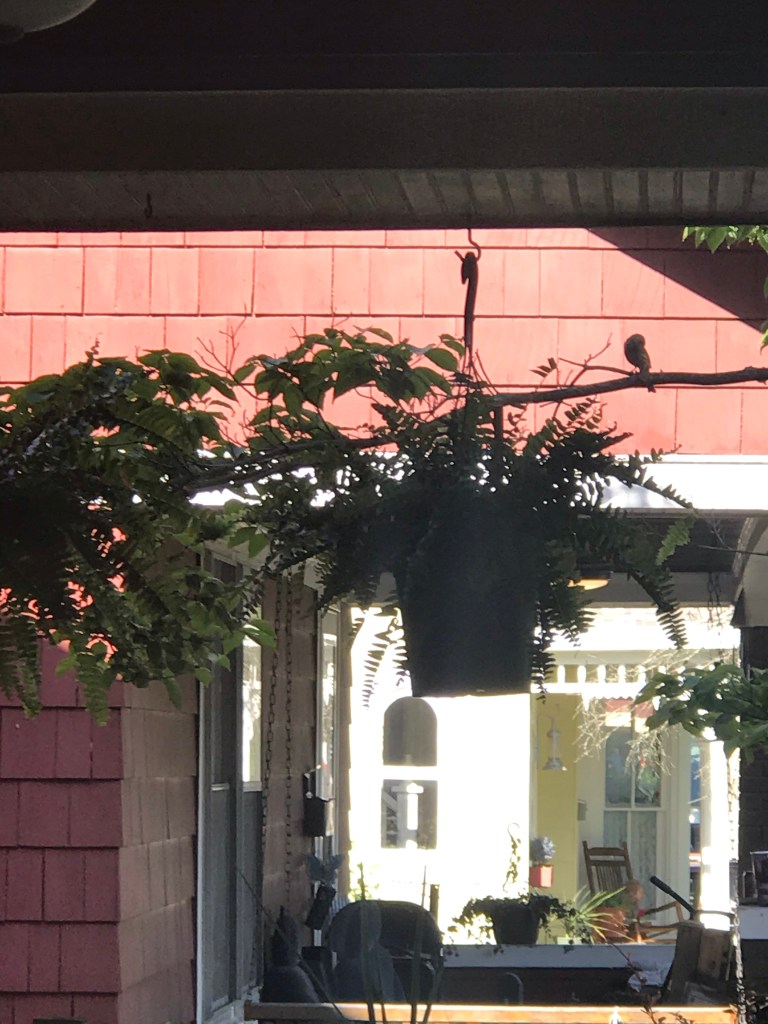
CHARLESTON, Ill., May 25, 2020— A pair of house finches have moved into the scrawny fern on the eastern side of Stacy Lynn’s porch. The mother-to-be finch built the nest secretively sometime last week, and it was discovered today that she had laid four eggs in it. She was seen sitting on the eggs and tweeting. Tweeting as in chirping, not as in Twitter. Finches in this neighborhood are not yet online.

Momma Finch Looks On

Stacy Lynn, the home owner and a new bird nerd, said she was surprised to discover the eggs. “I’ve been hearing that finch and seeing her fly out of the fern,” she said, “but I had no idea she’d made the nest!”

“I’m delighted, and I can’t wait to meet the babies,” she added.

Since the nest will soon be home to a family of six, bird protective services stopped by for a home visit. As the situation was investigated, the male finch, a first-time father, puffed up his red feathers, bold like a cardinal, and nervously watched from a nearby tree.

A cardinal couple on the other side of the front lawn looked on, and six house sparrows and a common grackle made up the crowd that had gathered in the rosebud tree next to the sidewalk.

To secure the little family’s new home, there is a temporary restraining order around the immediate perimeter of the fern. That order, along with a moratorium on the watering of the fern, will help ensure the health and wellbeing of the unborn chicks. Stacy Lynn has agreed to respect the young family’s privacy.

The mother finch and the eggs are safe from the weather in the fern, which is under the eaves, and although the nest is very near Stacy Lynn’s front door, she assures the bird authorities that there hasn’t been much activity at the door in the past two months anyway, so she said the young finch family would not be inconvenienced by the gathering of strange people. All agreed the little family would likely thrive in this location.

The planet is dying, the world finds itself in the death grip of a terrifying pandemic, and American democracy is going down the tubes, but all the creatures in the yard, including a fat angry bee that kept buzzing the reporter, agreed that the news of four baby finches on the way was happy news. Happy news, indeed. It’s a sign of hope and the beauty of life.

“Nothing better to celebrate like new baby birds in springtime,” hooted the barred owl up the block.

Calm, Cool, and Creative

Pandemic. Social distancing. Restaurants and bars shuttered. Cultural institutions and libraries closed. Economic crisis. Political dysfunction. Sickness and death. Uncertainty. Shelter in place. Isolation. Time. Oh my god, it is bonkers, and there are hours and hours of extra time to allow my anxiety to overwhelm me and surrender my spirit to despair and loneliness. And Netflix. And biting my cuticles bloody and freaking the fuck out.

Breathe in through the nose. Breathe out through the mouth.

I refuse to give myself over to loneliness in this time of quarantine, because I am finally starting to crack the code for living alone in peace. Besides, I am not alone. I have my dogs, the internet, and a cell phone with unlimited usage. I’ve already had countless text conversations with my mom, sister, and several friends. I’ve enjoyed lengthy telephone calls with my daughter Savannah in Chicago and my friend Sandra in Springfield. I had a scheduled video chat with my friend Bridgett in Olney, who doubles as my writing coach. All of these “social distance” interactions with beloved people in my life brought laughter, wisdom, and brilliant inspiration.

Deep Sigh regarding Netflix, though, because it is tempting to settle down in front of it and binge watch for days and days. I will not waste time watching Netflix. I refuse to give myself over to Netflix. Ok, so here’s my plan: I will allow Netflix to provide limited, curated therapy. Because if I’m honest, all the news about infection rates and death tolls, economic losses and news about people who are losing their livelihoods, and the daily buffoonage from the White House will make me crazy. The kind of crazy that yoga or meditation or contemplative walking cannot soothe, let alone undo. That’s the kind of crazy that requires me to get out of my own head. That’s the kind of crazy I usually combat by hanging out with friends in a cozy, noisy pub or cheering for a team during a televised sporting event. Netflix will have to step up and be the pub or the basketball game. Periodic episodes of Schitt$ Creek will lighten my mood on rainy days when I cannot work in my yard or go for a long walk. Father Brown’s singular concern for the souls of murderers will make me believe, at least for an hour, that all humans can be cast in their own tales of redemption. And when I think the entire world is going to hell in a hand-basket, I’ll watch a few episodes of the Great British Baking Show and remind myself that healthy competition is, indeed, possible, and you do not have to kill everyone around you or step on people to win at cake, politics, or life.

I am lucky. I am grateful. I have worked from home as a scholarly editor for eight years, so I don’t have to figure it out or patch it together like so many people now are scrambling to do. My job relies on NEH funding, which makes me nervous. But for now, it is secure, my paychecks are coming, and I do not have to worry about food or shelter or paying my bills. My daily life will not change all that much, and I will continue to do work that challenges my mind and makes my heart sing. I am going to continue my yoga and meditation routine, and I intend to be restful and calm during this isolation. Instead of seeing this predicament as forced isolation, let’s say we are hibernating. We are bears, cute and cuddly and warm in our homes, resting up for all the living we will do when humanity finally kicks this pandemic’s ass.

With a little help from my human, furry, and television friends, I will be calm and keep my cool. In the space of that quiet solitude, that beautiful serenity in my lovely new home, I vow not only to stay calm and keep my cool but to also make the most of my time. To cook. To draw and to color. To freestyle my yoga practice. To read half a dozen books and make a worthy effort to catch up on the New Yorker. But most importantly to write. Hours and hours and hours of extra writing. I will keep writing in my daily journal as well as blog and work on the revisions of my memoir. I am going to spend so much glorious time at my computer writing that my aging knuckles will get sticky.

Last week in the Washington Post I read an interesting story about Isaac Newton. During the Bubonic Plague of the 1660s, Newton’s college closed, forcing him home to his family’s estate. While at home, he wrote a paper about some math he was working on (math that became calculus); and he sat under that famous apple tree. I will do nothing so important as inventing calculus or defining gravity in my isolation during the COVID-19 pandemic of 2020. None of the trees in my yard produce anything big enough to knock brilliance into my head. However, like Newton I’m going to be creatively productive in my isolation. I’m going to engage my brain. I’m going to see all this extra me-time as a gift and do my amateur best to make the most of it.

I’ve already made scones and homemade granola and expended a lot of nervous energy doing “art.” Living well, especially under duress, is about the process and the journey. I’m not a chef or an artist, but I enjoy cooking; and drawing, I very recently learned, is a scary challenge that makes me smile like a fearless six-year-old on the monkeybars.

img_9821