Mack, Compassion, and America

I haven’t written a post on this blog for too long. I’ve been busy. An edited volume for my work at the Jane Addams Papers. The promotion all summer of my own book Loving Lincoln. An intense yoga-training course. And doom scrolling because the world is crazy and I am so damned sad about it. Yet this is the hardest time of the year for my personal grief, and I need to write. Last Saturday morning, Mack popped up louder than usual. She knew that I was overtired and faltering.

And so, Mack and I have been on a weeklong retreat together in my mind, and she’s got me thinking. About me a little bit, but mostly about the crazy world that is making me sad. Her presence in my thoughts and in my aching heart space has me pondering where we are and who we are in America. About what I revere about my country. About what I would change if I could change anything to heal all the fractures I see. About what we all need to do to get through this shocking, terrifying time in our history.

I am grateful to Mack’s good spirit for inspiring the conversation and making me find my words. She’s good at that, my Mack, at nudging me back to my writing, my remedy, the only way I know to untie the emotional knots of my fragile, beautiful condition of being human.

Deep breath in…

Long sweet exhale…

Now, let’s talk.

**********

Every single human being wants and deserves a comfortable place to live, good food, and good health; they want to be able to pursue a productive passion, to be safe, and to feel a sense of belonging. All human beings want those simple comforts and pleasures for their families and for their friends.

Compassionate human beings also want those simple comforts and pleasures for ALL people—no matter their gender, race, religion, politics, sexual orientation, economic situation, or immigration status, and no matter that we might not know those people or understand them.

Selfish human beings care only about themselves and their own kind and are willing to demonize others to allegedly protect themselves and those they define as worthy.

The United States is not perfect. It has never been perfect. As a historian of the American past, I could regale you for hours with stories about how we grossly failed to live up to our ideals. Yet the United States of America, a nation of dreamers and immigrants and brave free-thinkers, is a great country because of its diversity, ingenuity, eclectic variety of souls, and lofty, albeit sometimes faltering, aspirations. American democracy—despite all the ways it could be better, despite all the ways it has left people behind—is the best form of government on the face of this earth.

Why else do so many immigrants dream of life in America? Why has the United States for the last 80 years been such an inspirational force throughout the world? Our freedoms and our Constitution, yes. Our legal and educational institutions, yes. Our affluence, yes. But in great part the reason the American experiment has endured and inspired freedom-seeking people around the globe is because America is a free country made up of mostly generous, kind, and hard-working people. People who want to live their own lives in peace and let other people live their own lives in peace. People who care about the wellbeing of their communities, their states, and their country. People who want to feed starving children around the world. People who want to help people facing catastrophes like hurricanes or genocide. People like my working-class American grandfather, who put his body in harm’s way and endured the horrors of the battlefield to liberate Europeans from the Nazis.

I am not willing to give up on America, and I think most Americans are not ready to give up, either. But as our country is imperfect, so is our politics. Political discourse is ugly right now and political norms have been broken. I know many people are feeling fear and despair; and that fear and despair is not crazy, it is real. The political party in power rejects democratic standards of negotiation and compromise, and it has committed itself to policies that protect only like-minded people, rejecting an ethos of compassion for the vulnerable people among us. The opposition party consists of many individuals who have taken far more than their fair share, have clung too long to their power, and have propped up companies and policies that have harmed people, even as they have voted to ensure the basic human rights and comforts of the vulnerable.

I am an unapologetic political partisan; I have always been a liberal Democrat, and I believe with all my heart and my brains that if we want to save our country from the authoritarian threat we are facing, we need to elect Democrats to public office at every level of government. It is abundantly clear that the party in power disrespects the Constitution and is trying to dismantle our democracy. The Republican Party is an existential threat to American democracy and to our inspirational standing in the world.

We are in a full-fledged political crisis. But I also believe that this is not merely a political crisis that we are facing. This is a moral crisis. This is a humanitarian crisis. This is a fight not only for freedom and democracy and justice for all people, but it is also a fight for the soul of America.

Good Americans look out for their neighbors, and they care about people they don’t know. If we are going to save our democracy and write the next, better chapter of our democracy, we need to remember that at the root of everything we do for good in the world is love and compassion and the idea that all human beings deserve security and dignity and peace to pursue their own, individual happiness.

If you believe that some people because of their immigration status or their gender or their difference in any way makes them unworthy of rights and compassion, then you need to have your version of a come-to-Jesus meeting. If you are demonizing others to make yourself feel better about the deportations or to justify your hatred of mythical liberal demons, you need to look in the mirror to inspect yourself for horns. If you are supporting political candidates who believe due process and the rule of law don’t apply to all people equally, then you need to ask yourself if you really wish to live in a democracy at all.

Because here is a little truth for you: there will ultimately be no freedom for you if there is no freedom for your neighbor. Your right to pray to your god or to love who you love or to pursue your happiness in peace is impossible if you stand in the way of another person’s right to pray to their god or love who they love or pursue their happiness in peace. If you support leaders who hurt people and talk about human beings like they are animals or monsters, you are no better than they are.

I don’t wish to deny you your American right to advocate for immigration reform, for example, or to reduce or reform government agencies and policies. I believe in democracy and free speech and the civil exchange of different ideas. But when you advocate for the things you want at the expense of humanitarian concerns and, in the end, at the expense of your own humanity, you will fail every time to create anything that is lasting and good.

If we are going to save our democracy and move forward with a bigger and bolder vision of what American democracy can be and could accomplish, which I think we will do, we have to start from a base of compassion and human decency for all the people in our country right now, whether they are citizens or not. For the sake of our human souls as well as for the soul of our democracy, we need to take care of people who are living in fear of our government, who are in danger of losing their freedoms and their American lives. We need to fill up our bodies with love, despite our vast differences, and stand up to the authoritarians who are trying to destroy everything that is good in America.

And, here’s the thing about authoritarians: every damned one of them is a bully. And bullies are cowards. They are weak, and they have to punch down to feel good about themselves. All we have to do is declare our allegiance to every proverbial little kid who is getting pummeled for his lunch money. It might be scary, but if all the good and compassionate Americans stand up and stare down the bully, the bully doesn’t stand a chance in hell of survival.

The path forward won’t be easy, but it is very simple.

Do you want to be a bully or a protector of the bullied? Do you want to live in a democracy that cares about people or a dictatorship that doesn’t care about anything or anybody?

Like I said, this is a moral crisis. This is a humanitarian crisis. This is a question about who we are in our hearts as human beings and who we are and will be as Americans.

I know what side I am on. Do you?

Peace in War (or Ode to My Anger)

“Slow down” are the words I wrote in the front of my 2025 engagement calendar.

It was warm in October when I wrote those two aspirational words, after two years of writing and rewriting a book of history and my heart. Slow down, body and breath and mind. Yes, ssslllooowww dddooowwwnnn. Slow down, you tired old writing woman with stacks of novels waiting for you.

Slow down sounded so goddamned good.

Before the election.

Before November 6th when I woke before dawn in a panic.

Not good at all, slow down. Slow down? Never. Not now with a madman occupying Abraham Lincoln’s office.

There is no slow speed speed for a liberal political junkie when the people on the good side of good and evil are out of power and evil is destroying our government.

No down time, no do-nothing time. Not so many novels now that there is more political reading and doing and calling representatives and screaming. Not much chance of slowing down for this historian of American stories when America is in jeopardy and history is in crisis.

What now? What then, what words? What word? What theme for this new era of Nero? What aspiration when America burns and Republicans fiddle?

There may be no political peace this year or next year or, goddess help us, maybe never.

But personal peace is what I will need now more than ever.

Peace is my new word. Peace. Among family. Peace. In communion with friends and dogs, birds and soon with flowers. Peace. Of community. Peace. Inner peace. Peace. Peace. Just give me a little goddamned peace.

Peace of mind and peace of home will fortify my body for battle.

Peace is the word I rewrote in the front of my 2025 engagement calendar.

It was cold in January when I wrote that aspirational word, a new want, a better offering, after just one week of the political hellscape, America’s fading landscape, fear pressing its awful shadows against my body and breath and mind. Yes, peace. Pretty please, peace. You must seek peace wherever you can find it, you tired old warrior woman, because this is war and your country needs you.

Mary McDowell and Jane Addams weren’t fucking around in 1915, and neither am I in 2025.

Life on the Anxious Seat

Opening apologies: what started out as a short blog post about one day in my life has become a short treatise on anxiety. Heaven help the grossly pensive woman alone during a winter weekend.

Oxford English Dictionary

Anxiety [noun, early 16th century; Latin anxietas] 1 The quality or state of being anxious; uneasiness, concern; a cause of this. 2 Med. A condition of distress accompanied by precordial tightness or discomfort. 3 Earnest or solicitous desire for a thing, to do something. 4 Psychiatry. A morbid state of excessive; or unrealistic uneasiness or dread.

Anxious [adjective,early 17th century; Latin anxius] choke, oppress: see ANGUISH 1 Troubled in mind about some uncertain event; concerned, solicitous; being in disturbing suspense. 2 Distressing, worrying; fraught with trouble. 3 Full of desire and endeavour; eager for a thing, to do something.

Anguish[noun, Middle English; Latin angustia] straits, distress, narrow, tight; squeeze, strangle: see ANGER n., ANGINA. Severe bodily or mental pain, intense suffering.  [verb] to distress. 1 Distress with severe bodily or mental pain. Now chiefly as ANGUISHED [Middle English]. 2 [intransitive verb] Suffer severe bodily or mental pain.

A Dictionary of American English

On the anxious seat, in a state of uneasiness; troubled. 1839 Knickerbacker [N.Y.]. XII. 345. He did look as if he had been on “the anxious seat,” as he used to say, when things puzzled him. 1862 Stowe Pear Orr’s Island II. i. What a life you did lead me in them days! I think you kep’ me on the anxious seats a pretty middlin’ spell. 1865 Atlantic Mo. XV. 454 Almira … had long been upon the anxious seat. 1887 Francis, Saddle & Moccasin 226 Oh, the boys kept him on the “anxious seat” for two or three days, and that cured him [of card-playing]. 1894 Congressional Record Feb. 2382/1, I am glad to see so many gentlemen on the “anxious seat.” 1906 N.Y. Evening Post 4 Jan. 4. All the men present were on the anxious seat, seeking to learn whether their new judge was ‘easy’ or ‘tough.”

I woke up that morning in a state of uneasiness. By 10:00 a.m. I was in distress. By noon I could no longer sit still at my desk. My heart was pounding so hard in my throat that I feared I would choke on it or that it would burst right through the small hollow of my neck. My pectoral muscles were jammed up against my collar bone, and I could hear the whoosh of blood in my ears. The sound tingled and tapped on the skin of my reconstructed left ear where it attaches to my face.

I stood up and began my coping ritual of pacing and ringing my hands and clutching at my chest. My entire body was being squeezed in a menacing invisible vise. Heart attack crossed my mind at the exact moment I made eye contact with the sweet, heart-melting face of my chihuahua. Bug can almost always calm me, but this was not a troubled mind out of control. This feeling was not unrealistic dread, it was a response to my body in serious trouble.

My sister was out of town, so I texted a neighbor. She took my blood pressure. Twice. Very high, she said. I had no idea what the numbers meant but I could feel the surging of blood in every vein. I could hear my heart screaming.

Anxiety Is Real began as a failed watercolor painting and ended as a moderately successful digital drawing. A metaphor for my life as a work in progress!

Prompt care. EKG. Nitroglycerin tablet under my tongue. A Xanax. Blood pressure almost immediately easing. My sister arrives, which calms me further. The doctor comes back in, her face is concerned which is concerning to me while I wonder why I no longer think I am having a heart attack as her hand presses down on my own, telling me she’s called an ambulance. EMT’s hook me up to wires and the ambulance delivers me five minutes later to the hospital ER, where a beautiful male nurse whispers that I am in good hands. I say this is all ridiculous. I am fine. I must be, right? Or is that the Xanax talking? Another EKG. Chest x-ray. Blood draw. Blood pressure cuff on a fifteen-minute cycle, a monitor of my vital signs quietly beeping. My sister tries to sneak a photo of the beautiful male nurse. We laugh. I am calm. My heart is not pressing against the small hollow of my neck. It is resting in my chest where it belongs. I am not going to die today, even as all the wires attached to my body are no picture of good health. The attending physician enters the room.

Your heart looks good. No evidence of a heart attack. I think you’ve experienced a rather severe panic attack. Has something happened? Are you under a lot of stress or worried about something in particular?

It was November 15.

Ten days after the election.

Yes. The fucking election.

I said it out loud. And no one in the room contradicted me.

**********

The first time I remember experiencing a condition of distress accompanied by precordial tightness or discomfort I am six. A first grader on the school bus, I am silent and watchful, a nervous observer of the noisy chatter and laughter all around me. But there is a little boy crying, and I think, why is he crying? Should I be crying? Should all of us be crying? I notice that my heart is beating hard against my throat and my arms feel impossible heavy.

I think in part because I was a worried child, I became a determined and cerebral child, a self-disciplined and serious child, a skeptic always asking questions, collecting information, believing or hoping or begging that knowing would give me power to quiet my worries. I was a mother hen to my friends, always counting them and watching for loose gravel when we rode our bikes in the subdivision. My dad called me a nervous nelly and a worrywart. My mom often told me to calm down before I worried myself to death. My grandmother once said that if I didn’t stop it and breathe, I’d give myself a damned heart attack.

I became an adult believing I was responsible for my dread, that it was incumbent upon me to swallow it. There is no blame in this statement, because although anxiety was a recognized ailment in clinical psychiatric terms in the 1970s and 1980s when I grew up, such mental and emotional struggles were not everyday topics for discussion. As a kid, I had no way to define or understand the anxiety I frequently felt and, in fact, my privileged, middle-class childhood with luxuries like my own room, competitive gymnastics, and summer vacations to Disneyworld, made me believe I had no good reason to worry.

Lincoln biographers have written that Lincoln’s greatness was fueled by his melancholy. I am on the fence with regard to this historical interpretation while at the same time harboring a personal belief that my anxieties, at least a little, fueled some of the qualities that made me a relatively successful and accomplished human being. As I lived my first thirty years as an adult on the anxious seat, and accepting that perch, I developed healthy (and less healthy) copy strategies. My anxiety manifested itself in detailed organizational tactics, long-term planning, thoughtful assessments of life choices, close surveillance of my daughters, the creation of sophisticated spreadsheets and complex to-do lists, and self-disciplined goal setting. My husband saw me as a control freak, and he wasn’t wrong. I was trying desperately to control what I believed I could control and sometimes to freak level and with freaking-out ferocity. Control freak was another negative moniker, like nervous nelly, that I accepted with my desperate efforts to ease the dread I felt in my body about all of the bad things that could happen to me and my loved ones.

Control never fully soothed my unease, however, and, in fact, it sometimes exacerbated it. I still worried about death, the safety of my kids when they were away from me, family members and friends driving on freeways with semis. I fretted about tornadoes and wild animals outside in the snow and the kids that didn’t make the basketball team and melting polar ice.

Even the healthy strategies I developed only masked the anxiety. I didn’t know it then, but I was trying to hide the pathology of my distress instead of facing it head on and eyes wide open. All of the self-control I mastered within my life and all the pushing aside of all my distress and worry with excessive doing could not protect me from my greatest dread. And when my darling Mackenzie died and life as I knew it unraveled, forty-eight years of living had taught me nothing about how to survive the anxiety her death and my unbearable grief wrought upon my body, my mind, and my spirit.

That all seems like a lifetime ago now. I am not that woman anymore. I am altered, and my life is fundamentally different. My struggle with anxiety, however, did not die with that woman standing in the ruins of her life. As I had to collect new strengths to survive grief, so too I had to reevaluate my relationship with anxiety. And so, in the end, even the anxiety embedded in my DNA has, in many ways, shifted.

For five years now, I’ve been in therapy, wrestling with my worries and gaining acceptance and knowledge about how my brain is wired. A daily practice of yoga and meditation is teaching me that even a person like me who so easily leans into a morbid state of excessive and unrealistic dread, has the power to find inner peace. Simply having the words to define my unease and to better understand it has been a sweet release. I no longer blame myself for feeling anxiety. I no longer call myself a nervous nelly. In basic terms, my struggles with anxiety are no different than my struggle with seasonal allergies. While it is my responsibility to be as mentally and emotionally healthy as possible, I no longer blame myself when all of my best strategies fail me.

Whereas a good spreadsheet will always help me quell a particular financial worry, an orderly house inspires my calm and creativity, and a fastidiously kept calendar gives me confidence in my abilities to navigate the chaos of modern life, sometimes the outside world gets in, dammit, and I am, ultimately, only human. Anxiety is not who I am, but I am a person who experiences a level of anxiety that can make me unwell. To live with it gracefully will always be a work in progress.

The trip to the ER in November was not at all graceful. It was terrifying and humbling and life reaffirming. (And that short ambulance ride was all kinds of expensive). But the caring health professionals who saw me through that panic attack and my wonderful therapist have helped me see that medication can be a useful tool and that given my proclivity to sit in an anxious seat, my trauma and grief, and the very real political and planetary uncertainties, I am doing okay. In the two weeks since the inauguration, I have experienced several days of heightened anxiety, particularly stressing the threat that changing federal policy poses to my livelihood and my life’s work.

In last week’s therapy session, I expressed a feeling of guilt not only about all the health care consumed for a panic attack but also for having the luxury of all this naval gazing when so many less fortunate people are in real jeopardy. A holdover from my childhood that my life is too lucky to feel debilitating dread. My therapist reminded me that the anxiety I feel is as real as a heart attack and that I can help no one if I am unwell. She also urged me to consider the idea that my anxiety over the election and all of the chaos and uncertainty since the inauguration is exacerbated by my empathy and heightened concern as a historian for the wellbeing of my country.

She is not wrong to refocus me in this manner. There are real worries in the world AND I am a person wired to worry and vulnerable to unrealistic dread. Thus, my unfortunate trip to the emergency room. It is much easier for me to feel the pain of empathy, however, than to breathe through anxiety, even as I must admit that I worry so much in part because I care so much. Still, empathy was never my problem. Empathy did not cause my panic attack in November, and it is not the reason I have been sitting on the anxious seat these past two weeks. The reason I am anxious is because my messy beautiful imperfect brain is misfiring. Knowing this doesn’t make my brain better, but it makes me feel better, if that makes any sense at all.

It is absolutely true that all of the processing of anxiety I have done over the past five years has been worth the effort, even as I could see that it failed me in November. I understand myself better than I did five years ago. I am more accepting of my human imperfections, and I honor every experience. From the stresses of writing a new book to the worry I am feeling about promoting the book beginning this summer and from the dread that sometimes creeps in late in the night to a troubled mind that makes me spin out the worst political and historical consequences of a disastrous election, as distressing and uncomfortable it all might be, it only becomes debilitating anxiety in the manufactured mess of my dear old brain.

Anxiety. Anguish. On the anxious seat. All of it is me and it isn’t all of me. When anxiety rises in my body, it is real and it is emotionally and physically painful. It is not a figment of my imagination. It is my struggle, part of my story, a colorful descriptive inset on the perfectly ordinary crazy map of my life. And the only difference between me and so many other people I know who experience anxiety (it is a common struggle in our society) is that I find solace and affirmation in writing about it. I have a lot of fears, trust me, but sharing my truth is not one of them. I share because it gets the sharp edges of hard experience out of my body and there is always the chance that I will reach someone out there in the world who thinks she is all alone. Okay, so that can be my excuse for this anxiety treatise. These are anxious times, and I believe a lot of us are feeling anxious.

I wonder. If all the people sitting on an anxious seat all alone decided to sit together on one giant anxious seat, we might just have evolutionary power to rewire the future. 
Falling

I stepped outside into the warm sun and despite the brisk Autumn air, too cold for bare legs, my summer-loving heart was smiling. My freckled face was a feeling-good grin and giant sunshades, framed by freshly crimped hair. I was puffed up and downstate pretty in my Lotus-for-POTUS t-shirt, wool lumberjacket, leggings, and purple Allbirds sneakers with chunky white soles. I was a little full of myself if I am honest; and that vanity pause to congratulate my casual, put-together cool was my downfall.

I should have gone back into the house to humble up and check my conceit at the door instead of skipping down my porch steps and up the sidewalk toward the town square.

Because thirty seconds later, I was falling, tumbling down in instantaneous slow motion, landing hard on my right knee, a victim of my mirth and the broken, sidewalk slate at the corner of my front garden.

My hands burned from catching myself on the ground, but I pressed them down and rolled myself over onto my back. I grimaced. A flaming hematoma was blooming on my knee. I looked up at the blue sky and accepted my prostrate position. I breathed into the vulnerability of my human, middle-aged body.

One minute you’re open-hearted and skipping. The next minute you’re flat on your back and humbled. Hello, life, you bastard. I didn’t need this metaphor from the cosmos, by the way. I know full well that every day and life itself is up and down and sideways. And falling.

Some people say: “when life gives you lemons, make lemonade.” I now will always say: “when life brings you down on your knees, roll over onto your back and have a little think.”

I cared not that someone might see me and look away or pass by and not see me at all. I did not rush myself to get up and get going. I am not British. I do not keep calm and carry on. I am a grieving mother. I take my time to gather all the good and the bad and the ugly before continuing on my way. In part, I stayed still on the ground because I worried about my ability to get up and walk. But mostly, I just wanted to be still for awhile, feeling the cold ground holding me up.

A European starling flew overhead. I imagined that her affected screech was for me. A greeting or acknowledgment, a shared moment between fragile creatures confronting their particular days.

I noticed the sedum turning fall, the grass still emerald, house sparrows conferencing in the barberry bush, and a dog barking far off in the distance.

I rubbed the dirt from my hands. I touched the leggings on my throbbing knee. The fabric was not torn, but I could feel the swelling and the scraped skin underneath it.

I thought about Mack and the election and the novel waiting for me at the public library’s circulation desk. I thought about the difficult week I had just had, my lovely birthday party with my family, and the quiet, restful, lazy weekend in front of me. I thought about summer gone, fall’s arrival, and the coming of winter. I thought about falling and walking. I thought about my dogs inside the house and the pumpkin-bucket of Halloween candy on my dining room table.

When I was ready on my own terms, I stood up, gingerly testing my knee. It was boil sore but bravely bearing my weight. I was hobbled but strong enough to get on with my day. I was no longer full of myself, but I was okay.

Life is hard. It knocks us down. It leaves us with bruises. We are always falling, I suppose, in this way or that way. Falling reminds us to be in the moment, that we are human, and we are alive.

Dissonance

Recently I began a new project that combines writing and painting. Since I am a comfortable writer but a novice, unskilled painter, I planned to write a series of short essays and then illustrate them with watercolor. My therapist suggested that I experiment with the reverse, paint first and then write an essay. It was a terrifying prospect, so I put it off until  two weeks ago when I had an idea for a safe test, a photograph of myself doing a cartwheel in my yoga garden.

The painting is ridiculous, much like the photograph, which I thought would provoke a funny essay about how bad I am at painting, how weird it is that I like being physically upside down, and how unusual it is to be a 57-year-old woman who can and frequently does turn cartwheels. But it was not a humorous essay, even as my right humerus bone in the painting is a hoot of disproportion. The essay had nothing at all to do with my joy of cartwheels and the good rush of blood to my head. The words that came out of me instead were an emotional outpouring of how upside down I have felt all this year. Not the good kind of upside down, like a downward dog or a cartwheel, but a bad upside down like discombobulated. Dizzy. Dazed and confused. The kind of upside down that makes me want to vomit.

Grief and loneliness and the uncertainty of this damned, crazy world always make me feel sideways. Feeling sideways is just life. Nothing special about me. We all have forces that knock us askew. I have learned to balance the kind of sideways that life inflicts upon me. I counter it with creative and calm remedies I daily employ to stay upright. I practice yoga. I write. I paint. I walk, cuddle my dogs, and watch birds. Yet all during this productive year, this contented, creative, cathartic year, a new and different force threatened my uprightness. Numbers. Stupid numbers. All in my head, but these seemingly real numbers had done a number on my equilibrium; 10, 30, 57, and 80 had turned me upside down.

Mack should have turned 30 in March, and on October 7, 2024, she will be gone 10 years. Mack has been gone half the time she was here on this earth, and it is a fact that astounds me. I cannot bear it. The truth of it has been impossible to face, and spending the past twelve months being the age my dad was when he died made it more difficult. Being 57 has been like having an anvil of death hanging from a thread above my head. My dad should have turned 80 this year, and though I know so well the sharp edges of living, year after year after year, without my daughter, I want to see 80. I need to keep Mack’s memories for so much longer than a decade.

A week after painting and writing the upside-down essay, I sat at my laptop to write this annual blog post to commemorate the anniversary of Mack’s death. I couldn’t do it. I was worked up by what the painting-first, writing-second process had unearthed and unleashed. It is not at all a bad thing to examine my emotions but looking for answers to my upside down made it hard to find the words to express my state of disorientation, my fear of the numbers.

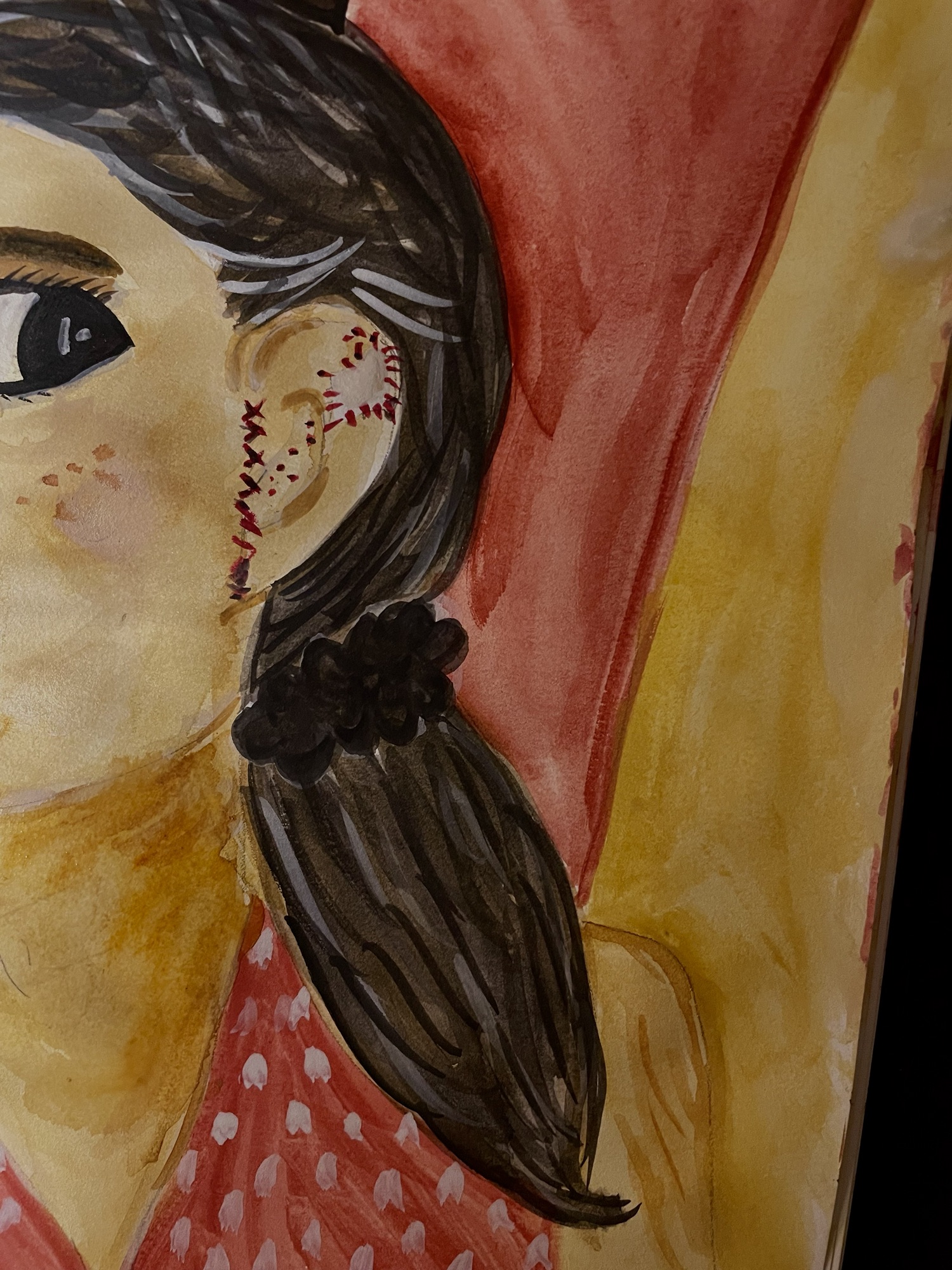
But while I was stumbling and struggling to right myself, I got an unexpected email. A watercolor of mine was accepted for publication in a quirky online journal called Waves. It was a self-portrait I had done while recovering from the deep removal of skin cancer from my ear. I painted it to find humor in my fear about the plastic surgery I would have to repair the damage. The issue of Waves in which “My Left Ear” appears is entitled “Dissonance.”

Dissonance. Yes, that is precisely what I was feeling.

Dissonance: the lack of harmony among musical notes.

Dissonance explained my year, my numbers, and my false belief that I was upside down in a bad way. Some notes of my life this past year have been lovely chimes out of creative flurry, the completion of a new book, professional accomplishment, and the establishment of new friendships. Other notes clunked from fear, exhaustion, and physical pain. The note of those damned numbers clanked. The note of no yoga for five weeks of convalescence honked like an injured goose. The note of my trepidation of a new project I wasn’t sure I had the talent to do justice thumped a little too deeply to be good bass. And grief, oh my dear constant grief, is always an unharmonious whisper.

Dissonance is awkward and unpleasant, but it makes you long for melody. It makes you want to hear and see and feel your life differently. I had lost my tune. My song was, indeed, dissonant, but I was still singing.

In painting, perspective is one of the hardest skills to master, much as perspective in real life is almost always hard learned. Recasting my year as dissonance didn’t erase the worry that had plagued me, nor did it give me hope that the next year of my life will be harmonious or even a little less dissonant. It didn’t help me figure out how to write about what it means to me that I’ve passed ten years without Mack, either. A perspective of dissonance does, however, give me back my beautiful and necessary upside down, my downward dogs and my cartwheels. Oddly, too, the idea of dissonance is a gentle reminder that I am only human.

A definition of dissonance might also have soothed my dread of those dastardly numbers.

No.

No, actually, as Mack’s spirit is reminding me as I write this, it is just that the year of awful numbers will soon come to an end. After breathing and sobbing through another October 7, I will turn 58 on October 9, and then I will fall sideways into whatever future starts for me on October 10.

There is precious little we can control. Life will blow us off our feet in terrible and beautiful directions we cannot predetermine. Dissonance is just the range of all emotions, the far and wide of the good, and the depth of the sorrow that life gives us. Dissonance keeps us awake and alive. It helps us appreciate the precious melodies. Mack is alive for me in my dissonance and in my melody. She is with me in the joyful upside down. She will be with me ever still, going forward, laughing at my ridiculous paintings, teasing me out of the dark hours, and singing be back into tune so I can keep her stories and continue writing and painting my own.

On painting Mack: I find it very painful to paint her face and to imagine her in watercolor. Watercolor is like a dream, and I long to paint her alive. I have tried and failed to capture her lovely spirit. When I paint anything else, I am fearless, but painting Mack opens a vulnerability that is terrifying. But, when I am brave, I will keep trying to do her justice. My painting, after all, is not art, it is therapy. It will remain a work in progress, just like me.

My Poor Ear and a Little Clarity

Awake under the surgical drape, I can see the torso and knees of the nurse monitoring my vital signs. She is sitting in a chair next to me, and I can read her badge. “Shirley, RN.” A middle-aged name. My age or older, I am guessing. There is another nurse behind her who leans down to peak at me under the drape. “You all right under there?”

“Yes,” I reply, but I don’t believe it. Given the tremble in my voice she probably doesn’t believe it either. She smiles at me with her piercing blue eyes. She is younger than Shirley and me.

I am lying on my right side with only my left ear and cheekbone exposed above the surgical drape, which is adhered to my face with sticky tape. There is a firm pillow at my back and a softer one between my knees. I would be comfortable if I wasn’t on an operating table about to be sliced up and stitched back together. I could be sleeping right now if not for the thumping beat of my heart and the nightmare of the full-thickness skin graft that will soon be cut from a healthy place on my ear to seal the wound at the edge of my ear caused from last week’s removal of a spot of basal-cell carcinoma.

Oh, no, my poor ear. My perfect, cute, little ear.

But this is what happens when you are a sun worshipper who spent the 1980s lathered up in baby oil and sunbathing on foil. This is what happens when anxiety keeps you away from doctors for ten years because the medical profession failed your daughter. Basal-cell carcinoma bores through cartilage if you ignore it, like I ignored it. How long did I know that spot was no bug bite? How long did I pretend it wasn’t there? So long. Too long. Long ago and away in my denial.

So here I am on a Monday morning in an operating room. Naked under a thin, cotton hospital gown, I am helpless in the hands of five medical professionals who do not know that I am a historian, a mother, a yogi, a lover of dogs and birds and Abraham Lincoln. How weird it is … how unreasonable … how crazy … how amazing … that we give ourselves over to doctors and nurses, human beings just like us, who sometimes burn their toast and forget to water that lonely Monstera adansonii on the sideboard, so far away from all the other plants that get watered on Fridays.

Be careful with me. I have two dogs at home, and I need to water that plant on my sideboard.

I am untrusting and petrified and scared like a wide-eyed child, but no matter my circumstances I am always compelled to be observant. My eyes dart around to see all I can see through the narrow opening of the drape, expertly tented to quell claustrophobia. A steel cabinet with drawers stands against a gleaming white wall. A gray power cord trails below a table. The black scrub pants of the blue-eyed nurse are cinched by flat, gray drawstrings with a single red stripe at each end. Shirley’s chair is a standard black office chair, which seems odd to me and makes me smile. There is a green light on the bottom of the monitor tracking my vital signs. I guess that means I am alive.

Wow. This experience is almost cool. I mean, it’s not every day you get your ear reconstructed by a plastic surgeon. It’s not every day you are awake in an O.R. I pretend I am an attractive patient on Grey’s Anatomy. That gorgeous Dr. Avery will be here any moment to make me gorgeous, too.

I am ridiculous.

I inhale deeply and slowly and then count down my exhalation. Seven … Six … Five … Four … Three … Two … One.

Gasp.

My first surgery is plastic surgery! And I’m awake for it? I am so afraid of the cutting and the pain and the stitches. I want to go home. I need to go home. Now. Please.

“Hush. You are strong, and you are lucky.”

It is my inner warrior speaking to me now. That warrior born from the husks of a grieving mother has arrived to do battle for me. “The skin cancer is gone, and this is a simple repair. You heard the plastic surgeon; this is nothing in the realm of plastic surgery. And look at you. You made it to fifty-seven without surgery, major injury, or serious illness. You delivered two humans into the world. It is okay to be scared, but you can do this.

Oh, shut up.

Inner warriors are so annoying sometimes.

The surgical nurse is now cleaning my ear. I can hear her working, and I feel the cold saline when it arrives at the back of my neck, beyond the reach of the lidocaine. She stuffs cotton in my ear. I know it because I can hear it, THUNDEROUS and SMOOSHING. Now faded away is the jazz music I selected, because, did you know, that awake patients get music dibs over surgeons?

A bright light comes on above me, immediately hot like the Midwestern sun I have tearfully broken up with, because it has, like a cheating lover, betrayed me. I start to sweat under the heated blankets the surgical nurse had so kindly draped around my body to keep me safe from the blasting chill of the operating room, even as she pushed me so dangerously close to a silver tray of scalpels.

Damn. I wish I had not seen those scalpels.

My surgeon arrives and taps my shoulder. I struggle to hear what he is saying, his gravelly voice difficult to understand even without the cotton muffling. He has decided on a different approach, he says, to improvise a better repair. “Watch this,” he says to the nurse. “You’ve never seen this surgery before, because I just made it up.”

Do I look like a guinea pig to you?!!

Oops. I said it out loud. There is muted laughter. “Two incisions instead of three,” he says. “You’ll like it.” He taps my shoulder three times.

Blue eyes smile at me again. “You still okay under there?”

No.

“Yes.” This time I want to mean it.

Then the cutting begins. I hear it. I feel pressure and pulling. The surgeon gets traction or steadies his hand by leaning on my left arm. Then there is sewing. Loud, unapologetic stitching. My ear is a megaphone turning the slipping of delicate sutures into the sound of rope and tug of war. Slip. Tug. Slip. Tug. My face is pulled taught. I feel pressure, but there is no pain. I feel my heart in my throat, but I don’t stop breathing as I listen to Dr. Frankenstein making his monster.

I breathe with my eyes wide open. I breathe with my eyes shut tight. I think about the new walking shoes I need to order this week. I wonder what my sister is doing out in the waiting room. My stomach rumbles, and I think about what I will eat for lunch before the lidocaine wears off. I imagine Bug, at home, sleeping on the back of the couch. I hear the surgeon singing. Is that Jimmy Durante? The sound is deep and lovely, and I think how funny it is that a person’s singing voice can be so different from their speaking voice.

After a month or forty minutes, the surgeon taps my shoulder. “You did good, kid,” he says.

No yoga or strenuous exercise for at least two weeks, so I’ll be leaning a little more on watercolor. Painting my poor ear was oddly therapeutic.

He’s right. I did do good. I did not deploy my plan to secure the strings of my hospital gown and run like the wind for the Illinois prairie. I breathed through all the fear and the disconcerting vulnerability. I breathed through all the cutting and the stitching. I managed my anxiety like a warrior.

What’s more, I am still a kid, but not only a kid to my chubby, singing surgeon who is in his mid-seventies. At fifty-seven, I am still a kid to me. With every new experience, in the face of change, or when standing on the precipice of the unknown, we are all babies. In these moments of course we are scared, because in these moments we are actively learning about the terrifying, wonderful world and learning how to survive what life is throwing at us. In this particular fascinating moment in my ordinary life, I am, indeed, just a kid. Young and scared and hopeful.

It Is Not Just the Birthdays

It is not just the birthdays.

Pulling on a warm, cozy sweatshirt from the dryer on a winter day can do it. Sunshine on my face. A Jeep Wrangler passing me by on the street. The sound of laughter, far, far off in the distance. The color of Cool Blue Raspberry Gatorade. An ordinary Tuesday can do it.

Pepper, who was her dog first, can do it. Does it most days these days, now that she is fifteen and her health is failing. Bug barking at the FedEx truck idling in front of the house can do it. Can do it despite never knowing the girl I lost. Can do it because she will never know the way that girl loved animals.

It is not just the birthdays.

The old days and the new days can do it. Joy or longing. The known or the unknown. The love or the loss can do it, and the yet to be found will do it, too.  

Everything, anything, and nothing at all can breathe a memory to life. And every memory has the power to undo me. Or to soothe me. Or to bring me peace. No particular time, setting, or frame of mind makes me more or less susceptible to the undoing or to the soothing. And goddess knows my grief has never followed any rules to bring me peace. 

It is not just the birthdays. 

But it is the birthdays.

The birthdays and the death days and the holidays. Milestones are a cumulative burden upon the hearts of the grieving.

On March 17, 2023, the day Mackenzie would have turned 29, I face another milestone. Another birthday, another her day, another Mack Day. And all I can do is lean the way the memories make me. All I can do is surrender. Bending is so much easier than breaking.

Maybe this year I will be lucky. Maybe this year the memories will arrive gently, possessed with the kindness to soothe me as well as the grace to bring me peace.

My Father’s Hands (but not his soda)

I have my father’s hands. My knubby-knuckled fingers upon my keyboard are his knubby-knuckled fingers, our pinkies, inward crooked, brave in their stretch to meet the A and the L. My manner of typing is just like his was, my short fingers tapping furiously like the bones of ancients punching out words that refuse to be quiet. The backs of my small but sturdy hands, are, like his, bony and painted by prominent veins, weathered and textured with life. Since my father died, when he was barely 57 as I will turn myself this year, I have not wished for the smooth perfection of the model hands in skin cream advertisements. My hands are far more lovely, freckled with memories of my father.  

Shared, these hands of ours, like our flagrant foreheads, forceful minds, and fierce opinions, delivered through thin lips, not pursed so much as certain in the forthrightness of the words they breathe. I miss my dad, especially since Mack died, the loss of them entangled in a knotty central ache that resides in my solar plexus. Whereas Mack’s spirit sits upon my shoulder every day pointing me in the direction of joy, my dad’s spirit rides shotgun on my conscience. Mack reminds me to giggle in the present, and my dad reminds me to do right and plan for the future.

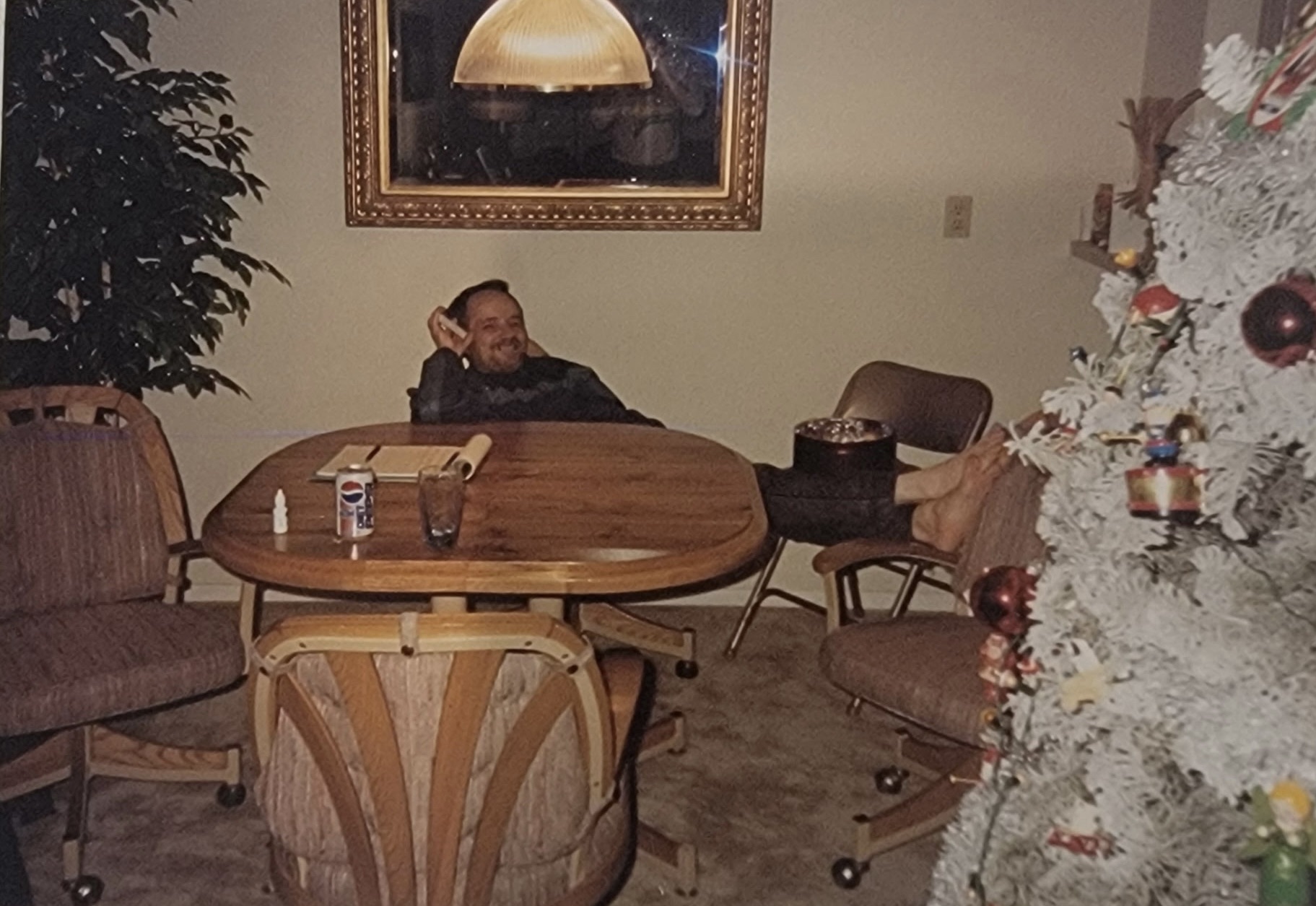
Every year since Jim Pratt left this earth, I have honored his joyful life by drinking a Pepsi on his birthday. He was passionate about Pepsi, a Pepsi zealot really, preaching its virtues over godless sodas like the Dr. Pepper I favored as a child, although it was not allowed in our household where Pepsi was religion. Even though I no longer drink soda (my dad called it pop), and despite the fact that I observe a tradition of no-sugar Januarys, for love of him I have a Pepsi every January 17. It has been my Pepsi-for-Pops tradition.

Although I have my father’s hands and his forehead, I do not share his love of Pepsi. I never have. I hate it, in fact. It is too sweet, too syrupy, or too something I’m not sure what. My dad was right about a lot of things—like the wonder of words and baseball and candy and ice-cream drumsticks and showing off while shooting pool. (Thanks to my dad, I can still make a great shot with the cue stick behind my back, my ass perched up on the edge of the pool table).

But my dad was wrong about Pepsi, poor dear. And after twenty-two years of consuming 250 calories of the wretched liquid in no-sugar Januarys, I’ve decided to alter the tradition to make it a more palatable one for me. I will still break the sugar fast and have a soda in honor of my dear old dad, loved and missed like the dickens. But henceforth it will be a delicious Dr. Pepper that I consume. I trust my father will appreciate the sentiment of my continued sugar-fast-breaking-soda toast to him on his birthday and also approve of his daughter’s newfound sugary beverage independence.

A Pop for my Pops, a new tradition that honors us both.

October 7

In late September 2019, I was emerging from the dense fog of grief, but I was still wobbly with heartbreak, and I was terrified. I was facing a new life on my own, packing and preparing to close on a new house in a new town at the end of the month. Change is a challenge in the best of circumstances. It can uncomfortably bend or break us even when we are strong and well-prepared. It is risky and daunting when you are grieving. It had taken every grain of grit I could collect from the ruins of my old life to set in motion this plan for building a new one. Even small things like a superficial papercut from a cardboard packing box could provoke an anxiety attack. I was a wreck that month, and before I moved I knew I needed to calm my nerves and find my courage.

So the weekend before I was scheduled to close on the house, I drove from St. Louis to outstate Missouri to visit some old friends from my Springfield days. Kurt and Alicia are two of my most calming influences, and I needed to soak up their good sense and soothing natures. I was relaxing on their beautiful deck, just settling in for a peaceful weekend, when my realtor called to tell me that he needed to push back my closing by one week, a minor glitch regarding the title. He said the closing was now scheduled for October 7.

October 7.

I sucked in my breath.

“No…No….No,” I whispered into the phone. “I can’t do October 7.” I told him I’d have to check my calendar and call him back.

Oh, Mack, how I miss your face.

I could not possibly start the new life I was planning on the very day my old life fell apart. October 7, 2014, was the day my darling Mack was taken from me, and every October 7 since had been a horrible reenactment of that nightmare of a day. October 7 was not just a day on the calendar. It could not be scheduled or rescheduled. It was a memory, a misery, a mark in angry, black Sharpie upon a terrible page of my life.

Kurt calmed me down, and then I called Savannah. My savvy and sassy elder daughter is my joy and my salvation. She is the reason I keep breathing, and she was my inspiration for taking hold of my life and making this plan for moving forward. I told her the realtor wanted to reschedule my closing for October 7. She sucked in her breath, and then she sighed. “Oh, my God, Mom, they want me to start my new job on October 7. Maybe we both need to say yes. Maybe Mackenzie wants us to remake this day.”

And so we did.

On October 7, 2019, Savannah started her exciting and better paying new job at a tech start-up in Chicago, and I closed on my charming 1919 bungalow and moved into my new life. It has not been an easy path for me. Learning to live alone, to maintain an old house on my own, and to build a new life in a very small town has been a struggle. The pandemic also interrupted my adjustment, of course, and I am still plagued with doubt and anxiety. However, I have made some great strides here in this old house and new life. I have discovered hidden talents, developed new skills, and collected a lot more grit in this effort. Most importantly, I have accepted my new life and my new self as a collective work in progress, an unpredictable journey upon bumpy roads with glorious scenery as far as my eyes can see.

I have survived three October 7s in my cozy, quiet bungalow. This year, I will survive a fourth. I will, if I am lucky, survive many more. October 7 remains more than a date on a calendar. It will always be a memory and a misery, marking the passing of my beautiful girl. But now it also marks the moment I began curating my own peace in my own place in honor of both my daughters. Savannah inspired this remaking of October 7, and Mack’s spirit may well have engineered it.

On every October 7 for the rest of my life, I will relive a mother’s nightmare and feel the loss of Mack more keenly. I will also give myself permission, with a happy license from Mack, to acknowledge every October 7 as the first day of my bold beginning. I have come to believe that all dates on a calendar are more than dates on a calendar. In the end, every day we breathe is momentous, and no date over the course of a lifetime is all darkness or all light. Each date of the year in every year of every life is a collection of stories, snippets of who we are and all we have experienced in our lovely and fragile human existence. Dates on a calendar make up an index of our history, marking our memories in time.

Mine All Along

Since April I have been writing and writing and writing, hard at work on my unusual biography of Abraham Lincoln. Nearly 80,000 words have flowed from my fingers, revealing the need within me to get my relationship with Lincoln and the field of Lincoln Studies out of my body and safely onto the page where it will no longer be unfinished business. Fits and starts, this writing, as strange to me as this biography-slash-memoir-slash battle cry, because everything I write since Mack died is hyphenated with battle cry. Writing this genre-bending book has been a scary struggle, artfully melding history with personal narrative has posed new challenges for me. I am making progress, but the process has been messy and painful. I’ve lost myself and my way a dozen times these past five months.

There have been crazy flurries of frenetic writing, words flowing onto the page like refreshing cold water gushing from a garden hose on a hot summer day. However, progress has often been followed by historic droughts, which leave my mind and my heart parched and thirsty for the words that will not come. Words abandoning me and my fingers sitting idle on the home keys are new experiences for me. I’m not used to these dry spells. I have been lucky in my writing life, rarely blocked or conscious of writing, the writing itself a joy and the research or preparation for writing the difficult task that paralyzes me. I’ve always been a weird historian that way, and I do not like this new feeling of writer’s paralysis.

Yesterday, when I was supposed to be writing on a free-and-clear Saturday reserved for working on the book, I was instead sitting on my porch, rocking and staring out into the front garden. As I was working up the nerve to return to my computer and risk another rejection from words, the mail arrived with a neatly addressed envelope postmarked Kirksville, MO. I knew my writing was done for the day. Because I also knew the letter was a handwritten thank-you note from the latest Truman State University recipient of the Mackenzie Kathleen Memorial Scholarship. The eighth such letter. The eighth scholarship bestowed on a creative writing student at Mack’s alma mater. These letters are a solace. Eventually. After good a cry and a little distance. First, however, they must do their damage. They must crack open the wounded side of my heart, scabbed over since last year’s letter arrived. The scholarship is a beautiful legacy to my beautiful daughter, but it is a starling reminder of all the life my baby has missed since the previous scholarship recipient was named.

Dammit. It never gets easier. It gets different, but it stays brutal, hard, and unforgiving.

This is why, for me, writing and grief and life have been braided all together into a thick strand of rope. Some days the rope is around my neck, threatening the breath within my body. But most days the braid is a lifeline. Thankfully, I have learned not only to see that lifeline but to take hold of it and let it save me. The arrival of this year’s letter coinciding with my cursing the failure of the writing was a reminder that life is the reason and should also be the respite.

Aha.

I think right now I am struggling because for the first time the writing threads of my braided lifeline are loose or a bit frayed. For eight years the writing has supplied the tension necessary to hold my weight, allowing the balance of grieving and living to be less burdened. I am far less adept at striking a healthy balance without the writing. I need the writing, and it scares me that the words have failed me. I understand these truths. I accept them. But I also know that writing this very personal biography of Abraham Lincoln has stirred up a brand new cocktail of emotions, opened old wounds, and triggered doubt. My work, my writing, my life, Mr. Lincoln, and my darling Mack are tangled up all together in this project, and I took for granted the power of the writing to make sense of the knots.

And so, on a day of writer’s block and the arrival of a letter, I gained some clarity. I have no answers, really, and the doubts they do linger. However, I have named the trouble and it is mine, not the writing, to tackle. A dear friend who is also my writing therapist recently told me I needed to step away from the writing in order to play. In other words, I need to let life carry the heavier burden of my braided lifeline.

The trouble is that I have not been so good at living these long eight years without my girl. I have rarely had the energy or the mindset for play. Work and writing, along with yoga, have been my saving graces. My challenge now is to lean into living, which a recent long weekend away with four of my oldest and dearest friends showed me I can do with energy and with joy. I need to cut myself a little slack and live. I can no longer take the words for granted, because it turns out my Lincoln book needs more of my own grit. I have been confident in this unusual writing project of mine, but I have doubted my ability to do it justice. The fear, I think, has scared off the words that have always flowed naturally and unencumbered. If I want to complete this project—and more than almost anything I’ve ever attempted I want to complete this project—I need to dig deeper. I need to locate in my bones the belief that my life is the power, not the words or the writing.

My life is the reason this unusual biography of Abraham Lincoln is possible. My knowledge and my experiences will guide me if I let them. Mack and the grief and my writing texture the story I want to tell and need to tell, but the living must fuel the narrative. Because this is a story of my life, and I cannot tell it on autopilot. I need to be present for the process and remember that I have all I need to do the work. I still have a full year before the manuscript is due. I have 80,000 words already. I have the historical expertise and a damn good story to tell. There is time to find myself in this project, to make sense of what I have written thus far, and to write what will be needed to complete the story. If I let myself live while I’m looking for the truth this work requires, the words will come. They will arrive when I am ready to summon them, because I they were mine all along.