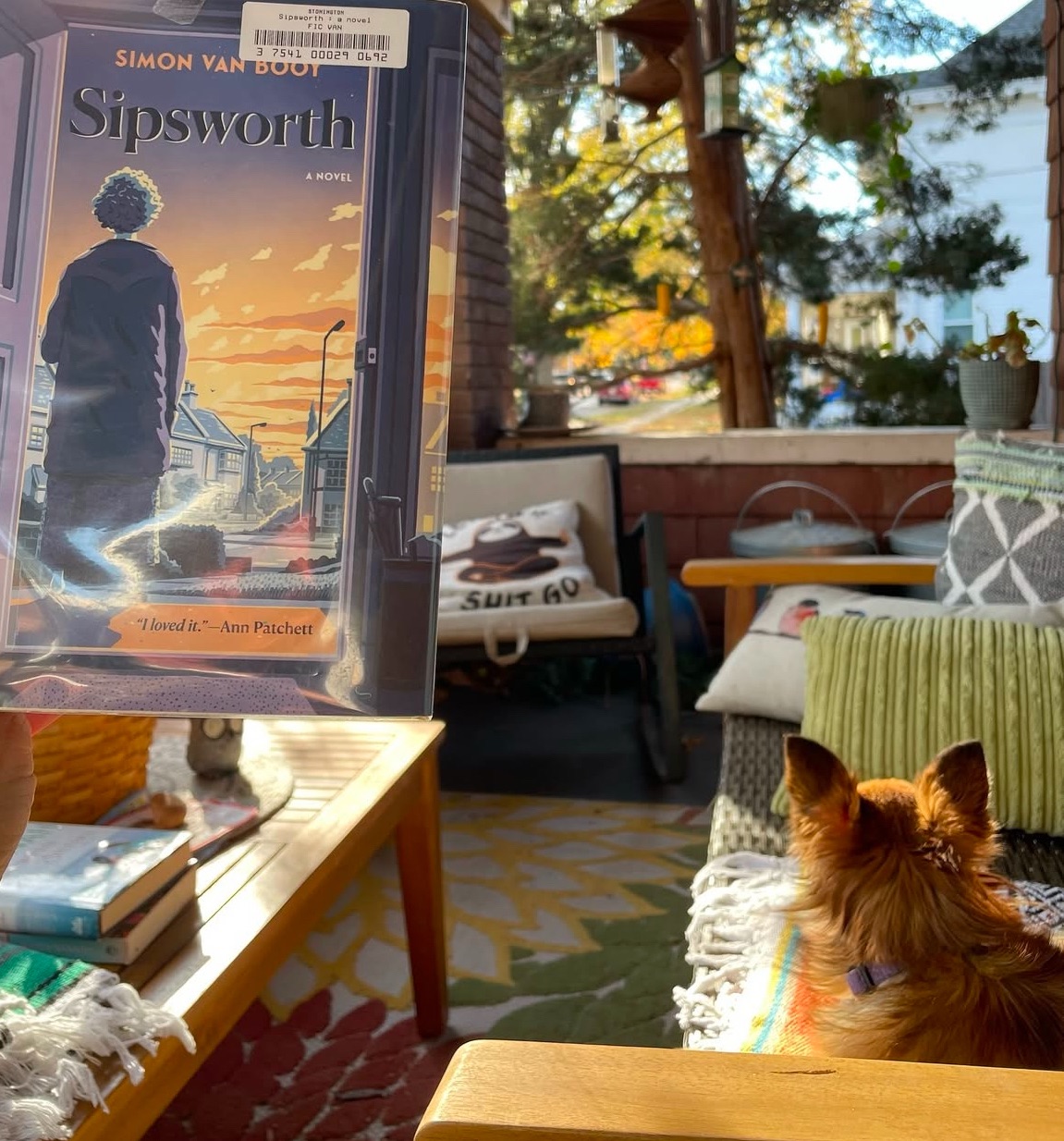
My Favorite Book of the Year (and favorite Instagram book review pic): Sipsworth by Simon Von Booy
As I finished reading my final book of the year in late December, I realized my year of reading in 2024 had been different. Brighter. Better. My very best year of reading, ever, in fact. Not because I read more books (I didn’t). Not because I read more wonderful books than usual, either (last year was more jam-packed with the exceptional). It was my best year of reading because I was present for every page of it. Even during the difficult moments, my reading was deliberate as well as joyful, all for love of good writing, learning, and a compelling story. I did not read to escape fully from this life or to blur the lines of my personal struggle.
I read to be present, much as I do yoga to be present.
All my life, except for four years during my fog of grief when I could not read at all, reading has been a joy, fed my curiosity, or helped me to escape my troubles.
In 2024, reading was a joy and fed my curiosity, but it helped me to balance my troubles with all the good in my life. Each book was what I wanted or needed it to be at any given moment, because I read it wide awake and open. I never read to pull the covers over my head. Reading was not a remedy. It was not merely a joy. It was a life force. Much like the breath in yoga. In and out, intentional and nurturing.
In the spring during my skin cancer diagnosis, Mohs surgery, plastic surgery to rebuild my ear, and the six long weeks of rest when I couldn’t walk briskly or get on my yoga mat, I was able to read. Yet my reading did not simply take me away from pain and worry, it engaged my senses and poked and prodded my emotions and intellect. The night after a panic attack that sent me to the emergency room in mid-November, I was able to read, but reading didn’t let me off the hook. Rather it helped me hold the doubt and find the sweet divine of stories other than my own. Throughout the hectic, year-long post-writing work on my forthcoming book Loving Lincoln, my pleasure reading was not just an escape from stress; and audio books were not just a rest for weary eyes. Reading or listening to a book was an energetic, purposeful pledge to be awake, the same euphoric release of a brisk walk, an hour’s work at my watercolor painting, or a lively discussion with a smart friend.
And maybe my beautiful new bookcase is the perfect 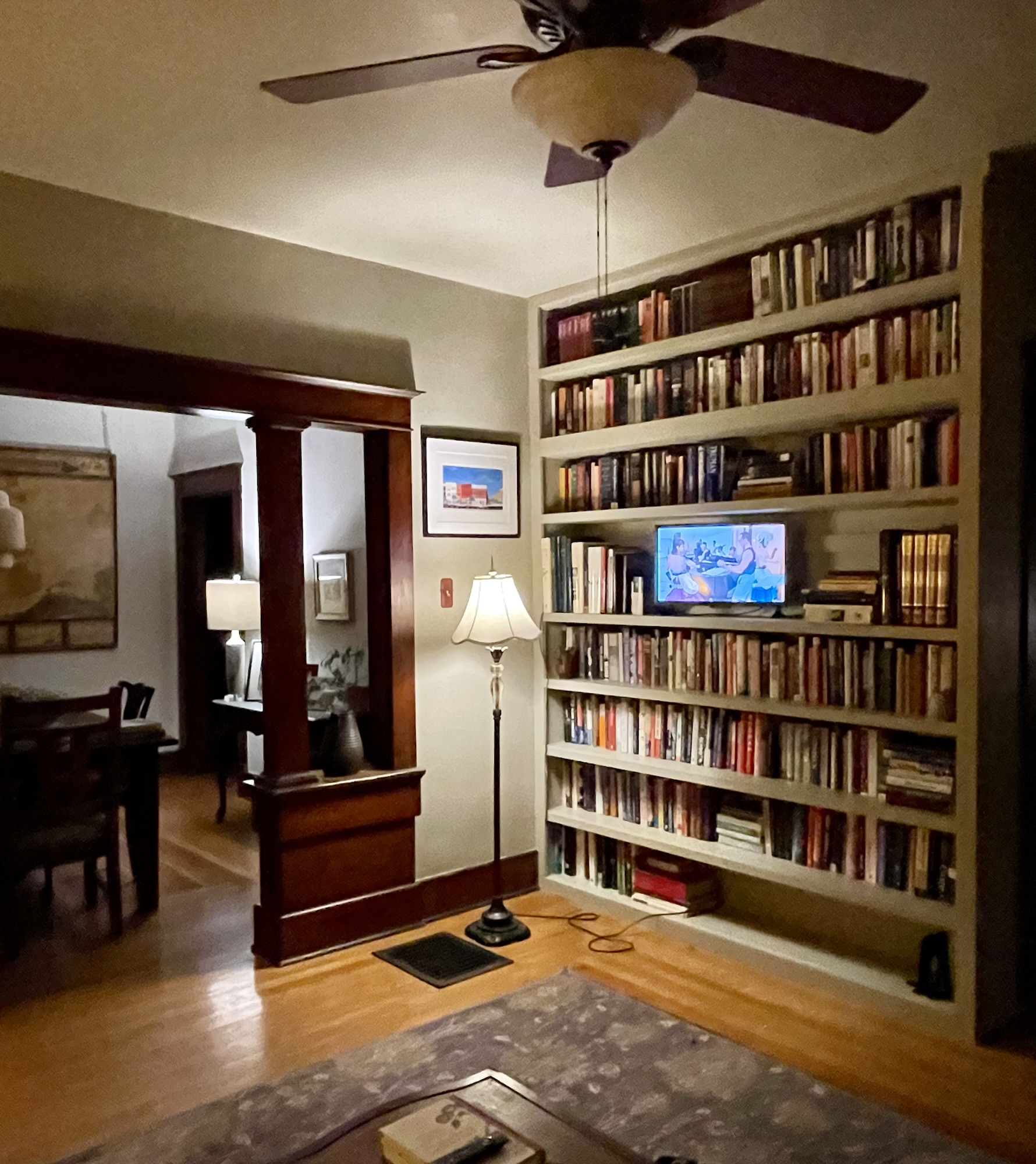 evidence of this best year of reading.
Books are my favorite possessions. Reading is not just a hobby, it is my happiest time spent in quiet, beautiful existence.
But lets get to the books, shall we? Among the list of 52 are three of the best books I’ve ever read in my life and a couple of duds. There are novels and memoirs and nonfiction books that speak to our country’s and our planet’s precarious conditions. There is a 624-page book and a novella, an artful book about birds, and a book about men at sea I never in a million years would have guessed I would love. As I stand back and peruse the list, I am not surprised at how fast the fast-clip pace of a book a week passed by, and I stand in awe of some crazy good writing by authors I’ve long admired and others that took me far too long to discover.
The top three books were, by far, my favorites, but the rankings of the others are less precise as it is hard to compare books that are important with those with beautiful prose. The reviews are taken directly from my Instagram reviews, unedited for this blog, even as I admit my opinion might have hardened or softened since reading the books and posting my reviews.
Cheers to all my 2024 books, one and all. You made me laugh and cry, ponder and worry and scream.
Sipsworth by Simon Von Booy (2024) ❤️❤️❤️❤️❤️
On a Friday, Helen is a lonely, cranky 83-year-old woman who has returned to her childhood town in England to finish living. On a Sunday, nine days later, she has adopted a mouse, turned vegetarian, broken the law, gotten a library card, and is entertaining a sitting room full of new friends.
This lovely little novel, with a surprising reveal in the middle, exudes the full range of human (and mouse) emotions from beginning to end. So charming and bittersweet, this beautiful story of a life is a quiet squeak that would warm even the chilliest heart.
North Woods by Daniel Mason (2023) ❤️❤️❤️❤️❤️
I gasped out loud at the end of this astonishing novel and then I sobbed at the beauty of it. North Woods is a creative whirlwind of stories across time, an epic history of place, and the haunting memories of lifetimes. A yellow house, humble and grand and humble again, is the setting for every tale, told in prose, poetry, letters, and even a real estate advertisement. From the discovery of a glorious variety of apple to the jealousies between spinster sisters to the forbidden love of a landscape painter for a poet, the stories of the North Woods unfold slowly like breath after breath after breath but they echo through the pages and build, together, to a breathtaking crescendo. The forest and the fields, catamounts, weather, and mental illness are central characters equal to the soldier-turned-orchardist who begins the novel, the young botanist who closes it, and all the peopling in between. The human emotions of love and loss and loyalty are foundational themes, but North Woods is so much more than a story of humanity. It is chronicle of the world, whispered from a remote piece of the earth in western Massachusetts.
Here After by Amy Lin (2024) ❤️❤️❤️❤️❤️
This gut-wrenching memoir has no purposeful narrative. No chronology. No story in time, with a beginning and an ending. Because grief has no purposeful narrative. No chronology. No story in time, with a beginning and an ending. This memoir, like grief, is a pulsating but horrifyingly quiet collection of thoughts, revealing the shock and pain of grief settling in for its permanent residency in the body. I’ve probably read 100 memoirs of grief since my daughter died. Too many words and so many books failing to capture the terrible, damaging rhythm of grief. In hardly any words at all, Here After captures the random, jolting, awful pace of memories that beat the grieving almost to death but also somehow miraculously lead us, at our own pace, back into the light.
Same As It Ever Was by Claire Lombardo (2024) ❤️❤️❤️❤️
Julia Ames is a character I will not soon forget. Not because she is a heroine or heroic or extraordinary. Not because she is exactly my age and, like me, still so uncertain about who she is and where she belongs. I won’t forget her because Claire Lombardo has drawn her with such detail and emotional depth that reading this book is like seeing the raw pain in real time of the mistakes and misjudgments of a friend you’ve known for twenty years. Almost like you are her friend, standing beside her as she learns to allow herself a little fucking grace, because don’t we all deserve a little fucking grace?
When a character in a novel becomes such a friend, you’ll read any number of pages, even a number you thought on page one was arrogant for such a young novelist, but then all of sudden you’ve read 250 pages and are so happy there are 250 more. It will never be arrogant to write such beautiful sentences, to so tenderly examine a psyche, to construct such a genuine life between the covers of a book so heavy you have to rest it on a pillow in order to keep reading for hours. The emotional power of this novel is stunning, the story is remarkably relatable, and the writing, even the long paragraphs, are crisp and delicious. And oh my goodness, those last lilting, mournful, joyful seven pages are a crescendo of all the love and the pain, the frailty and the beauty, and the simple, noisy melody of a life.
Tell Me Everything by Elizabeth Strout (2024) ❤️❤️❤️❤️❤️
Tell Me Everything is a perfect novel. Memorable, beloved characters. Heartbreaking and heartwarming stories about flawed humans. Beautiful writing. This book is also brimming with wisdom, friendship, and the little things that matter in the stories of our lives.
Tip: Read the Lucy Barton books, the Olive Kitteridge books, and the Burgess Boys first. This is a stand-alone novel, but the coming together of characters will be so much richer if you do.
Anything Is Possible by Elizabeth Strout (2017) ❤️❤️❤️❤️
Sometimes you read a book or a new author for the first time, and you’re not ready. Not ready for the characters or the story or the tone. Your mind is closed off from the beauty of the book or the author’s unique prose. In the early days of my grief I read My Name Is Lucy Barton. I hated Lucy. I hated Elizabeth Strout. I was mad at the world. I wasn’t ready. When I emerged from the fog of grief, I knew I had read books that I judged in sorrow, not in wide-eyed, open-hearted joy. So I gave Lucy and Elizabeth a second chance, and now I know the beauty of them both. Now I adore Lucy, Olive, William, and the fictional town of Amgash, Illinois, and I am in awe of Elizabeth Strout. She is now one of my favorite authors. Anything Is Possible is a love letter to being human. It is an ode to being frail and brave, lost and found, alive and also barely breathing. And there is Lucy, again, too. This beautiful novel is perfect timing for me as I anxiously await Strout’s new novel coming in September.
The Comfort of Crows by Margaret Renkl (2023) ❤️❤️❤️❤️
Renkl’s essays rock you like a creaky old porch swing on a summer night, the cicadas humming. Like everyone who loves nature, she worries about the future of our warming planet, but she gives herself and all of us permission to find the joy of shorter winters and early green leaves on invasive trees. The Comfort of Crows has love and snails, beauty in the face of uncertainty, hummingbirds, little animal hands, and the magic of leaf litter. And, wow, the gorgeous epigraphs offer up a fantastic, aspirational reading list. Better than a beach read, add this love letter to nature to your summer reading.
This Other Eden by Paul Harding (2023) ❤️❤️❤️❤️
This Other Eden is a lovely, softly written story of the evils people in power inflict upon the other. But it is also and more importantly the story of the stories of lives forged out of nothing, dignity and love breathed out of tragedy, and what is lost in the living, like a known landscape after a devastating storm. A fictionalized account of the horrific removal of a people, this book is more evidence to me that sometimes history is so painful it must be whispered into being and into memory on the pages of a beautiful novel.
The Cemetery of Untold Stories by Julia Alvarez (2024) ❤️❤️❤️❤️
Alvarez has written a poetic, imaginative, and deeply compelling novel about the stories we tell, the stories we keep to ourselves, the stories that haunt us, and the stories that set us free. She also poses the question: do stories need a teller and a listener, or can they keep themselves? I do not know, but I adore her idea of stories in communion with each other. In gorgeous prose, slipping occasionally, melodically into Spanish, the novel reinforces my belief that stories are everything, and in life and in death, they are the world.
The last line of the novel reads: “este cuenro se ha acabado.” But is any story really ever over? After reading this novel, packed with myriad stories and their fascinating, individual lives, I rather think not.
Small Things Like These by Claire Keegan (2021) ❤️❤️❤️❤️
Wow. This novella is gorgeous, both the writing and the tale exquisite. The story of a simple man’s enlightenment, it quietly illustrates how being blind to the injustices around you makes you complicit; and how it is impossible to look away once you have opened your eyes. Claire Keegan is an Irish writer well known for her short stories. I have to admit I had never heard of her until someone recommended this book, for which I am grateful.
The Mermaid Chair by Sue Monk Kidd (2005) ❤️❤️❤️❤️
I’m not sure how I waited so long to read this second of Kidd’s four novels, especially after devouring her most recent and best novel, the masterpiece Book of Longings (2020). I love Kidd’s writing. She is a queen of story and landscape and melody, and in this soulful novel she artfully reveals the deep center of a woman’s psyche, ripping her life and the world wide open with beauty and grace. This novel is the journey through a long year in a woman’s life, when she falls in love with a Benedictine monk and makes “a brilliant wreckage.” It is a story of family secrets, the fierce friendships of women, memory, and the quiet ways women lose themselves in domestic complacency. The book is bursting with beautiful writing. There is art. There is food. There is island culture. There are eccentric characters. And there are mermaids.
The Great Divide by Cristina Henríquez (2024) ❤️❤️❤️❤️
The construction of the Panama Canal is the setting for this crisp novel about people’s fierce sense place, the joy and power of unexpected friendship, and knowing when it is time to stand up and say out loud that you are here. In this lovely tale, the characters across the great divide help each other gather hope and love and to acknowledge the roots that nourish us in the face of revolutionary change.
Sandwich by Catherine Newman (2024) ❤️❤️❤️❤️
Sandwich is a novel about the middle—a woman in middle age with grown kids and aging parents, a human being living in between love and grief, the latter we all must do if we are lucky enough to truly live. Fear of grief is not quite the same as grief I wanted to tell Rocky, Newman’s protagonist; but I also wanted to assure her that she is absolutely right that the true bliss of loving is knowing that your heart might crack wide open at any moment. Sandwich is a witty and profound little book about life, and Rocky is a beautiful, bittersweet middle-aged woman I recognize.
As she reminds herself at the end of the story: “So you might as well love as much as you can. And as recklessly. Like it’s your last resort, because it is.” Life is like two slices of hearty bread, and it’s up to us to load it up with all the good stuff we can get our hands on.
Weyward by Emilia Hart (2023) ❤️❤️❤️❤️
In the pages of this debut novel are the distinctive and strong voices of three Weyward women across time. Hart’s prose is lovely, her pace is summertime time, and her historical tone is pitch perfect—impressive given the three historical settings, England in 1619, 1942, and 2019. I loved the mystical quality of the novel, the way the author connected the stories of the three women, and the crows. Oh, if only women really did possess the power to consort with crows and command nature to watch over them and exact delicious revenge on the men who harm them.
If you liked The Lost Apothecary, you’ll love Weyward.
Piglet by Lottie Hazell (2024) ❤️❤️❤️❤️
!!SPOILER ALERT!!
As her mother, sister, and father work to stuff her large body into the wedding dress, the wedding photographer witness to the horror, the last of Piglet’s self respect melts away like the profiteroles for the croquembouche leaking crème patisserie on the kitchen floor. It’s hard to watch this undoing of the poor protagonist so late in the story, when she’s had too many opportunities already to extricate herself from her doomed relationship. Food, relationships with food, self loathing, and betrayal boil over and stew across the pages of this odd little novel about a grown, professional woman who allows herself to be called Piglet. And like the pasta with tomatoes and olives and capers that she expertly prepares and eats on the final pages, the novel is satisfying and delicious.
The Heaven and Earth Grocery Store by James McBride (2023) ❤️❤️❤️❤️
!! SPOILER ALERT !!
In The Heaven and Earth Grocery Store, there is love and friendship, loyalty and bigotry, life and death and shelves and shelves of nourishment. This is a novel of the interconnected stories of a community both of and apart from the history of America. Beautiful writing and lovely, complicated souls await the reader on almost every page. Only four stars because I think the storyline falters a bit when we must say goodbye to that glorious and giving grocer at the novel’s heart, but this is a special kind of book that lovers of stories simply cannot miss reading.
Eve by Cat Bohannon (2023) ❤️❤️❤️❤️
Eve is a must read for anyone who cares about women and humanity. It should be required reading for anyone who doesn’t already know that women are queens. Full of remarkable research, fascinating observations, and stunning revelations about women’s bodies and their role in human evolution, Eve is mind blowing. Particularly interesting are discussions about the placenta; voice, gender, Bill and Hillary Clinton, and American politics; and a section at the end entitled Asteroids and Assholes that reminds the reader that the modern world is a spinning orb of uncertainty. All of us start out in a womb, people, and any society that oppresses or endangers women and girls is already on the path of its own extinction.
You Could Make This Place Beautiful by Maggie Smith (2023) ❤️❤️❤️❤️
A lovely, sad memoir of beginning a new life story. There are dozens of gorgeous sentences in this memoir, and the unusual cadence is haunting juxtaposition to the domestic story it unfolds. Seeing a little too much of my own experience in Smith’s story, especially the self-reflection, made me squirm, but wow, what a wonderful rendering of life, messy and beautiful and possible.
The Backyard Bird Chronicles by Amy Tan (2024) ❤️❤️❤️❤️
Lovely. Charming. Funny. Beautiful. And full of feathered fancy. I enjoyed this book all year, kept it on my porch all summer, and even gifted it to my mother. Tan’s drawings are fantastic! It’s not a book you read from front to back. It’s a book you randomly open to nibble and return to often, the discovery unfolding much like the birds arriving at the feeder in morning. This book is going back out on the porch in 2025 to enjoy for another year.
Fire Weather by John Vaillant (2023) ❤️❤️❤️❤️
Fire Weather is a true horror story, beautifully conceived and written. It offers a terrifying, brilliant examination of what human beings have wrought upon our planet. It is a searing indictment of the oil industry, policy makers, and politicians who ignored and then blatantly undermined climate science to feed their greed and power. Earth is on fire, and our reliance on fossil fuels has brought us to this fiery moment. Western society’s predatory delay in answering the fire alarm of climate change is responsible and to blame for the hellscape our children will inherit. In the not so distant future, as Vaillant puts it: “Lives will be cut short. Trauma will be far more common and good health harder to hold and maintain. None of this will be the fault of nature itself. It will largely be inflicted by the inaction of this generation of adults on what might fairly be described as the greatest inter-generational injustice ever inflicted by one generation of humans upon the next.”
This is a great book, but sadly, Vaillant is preaching to the choir. Only those of us who have faith in science and already appreciate the precarious position of human beings on our planet will even read this book. That’s too bad, because this is a fire and brimstone sermon that might put the fear of Jesus in some of those holding us hostage to bad energy and environmental policy, and better than any southern Baptist minister could do it. Fire Weather is not a hopeful book, but it sure as hell is an eye-opening one. Having read the book, I am hot with rage but also chilled down to my bones.
If you ever drove an SUV or consumed water from a plastic bottle, you are culpable. I am culpable. In the West, we are ALL to blame for the havoc already unfolding. Exhibit A: the Fort McMurray wildfire of 2016. And the only consolation I can find is that when we finally destroy humanity, the trees and plants that one day emerge from beneath the ashes will not know what we did.
The Wager by David Grann (2023) ❤️❤️❤️❤️
I don’t seek out adventure stories of men, historical or fictional, so I am grateful for the recommendations that led me to read The Wager. A fine piece of historical writing, this book beautifully illustrates what I love best about good history: it expertly conveys the facts we can know, spins out the conflicting evidence, and fills in the gaps with humanity. So if you are keen on naval history or the “ravaging dreams of empires” or just love a good story, I’ll bet you, too, will enjoy The Wager.
I also want to note the physical book itself is so lovely, printed on quality paper with two sets of gorgeous color illustrations and maps on the inside covers. The book has that satisfying weight and luxurious feel that many expensive but cheaply produced books these days so often lack (like last year’s Tom Lake).
Foreign Bodies by Simon Schama (2023) ❤️❤️❤️❤️
Foreign Bodies is classic Schama. Impeccably researched, exhaustive in scope, rich in detail and in context. His books are always a master class in the value of good history. I found some of the discussion of politics and the science of pandemics a wee dry (nature of the beast, I suppose), and I shuddered at some of the disease details (I would have been quite happy to have lived my entire life without reading about plague buboes). However, as usual, I am in awe of Schama’s brilliance. This book is a timely history, full of historical context about how human beings, their hatreds, their cultures, and their governments often stand in the way of public health. As stated by one of the epidemiologists Schama writes about: “It is a curious thing that the public always hates its benefactors.” And, so, Schama leaves the reader with COVID and Dr. Fauci.
To know the past not only explains the present but also debunks the false idea that humans made steady progress toward our present. Sometimes we read history and find ourselves standing in the same place as our ancestors. We might speak a foreign language from them and experience far different landscapes, but in some ways humans don’t change much over time. Perfect closing: “Contrary to what you’ll read in tabloid headlines or hear in the hoots and yells of social media, in our present historical extremity there are no foreigners, only familiars, a single precious chain of connection that we snap at our utmost peril.”
American Breakdown by Jennifer Lunden (2023) ❤️❤️❤️❤️
This book is impressive, fascinating and important. Lunden offers a deep dive into the toxic environmental, medical, political, and economic landscapes Americans inhabit. She parallels her personal search for health with that of Alice James in the 19th century, beautifully demonstrating the historical threads of women’s suffering. This human focus is also a counter balance to the complicated scientific and medical issues she tackles. American Breakdown is not an easy book to read (I never thought I would ever learn so much about chemicals), but it is a rewarding one. America is tragically unwell, and Lunden’s clear-eyed critique illustrates how the ravages of capitalism, sexism, inequality, outrageous health care costs, and the toxins to which we are daily exposed endanger our bodies, our communities, and our future. I started this book last summer, but put it down to finish my manuscript and forgot about it. I read the last 100 pages today, and wow, I’m so glad it emerged from under a stack of “to read” books so early in the New Year.
The Lost Bookshop by Evie Woods (2023) ❤️❤️❤️❤️
Martha is lost and has no idea that her future is in the past. Henry is obsessed with the past and has no idea his dreams are standing right in front of him. Opaline is the brave woman from the past who brings these two lost souls together so they can solve the mysteries of the lost bookshop. This wonderful novel has all of the glorious aspects of a cozy bookshop, even the smell almost lofts of the pages. The story is hopeful and bright, filled with magic and human kindness, and Henry is one of my favorite male characters of the year.
Our Hidden Conversations: What Americans Really Think about Race and Identity by Michele Norris (2024) ❤️❤️❤️❤️
Our Hidden Conversations is a must-read book about race and identity in America. NPR listeners will remember the author and her fascinating Race Card Project, which make up the collected conversations inside this thought-provoking volume. It is a long book on a fraught subject, but if you care about America and the problems we face as a free society with so much more room to be better, it reads like a winter prairie wind, fast and bracing. It’s a smart, open-hearted, and honest book, encouraging readers to share and to LISTEN. I chose the audio version, and I encourage you to do the same. To hear the cacophony of voices in this breathtaking book is to better facilitate the hearing that all of us need to do, especially as we face another four years of ugly othering and leaders whose intentions are to denigrate our beautiful diversity and to divide the best of us.
Poverty, by America by Michael Desmond (2023) ❤️❤️❤️❤️
In Poverty by America, Michael Desmond does not simply explain the condition and context of American poverty. He makes you think about your role in perpetuating poverty. He makes you cry, he makes you scream. He explains not only why poverty exists but examines ways to end it. It is a hopeful book in that Desmond illustrates how it is possible to end poverty in America. But it is a depressing book, too, because I know in my head and feel in my heart that there is little political will to make the sacrifices necessary to end it.
Maude Horton’s Glorious Revenge by Lizzie Pook (2023) ❤️❤️❤️
An uncomfortably delightful tale of the ghastly spectacle of public executions, murder, and revenge. Lizzie Pook takes the reader on a suspenseful ride through the underbelly of Victorian England, where a proper young woman muddies the hems of her skirt and her heart to avenge the violent death of her beloved sister. Fast, fun historical fiction in gruesome detail.
The Bookshop by Evan Friss (2024) ❤️❤️❤️
The Bookshop is a delightful history about the lineage and business of bookstores, but more importantly it is a collection stories about the quirky people who opened bookstores and the ways in which bookstores were advocates and activists, promoted authors and genres, and were members of their communities. Friss covers everything from Benjamin Franklin to the Strand in New York to Ann Patchett’s Parnassus Books in Nashville to Amazon. It’s good, interesting history and a fun read, filled with wonderful tidbits about the magic of books.
Eyeliner by Zahra Hankir (2023) ❤️❤️❤️
I have been an eyeliner devotee since I was a teen, and since I was a young scholar in a field of sexist men I have worn it as an armor. Imagine my delight happening upon this history of eyeliner in the new book cart at my local college. And imagine my validation when I learned that eyeliner in many cultures has been an armor. It was an interesting little book, and the line drawings of people in eyeliner at the start of each chapter are lovely.
The Grey Wolf by Louise Penny (2024) ❤️❤️❤️
The latest case of Chief Inspector Gamache of the Sǔreté is big stakes, the story dark. Sadly, though, it’s kind of boring. I mean, I liked it, of course, because it’s Gamache and brioche and the ambiance of Quebec, with brief appearances of the delightfully quirky residents of Three Pines. But this nineteenth installment of the series was not my fave. So now I’m even more ready for book twenty (does that even make sense?)!
The Twilight Garden by Sara Nisha Adams (2024) ❤️❤️❤️
Not as strong of a narrative as her first book, but this sweet tale of friendship and the communal spirit of a garden is an enjoyable read. I appreciate novels that evoke a strong sense of place, and The Twilight Garden is about as good as it gets on that point. It’s a sleepy story, but the characters, a family of foxes, and a young man finally coming to terms with his grief are worthy of the lullaby.
Amy and Isabelle by Elizabeth Strout (1998) ❤️❤️❤️
Sometimes it takes a dead body to see we’ve been doing it all wrong. We are only human, after all. Strout’s first novel, this story is about a mother and a daughter and the ways in which mothers and daughters and humans fail each other and love each other imperfectly. Tender as well as harsh, and beautifully written.
Bronze Drum by Phong Nguyen (2022) ❤️❤️❤️
Bronze Drum is historical fiction based on the life stories of two warrior sisters who rose up against the brutal oppression of the Han Chinese. Woah, damn. What I didn’t know about the ancient history of Vietnam is a lot, and a lot of it is quite terrible. The Tru’ng sisters are badass feminists and patriots even as the odds against them are unfathomable. A good human story, but a depressing one. The cruelties that men in power have wrought upon women throughout history is heartbreaking and horrific. But every once in a while brave women stand up and refuse to comply, which is beautiful and inspiring. Pretty good writing here, too, giving the reader I haunting sense of ancient Vietnam in 40 CE.
The Hypnotist’s Love Story by Liane Moriarty (2023) ❤️❤️❤️
!!Spoiler Alert!!
Not always great literature, but Liane Moriarty’s books are always great fun. The women she writes are original. Better than quirky. Human and weird and relatable. The plot of this one is hilarious. The protagonist is a hypnotherapist. Her clients are a hot mess. And her finance’s stalker is a woman who bakes cookies in her victim’s kitchen. It is a little down under dark, but the cookies are not poisoned and the stalker snaps out of it in the end.
Master Slave Husband Wife by Ilyon Woo (2023) ❤️❤️❤️
If you don’t know the phenomenal story of Ellen and William Craft and their bold and brilliant escape from slavery to freedom, read this book. If you know the story already, move on. I understand why this book was well received, because the history it tells is mind blowing and not widely known. But if you know the story already, it reads a little dull. That’s not a fair knock on the book, just a bummer for this one opinionated historian.
Yellowface by R. F. Kuang (2023) ❤️❤️❤️
Fascinating tale of book publishing, lies, racism, and cultural appropriation, but not enjoyable. No, too dark and cringy for me—and yes, I know it’s satire. Kuang is a great writer, though. She’s imaginative and wholly original.
Ruthless River by Holly FitzGerald (2017) ❤️❤️❤️
Holy hell, this memoir was my worst nightmare and reminded me that the nature around my porch is all the nature I need. Good grief and mercy sakes alive. If this horrifying story of being trapped in a bog in the Amazon covered with bees and eating grubs doesn’t cure you of extreme nature outings, you may be crazy. But nightmares aside, this is a fine memoir. Vivid and crisp and suspenseful.
Disillusioned by Benjamin Herold (2024) ❤️❤️❤️
Disillusioned is a heartbreaking investigation of the decline of the suburbs, focusing on five families in towns outside of Pittsburgh, Chicago, Los Angeles, Atlanta, and Dallas. Herold’s study is expertly reported and offers a sound indictment of the racist policies of municipal and educational institutions that failed to deliver the promises of suburban life to its nonwhite residents. The book offers little hope, as the COVID pandemic and modern political discord have deepened racial divisions and made even discussion of difficult subjects hostile. I was disillusioned before reading this book, which I hoped would offer possible solutions. But, alas, Herold is as disillusioned as his subjects. And that’s a big bummer.
The Burgess Boys by Elizabeth Strout (2014) ❤️❤️❤️
The story in this early Strout novel is too meandering, but the characters and the quiet falling out and back in with family is lovely. The Somali immigration story has a clear purpose of juxtaposition, but its lack of development left me wondering if it was necessary. Regardless, the writing is rich and melodic and full of life.
Bear by Julia Phillips (2024) ❤️❤️❤️
Fantastic writing. Compelling characters. But JFC, I wish I never read it. Now, excuse me while I get going on another book, because this story cannot be the last one I read this year. Gah.
The Story Collector by Evie Woods (2024) ❤️❤️❤️
I will forgive the misleading cover and the unexpected romance into which this love skeptical reader feels a tad tricked. Because I loved the characters and the bounce across time. Because I know first hand that Ireland is a little bit magic. Because like the woman at the center of this story, my own hard reset shifted my heart in a new direction. And because, if fairies can give comfort to the grieving, I believe. I believe. I believe.
This Time Tomorrow by Emma Straub (2022) ❤️❤️❤️
Good writing and a sweet story about a woman’s tender relationship with her father is not enough to overcome the time travel component of this novel. Time travel is stupid. Sorry, I just don’t like it. I am a big fan of Star Trek, for example, but I hate the time travel episodes. Lame on tv. Lame in literature.
One Perfect Couple by Ruth Ware (2024) ❤️❤️❤️
Reality television goes deadly wrong on a gorgeous island in this latest thriller from the British queen of darkness. Ruth Ware is so good at juxtaposition, psychological menace, and cheek. Should it be so fun to watch a group of wanna-be reality stars get picked off one by one? Well, it is, and I’m not ashamed to admit it. Although I also must admit that I probably won’t remember the characters or the plot a year from now. Thrillers thrill me, but they don’t stick to my ribs.
Rock Paper Scissors by Alice Feeney (2021) ❤️❤️
Rock Paper Scissors is the black-hearted story of a love triangle of sorts and three despicable people. It’s a good little thriller, set during winter on a Scottish loch, and it has a delicious twist. Not great literature, but if you like a dark story with a British accent, this quick read or listen (I chose the audio book) is an entertaining, 10-hour escape. Oh, and if you do take it up, pay attention to the chapter titles.
The Midnight Feast by Lucy Foley (2024): ❤️❤️
A short and fun thriller with a terrible wonderful villain. I don’t know what it says about me that I have become a strange little aficionado of thrillers by British women writers. I like to listen to the audio versions of these books by Lucy Foley and Ruth Ware. I scoff at most escapist literature, but murder and intrigue in a British accent is enormously appealing.
A Flicker in the Dark by Stacy Willingham (2022) ❤️❤️
I needed an easy read and this thriller was available at the library. Frankly, I chose it because I like the author’s first name and she spells it correctly. Sometimes I just want to float away to get out of my monkey mind, and even a mediocre thriller helps me escape or, like this one, makes me think things like: “Hey, my life’s not so bad, at least I’m not a pill-popping mess of a young woman who has a serial killer in my immediate family.” I think there might be one pretty big hole in the plot of this novel, but overall it did precisely what I asked it to do.
Mercury by Amy Jo Burns (2024) ❤️❤️
This is a decent novel with complicated characters and a solid family story to unwind. But, mercy, Mercury is flawed, some chapters getting bogged down with too much detail, unnecessary to carry the plot. I liked the setting and the messy examination of a family business, but a couple of the decisions of main characters left me scratching my head and the tacked on later years of the story wasted paper. Sometimes I read a novel that reminds me of how much daylight there is between a good novel and a great one. This is one of those times.
The Soulmate by Sally Hepworth (2023) ❤️❤️
I hate to start the year with a mediocre thriller, but the story was good enough and the audio narration well done enough to keep me entertained while doing a jigsaw puzzle on New Year’s Day. In a few places, the novel (set in Australia) offers intriguing assessments of the secrets spouses keep in a marriage; and a dead woman as one of the two narrators is fun. It is a decent mystery, nicely paced and unfolded, with enough left unsaid at the end of each chapter to keep the reader turning the page.
Starling House by Alix E. Harrow (2023) ❤️❤️
Terrifying dreams shade into horrifying reality, but the reality was far less intriguing to me. I kept hoping the next chapter would be a nightmare. I enjoyed the historic tale, a long-ago woman taking revenge on the descendants of the family who destroyed her. But the monsters, the sword fighting, and creepy love? story failed to keep me wide-eyed deep into the night like a good creepy novel should do. I selected it to read at Halloween, but it got bumped for an inter-library loan. Perhaps I didn’t give it a good scream, but the library book overshadowed Starling House in time and in quality.v
Saturday Night at the Lakeside Supper Club by J. Ryan Stradal (2023) ❤️❤️
!!Edited review and spoiler alert!!
I love a novel that makes a place a character, and a Minnesota supper club seemed a likely winner. And it was for a few chapters in this novel, with funny, quirky characters and the connections and conflicts set at the supper club across the generations of a family. I could not, however, get past the magnitude of two tragedies—one early in the novel and the other late and completely out of left field— for which there is no examination of loss and grief and no effort to see the supper club as an anchor or a wedge in that trauma. Frankly, I’m confused. Is this some aspect of Minnesota nice? Whatever it is, the lack of emotion in a novel filled up with emotional trials makes it a real bummer for me.
I woke up the morning after finishing it and posting a review rather mad at this novel. This author killed off the main character with no warning and no grappling with it. And I’m pissed off—I’m not going to downgrade my hearts, because there is that sense of place feeling this novel possesses, which I love. But dammit the lack of emotional depth is infuriating.
The Villa by Rachel Hawkins (2023): ❤️❤️
A little too young for my tastes, but this suspense novel has a couple of juicy twists. The duel stories in the novel track well and dovetail nicely, and there’s lots of sex, love, jealousy, betrayal, and a little murder to make things spicy. There are a few highs in the novel (I loved the villa) but far more lows (ugh that dreadful podcast chapter). In the end, I just didn’t like the characters well enough to care. I prefer my shallow author protagonists to be less … well, less shallow.
Consent by Jill Ciment (2024): ❤️
Consent is shocking. Hard to read without wincing at passages because it is impossible to see a relationship between a 17-year-old girl and her 47-year-old teacher (no matter that it resulted in a 45-year marriage) as anything other than gross. I hate the story. To be honest, I gagged in several places. What is interesting, however, and why I kept reading is not Climent’s reevaluation of the relationship post #MeToo but rather of the memoir she published in 1996 when her husband was still alive. This new memoir raises all kinds of interesting questions about how we rewrite our stories to accommodate new perspectives, changing social norms, and our shifting definitions of peace. Memoir is more about getting things real than getting them right. Climent obviously needed a do over, because that first memoir was a whitewash. But, in the end, I’m not sure she moved the needle all that much closer to real.


 Being Mack's Momma Bear
Thanks for some great ideas of books to squeeze onto my reading list! Hope you find more great books in 2025.
LikeLiked by 1 person